



Safe Rigging with Roller Skids: Expert Safety Tips
Moving heavy equipment or machinery in a work place facility is a task that should never be taken lightly (no pun intended). In fact, thorough planning and organizing should always precede any rigging project. Below are a few proactive safety recommendations that are worth noting prior to utilizing the MultiRoll Roller Skids, or any other brand of machinery skates.
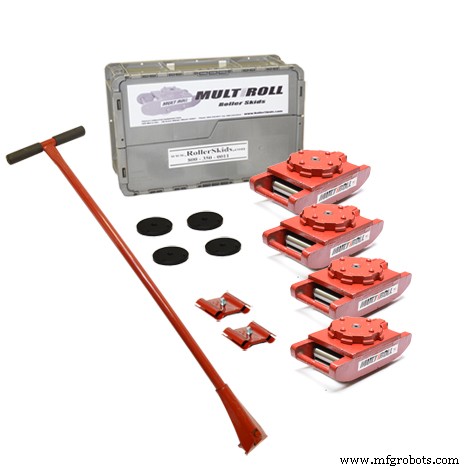
1. Assess Your Rigging Scenario
What Does Your Layout Look Like?
Create a 2 dimensional drawing demonstrating your route, potential obstacles, and distance of travel. Chart out the directional adjustments you will need in order to reach your destination. The more turns required to move a load to its destination the more planning is needed to safely get it there. “Safely” means no accidents and no surprises. Always think safe when moving heavy equipment.
What type of floor will your equipment or machinery be travelling over?
Will it be wood, cement, ceramic tile, rug, earth (terrain)?
Is the surface stable? Will it handle the pressure applied by the load?
Remember, not only does the surface have to handle the weight of the load but also the concentration of the load applied by the wheels or roller chains of the roller skids. For example, what do you predict would happen if you had a 4 Poly Wheel Roller Skids (example picture below) carrying a 20,000 lb load over a slightly wet dirt surface?
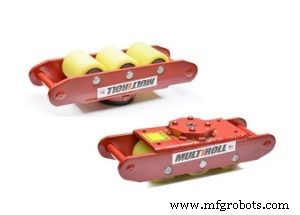
Let’s just conclude together that the rigging project would not be successful.
Another very important question to consider is, “Will it be an issue (a problem) for the final decision maker if the surface in his or her facility gets scuffed, scratched, cracked, or possibly damaged?” If so, then consider carefully what type of wheels your roller skids will need in order to avoid any such occurrences. More on this will be discussed in the latter questions.
Is the floor uneven, at an angle, smooth, grated, bumpy or full of debris?
When it comes to moving heavy loads with roller skids the smoother and cleaner the surface the better. Prior to transporting any heavy load on roller skids be sure to clear the path of any and all debris (where applicable).
Warning: As a load is being transported debris (such as a small pebble), bumps in the floor, and sudden elevation adjustments in the surface could potentially dislodge a roller skid from its placement underneath the base of a load. Please review photo below.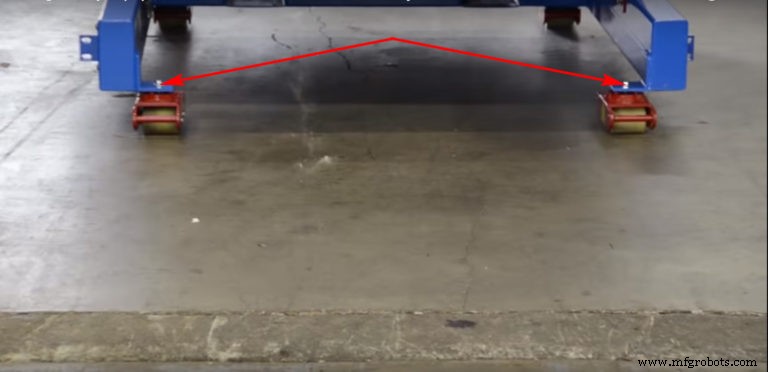
In the above example, a 4000+ lbs. machine needs to be moved beyond a threshold that is slightly raised and bumpy. The decision was made by the rigger to affix the roller skids to the base of the machine with a bolt. With all four roller skids bolted to the base of the machine the load is able to be safely transported across the threshold without any of the roller skids dislodging out of place.
Another important factor to consider (if applies) is the pitch or angle of the floor or surface. Remember, the weight of a load being transported along an angled surface will not be evenly distributed among the wheels or roller chains of the roller skid. The weight will focus onto one side or portion of the wheels depending on the pitch. Please review the illustrations below and answer the question, “What portion of the wheels (in the photo below) is bearing the greater weight of the load?”
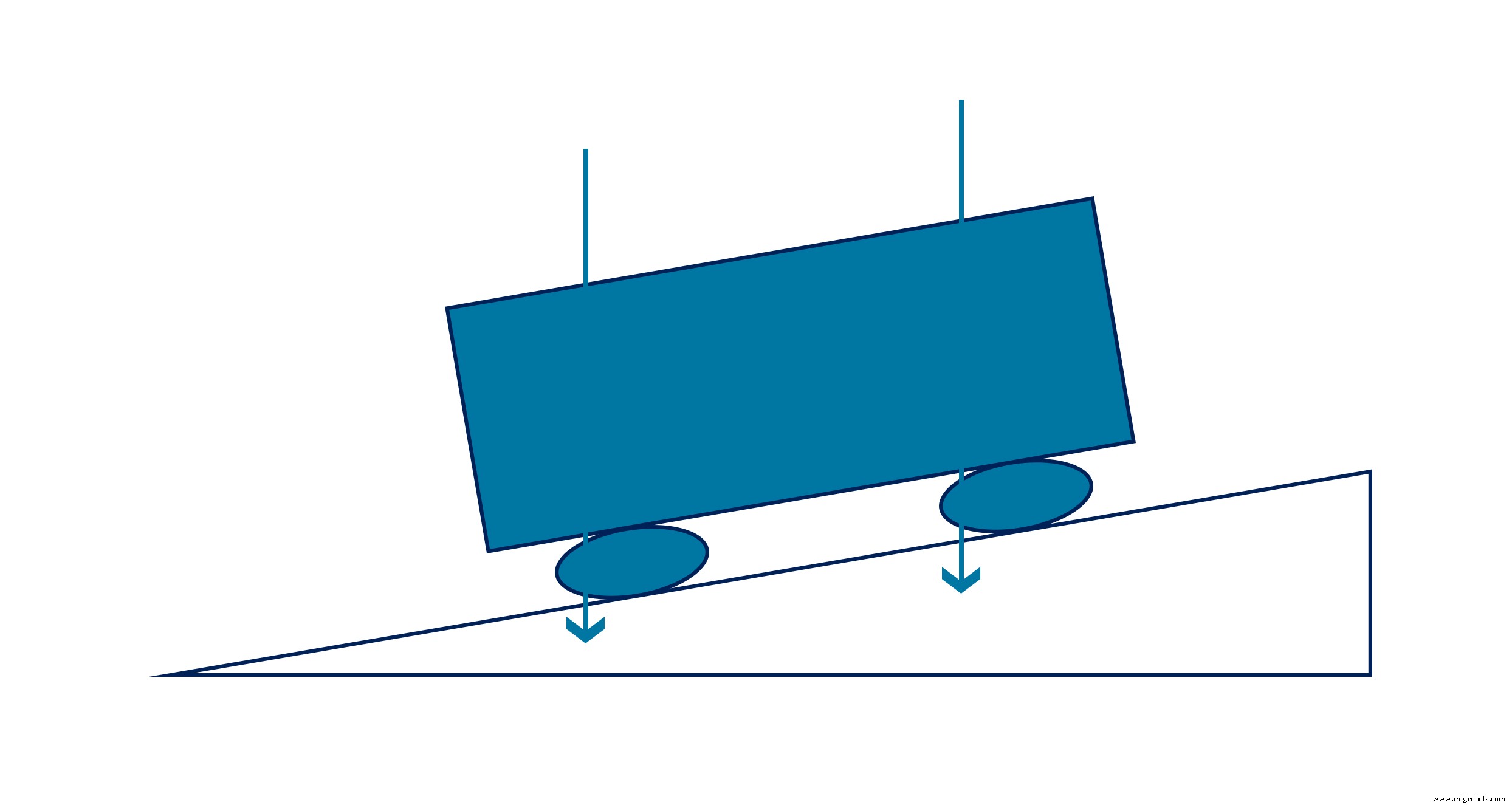
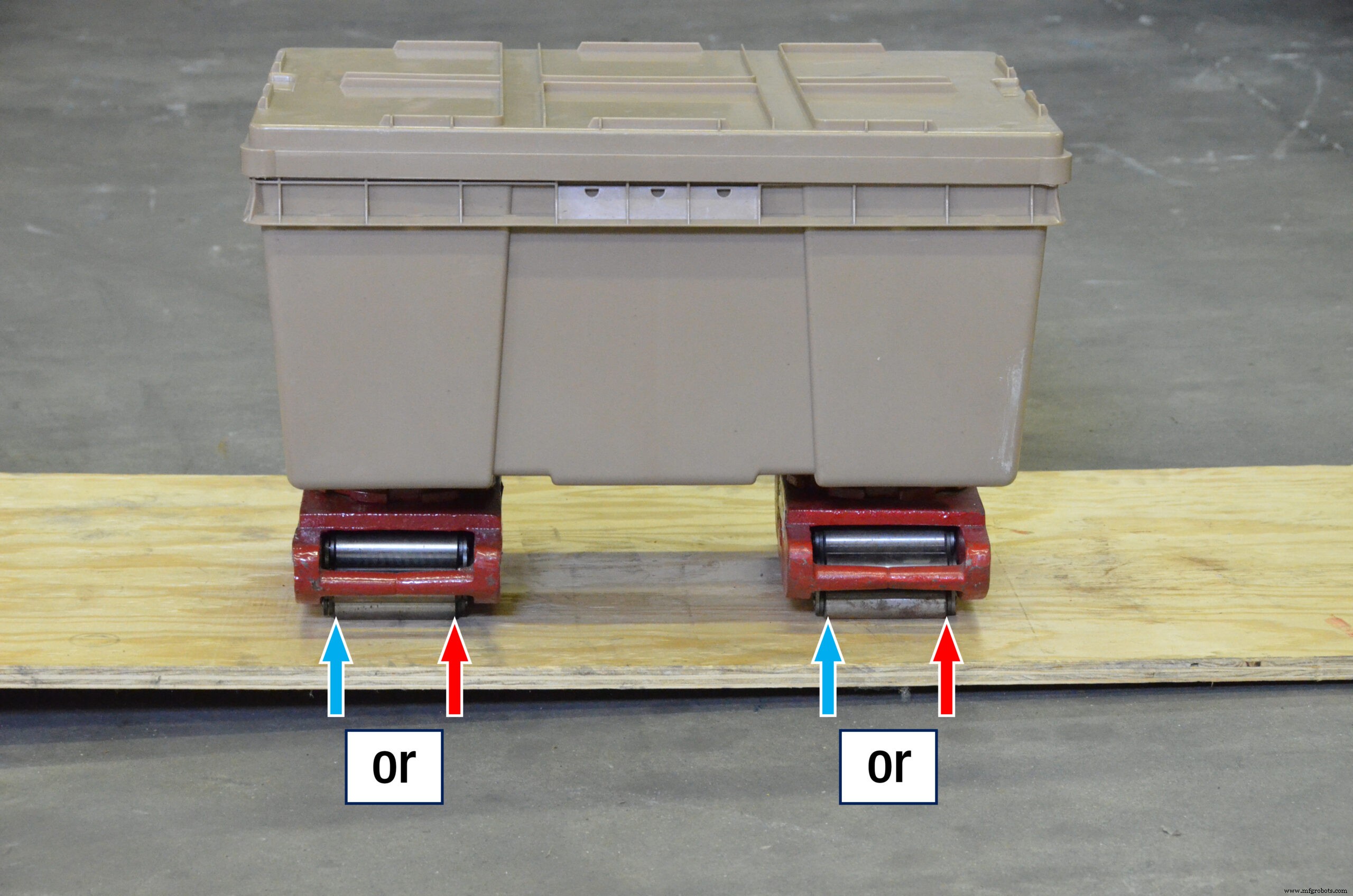
Since more weight is applied to one portion of the roller skid wheel (or roller chain) than the other then, depending on the weight of the load, a potential impairment or fracture of the wheel or chain could occur. The capacity of a roller skid applies only when the weight of a load is uniformly supported by all of the wheels. Here is the warning we give our customers: “Load capacity ratings are based on the transportation of loads over level surfaces. Do not use if load is not evenly distributed on the roller skid. Failure to follow this may cause serious damage to the roller skid and product being moved. If you are unsure if this product will work for your application please consult with an engineer or rigging specialist prior to use.”
When it comes to moving heavy equipment safety is priority #1 and careful consideration of the factors discussed (along with the ones that will be discussed in the following questions) is very, very important.
How long will the load, machine, or equipment rest on the roller skids prior to being dismounted and placed in its new location?
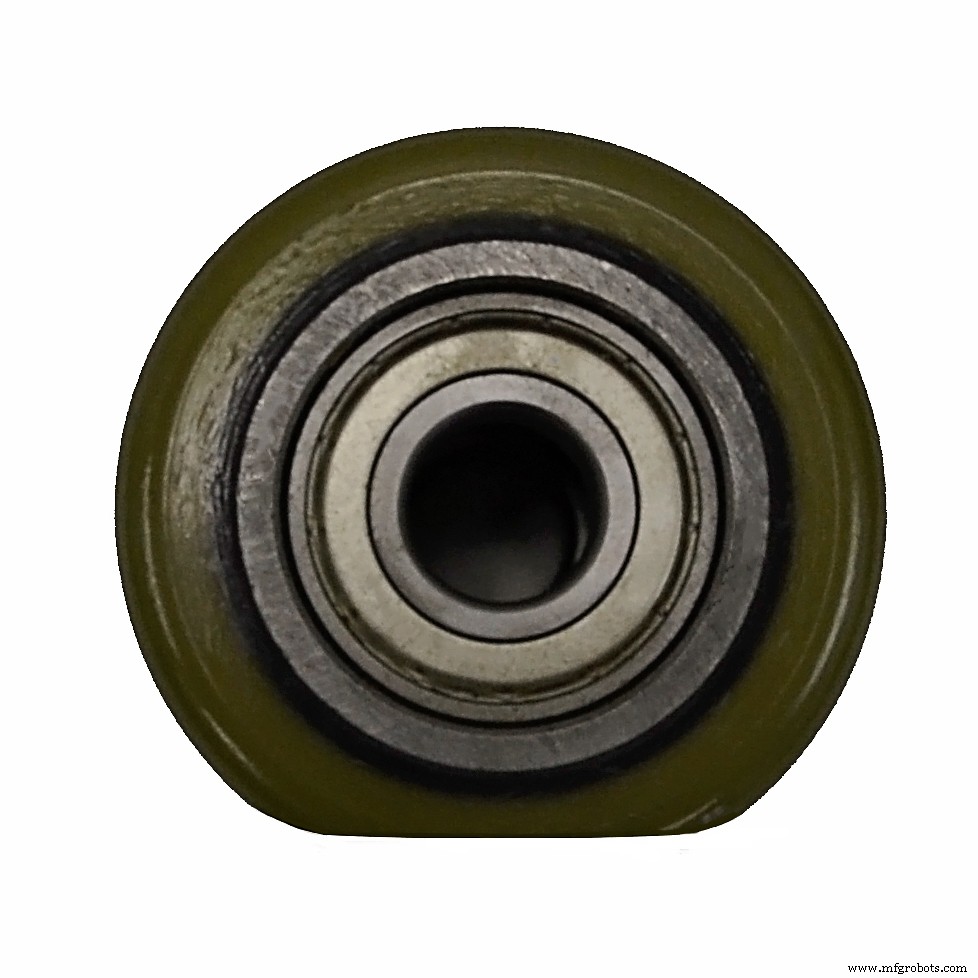 The longer time a load remains on a set of roller skids the more durable the wheels need to be. If, for example, you intend to use roller skids with polyurethane wheels then be aware of the potential for “flat spots”. Depending on the weight of a load and the capacity of the roller skids the poly wheels of a roller skid can lose their curvature. See example photo.
With poly wheels the closer the load weight comes to the load capacity of the roller skids the more susceptible the polyurethane wheels are likely to develop flat spots when at rest. In cases where a load needs to remain on the roller skids for an extended period of time (days, weeks, etc.) then steel wheel or roller chain roller skids are recommended.
What type of wheels will your roller skids or machinery skates require?
This question is a follow up to the prior question and is very important.
- Polyurethane – is very popular in that it provides the smoothest transport. It does not leave scuff marks behind. It can be used on wood, vinyl and ceramic tile, and relatively smooth cement and gravel. Depending on the load weight and capacity of the roller skids polyurethane wheels can form flat spots if bearing a load for an extended period of time.
- Steel wheels – not recommended for wood or ceramic tile floors. Highly durable, lasts for a very long time, and will not develop flat spots.
- Roller chains – best for imperfect concrete surfaces and somewhat uneven terrain. Eventually leaves marks such as grease spots or scratches. In cases where super heavy loads are being moved, roller chains may potentially scratch or crack the concrete.
How much weight will you be moving?
This is a question that deserves more attention than it seems. The most important advice we give to our customers with regards to choosing a set of roller skids for a particular rigging project is to always think “more than enough.” What we mean by that is the load capacity of the roller skids should always far exceed the maximum weight of the load being transported. Never purchase a 10,000 lbs. capacity roller skid kit to move a 9000+ lbs. piece of equipment. Despite the disclosed load rating, we recommend to always err on “more than enough.” In this example, I would purchase a roller skid kit that can handle 20,000 lbs. or more.
What directional adjustments are required to reach your destination?
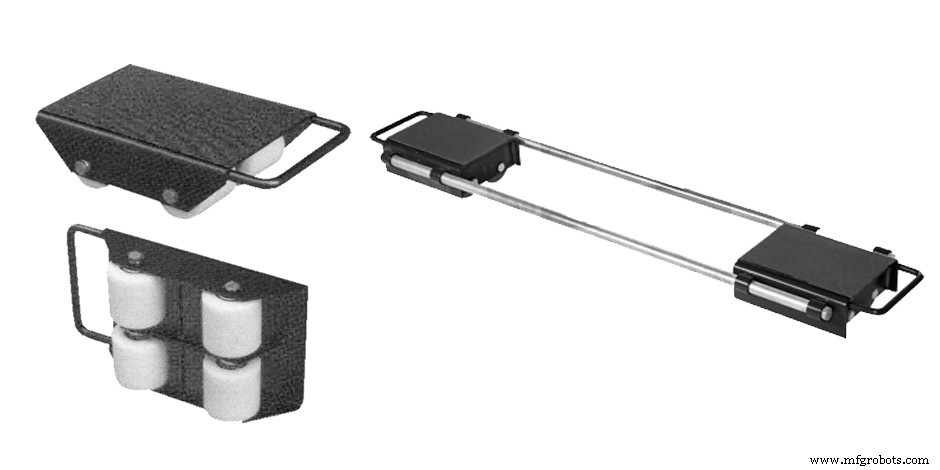
The answer to this question will help you determine if you should purchase fixed skates which are designed for one directional travel or steerable skates which allow for maneuvering in any direction. Below are representative photos of fixed machinery skates:
When it comes to the steerable skates or roller skids there are 3 basic systems on the market. Here is a basic overview of the 3 basic systems for your reference:
-
- 3-Point System: 2 roller skids are placed parallel at one end while a swivel top steerable dolly is placed centrally at the other end of a load.
- 3-Point System: 2 roller skids are placed parallel at one end while a swivel top steerable dolly is placed centrally at the other end of a load.
-
- 4-Point System: 4 swivel top roller skids (or 2 fixed in back and 2 swivel in front) are placed under each corner of the base of the load.
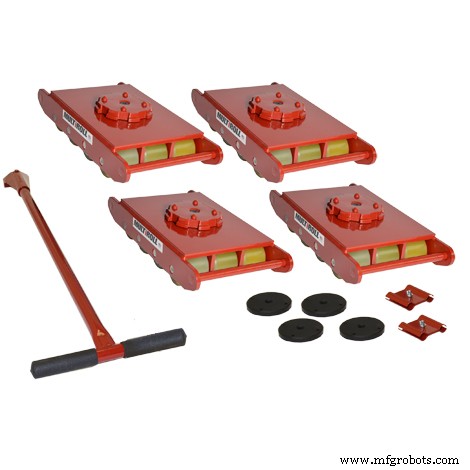
- 4-Point System: 4 swivel top roller skids (or 2 fixed in back and 2 swivel in front) are placed under each corner of the base of the load.
-
- Hybrid: 2 roller skids are placed parallel at one end while a dual swivel top steerable dolly is placed at the other end of the load.
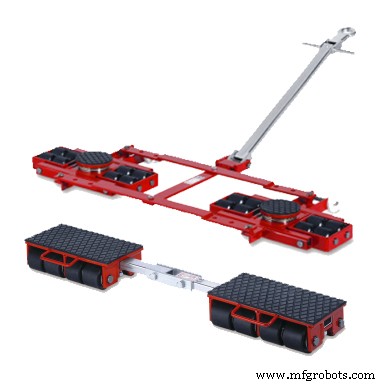
- Hybrid: 2 roller skids are placed parallel at one end while a dual swivel top steerable dolly is placed at the other end of the load.
Safety Rigging Reminder: The more turning required to get to your destination the more assistance you want to have to help maintain load stability.
2. Assess Your Current Resources
How many people are going to assist you with this rigging project?
- Will that be enough people?
- Does that number = Safety?
Do you have proper safety attire?
- Gloves, steel toe shoes, protective eyewear, etc.
- Health and Safety must be your #1 priority.
Is your equipment more than adequate to meet the demands of this rigging project?
- Quality Products = Safety
- Less Than Quality Products = Uncertainty at Best
- It is always best to work with the proven and reputable brands of rigging equipment.
- Is the capacity of the roller skids or machinery skates “more than enough”?
Is your rigging plan clear?
- Is it stated in writing and illustrated?
- Is your team on the same page with that plan?
- Before proceeding with your rigging project be sure to apply the carpenter’s motto: “Measure twice, Cut once.”
3. Ask, Ask, Ask Questions
From the very start ask, “Who is the final decision maker and what is precisely his or her expectation?
You cannot go wrong in having a thorough understanding of the final decision maker’s expectations. One minute detail could potentially make or break a project. Don’t let yourself find out when it is too late.
Also, experience teaches “Never Assume Anything”. Always ask. The company who asks the most questions is the one that has the potential to be the best at their craft.
Use the questions provided in this blog to help you ask those important questions that will prepare you to safely transport heavy equipment or product to their new destination.
Manufacturing process
- Revolutionizing Manufacturing Health & Safety with Autonomous Robots
- Preventing Catastrophes: Mastering ISO 26262 for Autonomous Vehicle Safety
- Safeguarding Warehouse Infrastructure: Using Safety Guards & Barriers
- The Ultimate Roller Skid Buying Guide: Choose the Right Skid for Heavy Loads
- Choosing the Right Heavy‑Load Transport: Roller Skids, Machinery Skates, and Dollies
- Enhance Warehouse Safety with Effective Floor Signage
- Lightweight Robots Alleviate Soldier Load and Reduce Injury Risk
- Enhance Safety & Efficiency with ABB Deburring Robots
- Elevating Safety Standards with Brazonics' Advanced Brazing Solutions in Hampton, NH
- Compressed Air Safety: Best Practices for a Secure Work Environment