



Enhancing Industrial Safety Through IoT and IIoT Integration
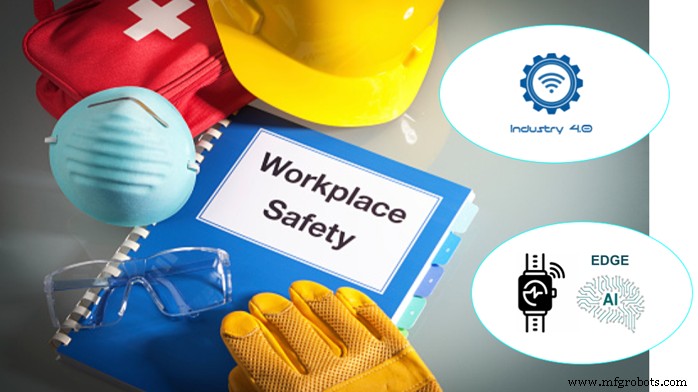
The internet in its myriad forms has been enabling people to connect and communicate with one another for various purposes ever since its formation. With the advancement of technology, this ability of the internet to provide a means of connection is slowly seeping into other aspects of the world’s day-to-day affairs. Integration of the internet among other technologies with the industry has prompted a new industrial revolution, dubbed “Industry 4.0”. The developments in the fields of Internet of Things (IoT), Machine Learning (ML), Artificial Intelligence (AI), etc. have made it possible to imagine and realize an industry that operates within the framework of sustainability and maximizes resource utilization while increasing product quality and minimizing the overall cost of production. Apart from directly influencing the way manufacturing is carried out, Industry 4.0 is well on its way to revolutionizing other aspects of the industry like transportation, safety, etc. This article will be a dive into how Industry 4.0 is using its tools, particularly IoT to ensure increased safety for both humans and machines alike.
Understanding the basic idea of industrial safety using IoT
Internet of Things refers to a network of physical objects that are interconnected and possess the ability to send and receive data from one another over the internet. These devices could range from simple, like a lighting level sensor, to complex, an automated robotic arm. They share data among one another which are then processed and appropriate measures are taken, all without the need for human intervention. This very nature of the technology enables it to be a perfect platform to implement better safety protocols that are based on real-time monitoring and automatic intervention.
A very basic implementation of this idea would be to deploy sensors throughout the industry floor that are continuously monitoring important parameters such as temperature, humidity, toxic gas levels, etc. The processing can be based on AI and ML where the algorithms are fed the data for expected levels of these parameters and are configured in such a way that they enforce safety measures in the event of deviation of sensor data from the expected levels. Another example would be to integrate algorithms that can detect and distinguish human workers into the processing systems of IoT-enabled autonomous robots such that the machines can anticipate whether their next actions will directly encounter a human being and then deploy measures to avoid that possibility.
In processes where high precision is involved, a slight deviation may cause considerable safety hazards. Having an IoT system in place that continuously monitors the various parameters of the entire high precision process by the means of sensors can help detect any anomaly and respond to these anomalies faster than any type of human monitoring. Such monitoring protocols can also be further extended to preventive maintenance, i.e. timely maintenance that counters potential unexpected downtimes due to sudden equipment failure. IoT systems can also be configured in such a way that the failure of one piece of equipment in a cluster would not necessarily lead to the shutting down of the entire process.
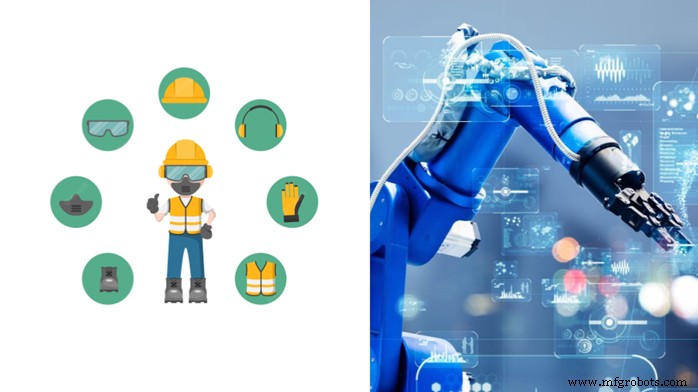
Using IoT, and its feature of M2M (Machine to Machine communication), the failed process can be shut down and its workload be automatically reassigned to other similar machines in the same cluster at a much faster rate than what would have been possible with traditional monitoring and enforcing systems.
Enforcing construction and transportation safety systems
Extending on the idea of using sensors for monitoring, construction workers can be equipped with smart wearables that would monitor the worker’s state along with environmental parameters. This data would be collected and processed for each individual worker, and necessary alarms and prompts would be deployed in the event of any deviation from the predicted model. The various environmental variables may include humidity, wind speed, etc. Such a system can help prevent accidents like falling from heights, etc.
In the related field of transportation and logistics, IoT systems can be employed on multiple levels for safety and monitoring. One such level is directly monitoring the behavior patterns of the drivers and processing this data through established ML models to determine whether or not the driver is fit to operate his vehicle. This can be sent to a centralized fleet supervisor to make further decisions. Another application is during the last mile of the delivery process when multiple vehicles are expected to converge their paths. IoT-enabled trucks can help decide upon the best course of action in case of a large number of vehicles and their delivery times coincide, avoiding mishaps.
An outlook for the future of IoT-based safety systems
Moving further from simply equipping existing machinery with IoT to improve their safety prospects, the next step would be to employ machinery based on IoT to completely replace the existing processes in such a way that the safety hazards are minimized drastically. For example, according to the US Occupational Safety and Health Administration, in 2020, trips, falls, and slips accounted for the most number of safety violations. This could inevitably lead to serious consequences in terms of worker safety. Such safety hazards can be mitigated by proper design of the industry floor paired with implementing IoT-based automated systems in place of human workers, which are much more reliable and less prone to such mistakes. Considering another major violation, that is fire breakout from electrical installations, IoT-based systems can be implemented to ensure timely intervention and even prevention of such safety hazards.
In conclusion, through the various implementations mentioned, the implementation of IoT technologies seems promising when it comes to improving the safety of the industrial workplace, either by monitoring and acting on deviations, or by eliminating the dependency on the human element completely for certain tasks. The second step in particular has rather important implications in the way that eliminating jobs on the industry floor leads to employment opportunities opening up elsewhere where the requirements differ dramatically from that of the current industry. The human element will be recruited for much more intellectual positions, which will decrease the number of people out on the field, which has been a huge contributor to human fatalities.
Industrial Technology
- Designing Industrial IoT Systems with the RTI DDS Toolkit in LabVIEW 2017
- Industrial IoT: Empowering Safer Workforces Through Smart Connectivity
- Industrial IoT: Key Building Blocks Driving Industry 4.0
- Bridging the Gap: How ERP and MES Systems Adapt to the Industrial IoT Revolution
- Industrial IoT: Advancing Smart Warehousing Trends
- Industrial IoT Security: Overcoming Challenges and Implementing Robust Solutions
- Integrating Total Productive Maintenance with Industrial IoT for Optimal Manufacturing Efficiency
- The Ultimate IIoT Handbook: Strategies, Use Cases, and Success Tips
- Revolutionizing Industrial IoT Through Digital Twin Integration
- Secure & Connected IoT Development: Live Workshop for Medical & Industrial Solutions