



Essential Industrial Pallet Handling Tips for Efficient Warehouse Operations
Pallets are a fundamental component in every warehouse. Every business in the storage and distribution industry uses some form of pallet handling systems to secure and transport goods from one location to another. Pallets are a tremendously important link in the nation’s supply chain. In fact, it’s estimated that nearly two billion pallets are circulating the United States — never mind a truly staggering number of pallets in use worldwide.
Pallets are indispensable when it comes to letting workers move loads quickly and safely. Most people don’t give a pallet a second glance. Pallets are so commonly used that even most workers who handle pallets on a daily basis often overlook or neglect to consider the design, construction and purpose of the pallet they’re loading or transporting. That complacency in pallet handling safety can lead to trouble.
Guide to Pallet Handling Best Practices
Properly working with pallets is highly important for keeping workers safe and products protected. Valuable inventory needs to be kept in good condition. However, it can be damaged by improperly placing it on a pallet or by using a pallet that’s damaged or not designed for that specific load.
Weight is a big factor in pallet performance and so is the height of the load proportional to the pallet base for stacking pallets safely. Pallet composition also plays a part in avoiding damage to goods through contamination. But the biggest concern in pallet use is worker safety.
Though most pallets appear rough and disposable, like the common wood pallet, there are many different types of pallets constructed from alternate materials like plastic, aluminum, presswood and even cardboard. General purpose wooden pallets are used across the board while pallets made of composite materials or metal are utilized for specialties like the food and beverage, pharmaceutical or aviation industries.
While pallets come in different designs and are intended for a multitude of applications, pallet handling safety follows universal guidelines.
Leading storage and shipping companies that have excellent safety records know the value of respecting pallets. They do two basic things right to reduce pallet mishaps. One is choosing the right type of pallet for the job. The other is making sure their employees are properly trained and equipped to handle pallets.
These top companies and managers implement a pallet protection program. Their programs are designed not just to protect their valuable goods from being damaged from improper pallet handling. A good program is planned for preventing injury to their invaluable workers. It serves as a proper guide to pallet handling.
Read on for expert advice from Cherry’s Industrial Equipment on how to properly handle pallets and their associated equipment to ensure the safety of your workers and inventory.
Reasons for Implementing a Pallet Protection Program
Having a company pallet protection program might sound like a bit of overkill. But those who have gone the extra mile can attest that it pays off. They view pallets as a vital part of their business model and know the extent of interaction that goes on daily between all types of workers and the pallets who serve them.
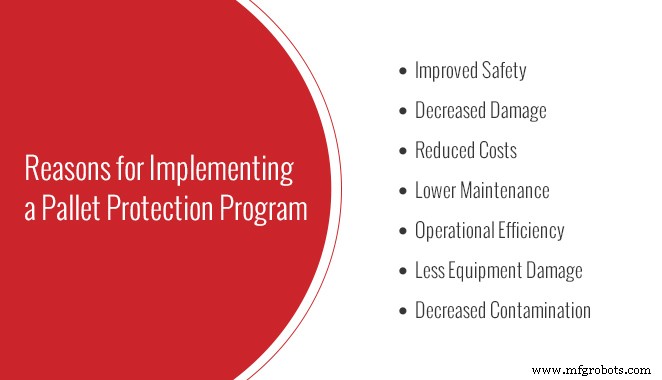
Smart managers realize these benefits from implementing a pallet protection program:
- Improved safety: Workers who are properly trained with pallet handling tips have a far lower rate of accidents involving pallets and pallet handling equipment.
- Less equipment damage: Proper treatment of pallets reduces the risk of damage to handling equipment. Damaged pallets can jam or jar mechanical equipment resulting to breakdown and costly repairs.
- Reduced costs: By reducing damage to pallets and pallet handling related injuries to workers, a significant cost savings is realized.
- Lower maintenance: Pallets are a tool like many other components in a warehouse. They need to be maintained. Properly protected pallets require less maintenance and repairs.
- Operational efficiency: Protecting pallets allows them to remain in circulation. That leads to less downtime from broken or damaged pallets and greater efficiency.
- Decreased contamination: Pallets that are cleaned and regularly serviced reduce the chance of product contamination that can cause spoilage or rejection.
When a pallet protection program is implemented and appreciated by the company culture, it results in a greater awareness of pallet handling safety and the benefits of proper pallet treatment. This causes less pallet mishandling. Preventing pallet damage is more than just training employees to pick the right pallet for the job. It comes down to identifying the common causes of pallet damage.
Common Pallet Mishandling Mistakes

Regardless of how strong and durable a facility’s pallet stock is, if workers aren’t trained, they’re bound to mishandle pallets and the various forms of equipment that transports pallets. Without the right training, common mishandling will continue. Common mistakes with pallet mishandling include:
- Pushing pallets across the warehouse or trailer floor with a forklift or truck. Bulldozing is the greatest cause of pallet damage. Pallets are designed to be lifted before moving. Sliding pallets — especially loaded pallets — creates a huge amount of friction between the pallet’s lower surface and the floor. This causes immense stress on the pallet structure that can result in integral failure. It can also damage floor surfaces.
- Failing to insert lift truck tines entirely through the pallet openings. Partially inserted tines or fingers don’t allow for proper weight distribution and a shifting of the load center point. It’s called “short-forking.” This creates unnecessary and unacceptable stress on parts of the pallet. Pallets are designed to share the load evenly. Improperly placed tines defeat this design purpose.
- Failing to properly spread lift truck forks. This is as serious a mistake as short-forking. When tines are spread too wide or too narrow, they don’t allow proper weight distribution from the load to the handling equipment. This also results in an excessive amount of strain being placed on the pallet frame resulting in a load collapse.
- Approaching a pallet too fast. Bigger pallet handling machines, like powered forklifts or even pallet jacks, have a lot of weight behind them. When workers approach a pallet at high speed, they have less time to align their forks with the pallet frame holes. Tines striking the upper or lower platforms can easily shatter the frame and cause shock spreading throughout the load.
- Turning pallets by spinning them with a machine. Often workers need to turn pallets and do so by pinwheeling. That refers to placing a lift fork on one corner of the pallet and twisting it to face another direction. Pinwheeling creates force on a small area and causes pallet frames to become weakened or break. Pallets should always be lifted for turning and not dragged.
- Improper loading of pallets. It might seem like common sense to uniformly load a pallet so the weight is evenly distributed. This unfortunately isn’t always the case. Placing too much weight at one edge or even in the pallet’s center can exceed the design limitations and cause the framework to collapse.
- Failing to secure pallet loads. There are so many different products that are loaded on pallets that it’s impossible to prescribe a uniform load securing method. The most common method is stretch-wrapping, but other systems, like banding and strapping, are often implemented. The main principle in pallet load securing is to bind the products to the pallet frame.
Improperly trained workers often don’t put enough tension on the bindings or put too much tension against the pallet frame. Weak compression results in dangerous load shift. Excessive tension causes pallet frame-snapping and compromised loads. Both are hazardous to worker safety.
- Failing to inspect pallets before using. Despite the best handling procedures that a company implements, often pallets are used that arrive from outsources as part of the pallet exchange pool. These used pallets often show up damaged and need to be thoroughly inspected before being placed into new service.
Workers who aren’t trained may not know the subtle but serious signs of pallet damage and proceed to load them. This mistake puts products and other workers at risk.
- Throwing or careless handling of pallets. Although it seems inconsiderate to throw pallets, it often happens in busy places like loading docks and freight yards. Workers who are in a hurry may throw pallets by hand or dump them off a forklift without realizing or caring how the kinetic energy from impact with the floor or ground affects the pallet’s structural integrity.
Wood pallets are particularly susceptible to jarring as this loosens fasteners or cracks stringers and platform boards. Plastic pallets easily crack from being mishandled, which effectively ruins them.
- Improperly stacking pallets. Almost all pallets are designed to be stacked when not in use. Many pallets are also designed to be stacked on top of each other when loaded as well. But there are proper techniques in stacking pallets safely, and workers need to be taught how to do this as part of a company’s pallet protection program. Misalignment is the leading stacking mistake, followed by overloading.
Preventing pallet mishandling is a prominent part of a pallet protection program. Worker safety is the other main part of the program, and both are inseparable. Prevention of accidental injury to workers and damage to inventory products starts with awareness of what the basic principles of pallet design are and the procedures for properly handling pallets. It’s a matter of worker training and education, and it’s an employer’s responsibility.
Prevent Poor Pallet Handling Through Proper Training
The best way to prevent poor pallet handling is through training workers in overall pallet use. The vast majority of workers want to do the job right. They want to work in a productive environment, and they certainly have no intention of causing injury to themselves or fellow workers. They also have no intention of damaging company property or customer goods.
When accidents happen, the root cause is often that the person responsible simply didn’t know better. They were never educated.
Educating workers on safe pallet handling goes beyond giving them tips. Preventing poor pallet handling takes a large approach at training workers about how pallets are made, how they’re to be loaded and how to properly use the various types of equipment needed to handle pallets. Properly trained workers are going to be more careful, therefore reducing injuries and property damage.
There are many different ways to educate workers. The most proven system in every practical training situation is to instruct the worker in operation, demonstrate how a process unfolds and then test them to ensure they’ve retained the information or skillset. Working with pallets is no exception to conventional training methods. Fortunately, today there are many training aids from written instructions to online videos.
A proper and effective pallet training approach should include the core elements of pallet design, loading, securing, handling procedures, maintenance and using the equipment available to make working with pallets safer and prevent poor handling.
Be sure to follow best practices when loading, securing and handling pallets and pallet equipment.
Pallet Loading Best Practices
Pallets must never be loaded beyond their maximum weight capability. This is inviting disaster. Best practice is to use a lower weight and multiple pallets in a shipment than risk an overload failure. Pallet loading is a skill that’s easy to master provided a worker understands these basics:

- Never exceed the outer perimeter of a pallet’s footprint. Most pallets are similar sized, but, if a wide load is required, it’s safer to construct a custom-sized pallet.
- Never use pallets in tandem or attached side by side. Pallets need to have a single unified integrity and will easily detach if temporarily joined.
- Load the heaviest items at the bottom and the lighter ones progressively above. This avoids product compression, which is similar to framework compression.
- A rule of thumb is not to exceed a pallet’s load height above the same dimension of its base. An exception is when goods are lighter and securely fastened to the pallet.
- Understand how the center of gravity works in pallet design. When a load is not evenly distributed on a pallet there is always a chance for toppling.
Pallet Securing Best Practices
One of the biggest reasons for pallet failure is the worker’s failure to properly secure the load to the pallet base. Occasionally with lighter loads, the products can be set on a pallet without any restraint and allow the forces of friction and gravity to cooperate. This is dangerous in most cases and is overcome by using some mechanical means.
- Stretch wrapping is the most common restraint used in pallet handling today. It’s light, cost-effective and strong. The key to stretch wrapping is not to just wrap the goods being shipped. It’s critical to wrap the goods to the pallet.
- Banding and strapping are still widely used. Materials can be metal, fiberglass or fabric-based webbing. This depends entirely on the type of pallet and the goods being shipped. Care needs to be taken by not extending tension on the bands. This can cause pallet frame failure.
- Edge protection is often used on materials sensitive to compression like cardboard boxes. Simple devices like angle brackets are commonly used on box edges as well as on pallet frame corners to prevent damage from tense straps.
Pallet Handling Best Practices
Improper pallet handling is where most accidents occur. That includes worker injury and property damage. Almost all accidents are preventable, and it’s no different in the pallet business. Educating and training workers in proper pallet handling techniques significantly reduces the risk of accidents.
- Workers need clear and specific instruction in operating pallet handling equipment. Pallet jacks and hand trucks can be dangerous if not operated correctly, as can rollers and pallet stackers. Forklifts are an entirely different situation and operators are required to be officially trained and certified. Forklift training is mandatory under OSHA regulations.
- Proper ergonomics are important in handling pallets. They come in various weights and can cause back strains or sprains if manually handled. The standard advice — lift with the back straight and knees bent — applies to pallet handling.
- Pallets should always be set on their edge and skidded if handling by hand. Picking a pallet up is awkward and presents a serious hazard for muscular-skeletal injuries. A good tip is for two people to handle one empty pallet.
- Personal protection equipment must be worn when handling pallets or operating handling equipment. That includes the minimum of wearing gloves and safety footwear. Eye protection is also a good precaution.
Pallet Maintenance Best Practices

Pallets are exposed to a lot of wear and tear, including abuse. Maintaining pallets is a main part of a pallet protection program and should include these points.
- Inspect a pallet before using. Avoid any with broken or cracked slats. Watch for loose nails or fasteners on wood pallets and for ultraviolet ray discoloration on plastic pallets.
- Pallets used in consumable product movements must be properly cleaned before using. This might be a simple hosing off or a deep clean required by FDA regulations.
- Damaged pallets must be immediately taken out of circulation and marked as unserviceable. If there is any doubt about a pallet’s strength or integrity, do not use it.
- As much as possible, make sure any splinters or rough edges are removed in wood pallets. These imperfections easily cause slivers and cuts.
Proper Pallet Equipment Usage
Handling equipment is used in virtually all workplaces that ship or receive goods transported on pallets. Each piece of specialized handling equipment has its safety features and its hazards. Workers using pallet handling devices must be competent in operation and understand their purposes and limitations. In larger workplaces, there might be several different pallet handling equipment pieces. Some of the common ones are:
- Pallet trucks including manual, electric, specialty and all-terrain models.
- Pallet stackers that move in tight aisles and confined spaces, like manual, semi-electric and full-power.
- Pallet accessories such as slip sheets and freezer spacers.
- Stretch wrapping machines like turntable, overhead mast and automatic wrappers.
Pallets and Pallet Handling Equipment You Can Trust from Cherry’s Material Handling
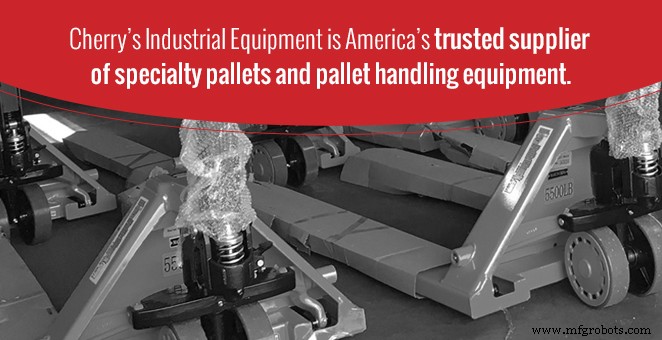
Cherry’s Industrial Equipment is America’s trusted supplier of specialty pallets and pallet handling equipment. For over three decades, Cherry’s has provided plastic, aluminum and presswood pallets across the nation and to shipments bound for international markets. Cherry’s Industrial also supplies a wide assortment of pallet trucks, toe jacks, rollers skids, pallet truck stops and slip sheets. For all your pallet and pallet handling needs, contact us, and speak to a Cherry’s Industrial Equipment representative about finding the right pallet handling equipment for your industry.
Manufacturing process
- Top 5 Forklift Maintenance Tips for Peak Performance and Longevity
- 5 Essential Industrial Maintenance Tips to Cut Downtime Costs
- Top 3 Pallet Racking Safety Tips for Reliable Warehouse Operations
- Essential Pallet Truck Safety Practices for Warehouse Operations
- Essential Industrial Pallet Handling Tips for Efficient Warehouse Operations
- Proven Food Safety Strategies for Safe Material Handling
- Essential Drum Handling Safety Guidelines for Warehouse and Jobsite Workers
- Expert Cleaning Guidelines for Material Handling Equipment
- Expert Tips for Safe & Efficient Raw Material Handling
- Leading 8 Industrial Manufacturing Blogs: Insights & Trends