



How Lithium‑Ion Batteries Work: A Clear Guide to Their Power
As a carrier of electrical energy and a source of power for many devices, we can well say that lithium-ion batteries is essential to us. Without it, our world is unlikely to function properly. So what is lithium-ion battery? And what makes it so important?
What is lithium-ion battery and how does it work?
Lithium-ion batteries are rechargeable batteries, which means they mainly rely on the movement of lithium ions between positive and negative electrodes. During charging and discharging, Li+ is intercalated and deintercalated between two electrodes. When charging, Li + is deintercalated from the positive electrode, and then embedded into the negative electrode through electrolyte, so that the negative electrode is in a lithium-rich state. When discharging, vice versa.
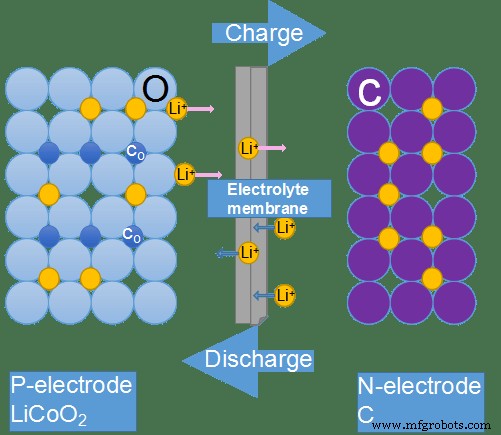
Lithium battery can be divided into lithium battery and lithium ion battery. We use lithium ion batteries on our daily gadgets like mobile phones and laptops, but we usually call them lithium batteries instead. Generally, lithium batteries use materials containing lithium as electrodes, which makes it the icon of modern high-performance batteries. True lithium batteries are rarely used in our daily life because of their high safety risk.
Advantages and disadvantages of lithium ion batteries
Advantages
- High voltage. The operating voltage of the single cell is as high as 3.7-3.8V (3.2V for lithium iron phosphate), which is three times that of Ni-Cd and Ni-MH batteries.
- Large specific energy. The actual specific energy is about 555 Wh/kg, which means that the specific capacity of the material can reach more than 150 mAh/g (3-4 times that of Ni-Cd, 2-3 times that of Ni-MH), which is close to 88% of its theoretical value.
- Long cycle life. Generally, it can reach more than 500 times, or even more than 1000 times of charging, and the lithium iron phosphate can reach more than 2000 times.
- Small self-discharge. At room temperature, the self-discharge rate of a fully charged Li-ion after been stored for one month is about 2%, which is much lower than Ni-Cd (which is 25-30%) and Ni-MH (which is 30-35%).
- Fast charge. The capacity of 1C can reach more than 80% of the nominal capacity after charging for 30 minutes, and that of ferro phosphorus battery can reach 90% of the nominal capacity for 10 minutes.
- Working temperature. The working temperature is -25 to 45 °C. With the improvement of electrolyte and cathode, it is expected to expand to -40 to 70 °C.
Disadvantages
- Age easily. Unlike other rechargeable batteries, the capacity of lithium-ion batteries will slowly decline. The rate of decline depends on the number of times used and the temperature. Because high temperatures can be destructive (the battery material will be broken down), the feature is easier to embody in electronic products with high operating current.
- Intolerance to overcharge. When overcharged, excessively embedded lithium ions will be permanently immobilized in the lattice, and cannot be released, resulting in a short battery life.
- Intolerance to over discharge. During overdischarge, the electrode deintercalates too much lithium ions, resulting in lattice collapse and shortened battery life.
- Safety issues. The organic electrolyte used in lithium-ion batteries makes the battery have certain safety hazards such as burning or even exploding.
Applications
At present, lithium-ion batteries are mainly used in the following fields.
Application in electronic products
Lithium-ion batteries can be made smaller and lighter, so they are widely used in portable electronic products. With the popularity of mobile phones, digital cameras, camcorders, laptops and handheld game consoles (PSPs), the lithium-ion battery market has maintained a rapid growth.
Application on transport vehicles
Lithium-ion battery has the advantages of good energy density and power density. Comprehensively speaking, it out-performs the other batteries, so it’s been widely used in various electric vehicles such as electric bikes and electric cars.
Application in aerospace
In 2004, lithium-ion batteries were used in Mars Lander and Rover. In addition, NASA’s Space Exploration Agency and other space agencies are considering the use of lithium-ion batteries in space missions. Currently, the primary function of lithium-ion batteries in the aviation field is to provide support for launch and flight correction and ground operation.
If you are interested in learning more about batteries, please feel free to contact us or leave a comment. We’d be very happy to hear from you.
Manufacturing process
- Electrical Grounding Explained: Safeguarding Systems from Arcing and Fires
- How a Car Radiator Works: Inside the Cooling System
- How a Metal Foundry Turns Molten Metal into Everyday Products
- Understanding Overrunning Clutches: How They Operate and Why They Matter
- Understanding Turret Punching: How It Works and When to Use It
- How 3D Printers Operate: A Comprehensive Technical Overview
- How a 3D Pen Works: From Filament to Finished Model
- Precision Casting Explained: Process, Benefits, and Applications
- How an Oil Pressure Gauge Works: Protecting Your Engine
- How a Two-Stage Pump Delivers Reliable Water Pressure