



Mean Time to Repair (MTTR): Definition, Calculation, and How to Improve It
MTTR is a key maintenance metric that measures the average time required to diagnose and fix equipment failures, giving insight into a maintenance team’s response efficiency.
What Is MTTR?
When you hear the phrase “mean time to…,” you’re looking at an average interval between two events. Mean time to repair (MTTR) quantifies the period from the moment a failure occurs until the asset is back in production. It encompasses:
- Alerting maintenance personnel
- Diagnosing the problem
- Executing the fix
- Reassembling, aligning, and validating the equipment
- Resetting, testing, and restarting for production
MTTR deliberately excludes spare‑part lead times and is not intended for planned maintenance or scheduled shutdowns.
Tracking MTTR offers a baseline for reducing unplanned downtime, saving costs, and improving customer satisfaction. It also reveals why repairs may be delayed, enabling targeted interventions that restore critical equipment swiftly. In addition, MTTR analysis can guide purchasing decisions, maintenance scheduling, and overall operational strategy.
Although MTTR is a reactive metric, its trend can highlight gaps in preventive maintenance. For instance, a rising MTTR on a specific asset may signal inconsistent preventive procedures, such as unclear lubrication instructions, which can lead to repeated failures.
When an asset’s repair time grows with age, MTTR history can inform whether to repair or replace it, and help predict lifecycle costs for new equipment.
Mean Time to Repair vs. Mean Time to Recovery
The “R” in MTTR is sometimes used interchangeably with “repair” and “recovery.” Mean time to recovery includes repair time plus the testing and return‑to‑normal phases. Clarifying the definition is essential when drafting maintenance contracts or SLAs.
MTTR Calculation
The MTTR formula is straightforward: total unplanned maintenance time divided by the total number of repairs. It is typically expressed in hours and assumes sequential, trained personnel handling each task.
Total Unplanned Maintenance Time / Total Number of Repairs = MTTR
Example: A pump fails four times in a day, taking one hour to repair each time. MTTR = 60 minutes ÷ 4 = 15 minutes.
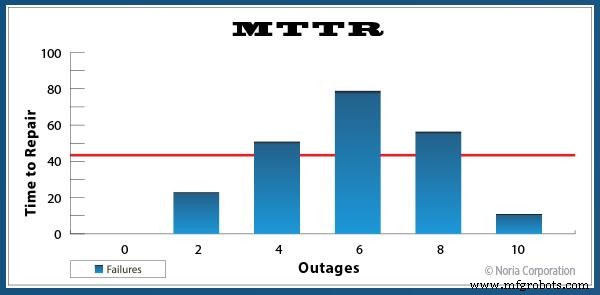
Another example: Over 90 days, an asset experiences 10 outages with downtime of 24, 51, 79, 56, and 12 minutes. MTTR = (24+51+79+56+12) ÷ 10 = 44 minutes.
Key assumptions:
- Failures vary in severity; MTTR is an average.
- All repairs are performed by qualified, trained technicians following standardized procedures.
Industry leaders often report MTTRs below five hours, but benchmarking is challenging due to variables such as asset type, age, criticality, and team expertise.
MTTR vs. MTBF: What’s the Difference?
Mean time between failures (MTBF) predicts the interval an asset operates without interruption. It is calculated as total uptime divided by the number of breakdowns.
MTBF = Total Uptime / Number of Breakdowns
MTBF and MTTR together determine overall uptime. Uptime can be derived as:
Uptime = MTBF / (MTBF + MTTR)
Example: A system is scheduled for 40 hours but is down for 28, leaving 12 hours of actual uptime and five failures. MTBF = (40-28) ÷ 5 = 2.4 hours; MTTR = 28 ÷ 5 = 5.6 hours. Uptime = 2.4 ÷ (2.4+5.6) = 0.86 or 86%.
How to Improve MTTR
Reducing MTTR is a core KPI for maintenance. Faster repairs mean stable production, higher customer satisfaction, and lower costs. Improving MTTR involves addressing the four stages of the repair cycle:
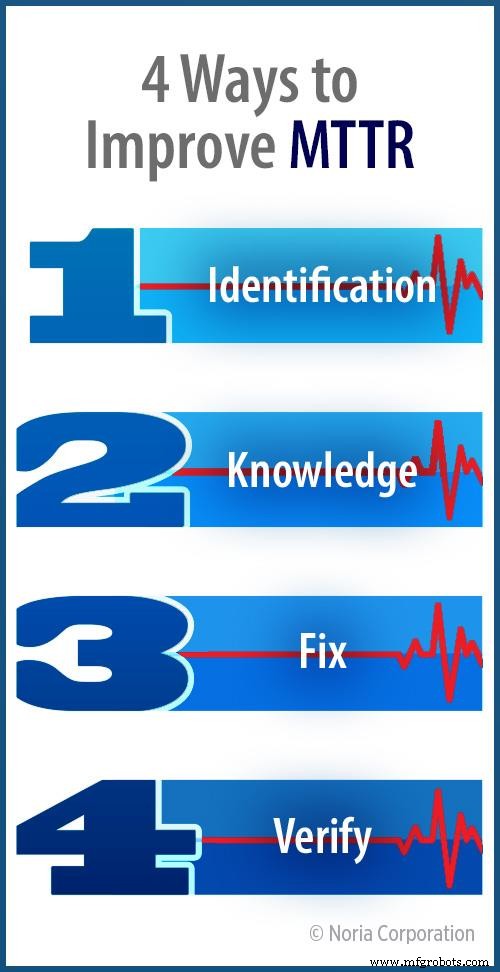
- Identification – Time from failure to technician awareness. Wireless sensors and automated alerts cut this interval.
- Knowledge – Time spent diagnosing the issue. Accurate documentation and historical data reduce this phase.
- Fix – Actual repair time. Standardized procedures and well‑trained staff streamline fixes.
- Verify – Confirmation that the fix works. Real‑time monitoring provides instant validation.
Diagnosing consumes about 80% of MTTR. Maintaining detailed machine ledgers, preventive schedules, and component histories enables technicians to pinpoint root causes quickly, preventing redundant calls and misdiagnoses.
Training and Procedures
Comprehensive, written procedures should be accessible to all technicians and followed rigorously to eliminate trial‑and‑error. Continuous training, coupled with focused lessons, is essential.
- Single‑point lessons – Short visual tutorials on specific problems, useful during live breakdowns or drills.
- Recurrence matrices – Weekly logs tracking failures, root‑cause analyses, and countermeasures, helping teams differentiate between forced and natural deterioration.
Spare Parts
While MTTR formulas exclude spare‑part lead times, the availability of parts heavily influences repair duration. Alex Thulani Madonsela notes that timely part access “significantly affects maintenance task duration.” A structured inventory strategy can reduce MTTR:
- Compile a functional location structure based on plant hierarchy.
- Develop an equipment inventory list.
- Create naming and coding standards for easy part location.
- Evaluate spare part criticality to support maintenance strategy.
- Finalize and share an accessible inventory list.
- Implement storage standards following OEM recommendations.
- Conduct quality assurance checks for readily available items.
- Perform regular audits involving storage, maintenance, and planning teams.
Technology
Modern monitoring and data analytics can dramatically shrink MTTR. On‑site or remote monitoring via smartphones or tablets offers 24/7 insight into equipment performance, enabling proactive maintenance planning.
Computerized Maintenance Management Systems (CMMS) automate data collection—labor hours, breakdown counts, uptime—and can calculate MTTR and MTBF automatically. The Industrial Internet of Things (IIoT) extends this capability by providing real‑time failure data and predictive analytics, reducing the time spent diagnosing issues.
Equipment Maintenance and Repair
- RF Transformers: Design, Function, and Key Applications
- Predictive Maintenance: The Complete Guide to Reducing Downtime and Maximizing ROI
- Grounds Maintenance Demystified: Comprehensive Services & Best Practices
- Predictive Analytics Demystified: Forecasting the Future with Data Precision
- Understanding Metal Fabrication: Processes & Applications
- BC547 Transistor: Key Features, Applications & Usage Guide
- Hybrid Cloud Architecture: Modernizing Legacy Systems with On‑Premise Control & Public Cloud Power
- Mastering Metal Fabrication: Techniques & Processes Explained
- Metal Core PCBs: Design, Materials, and High‑Temperature Applications
- Understanding Process Cooling Systems: Why They’re Vital to Industrial Efficiency