



Autonomous Maintenance: Empowering Operators to Maximize Equipment Performance
Autonomous maintenance equips operators with the skills to carry out routine upkeep, driving higher efficiency and stronger overall equipment effectiveness (OEE). Below, we outline how to implement, sustain, and reap the benefits of this transformative strategy.
What Is Autonomous Maintenance?
In autonomous maintenance, machine operators assume responsibility for continuous monitoring, adjustments, and minor upkeep—replacing the need for a dedicated maintenance technician to perform routine tasks. This first pillar of Total Productive Maintenance (TPM) empowers operators to maintain their equipment at "like-new" standards through cleanliness, lubrication, and inspection.
The approach rests on two core principles:
- Prevent deterioration through proper operation.
- Restore and maintain equipment in a "like-new" state.
Operators learn to recognize when a machine requires a simple fix versus a more substantial upgrade, mastering skills such as anomaly detection, corrective action, and proactive quality assurance. By freeing skilled technicians from routine work, autonomous maintenance enhances OEE by reducing breakdowns and extending equipment life.
How to Implement Autonomous Maintenance
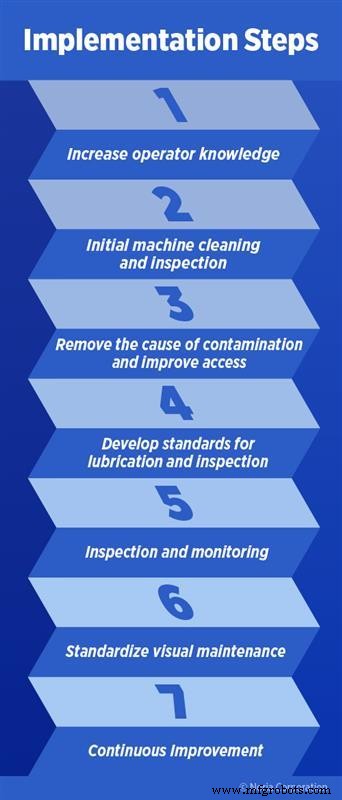
While the specifics may vary by plant, most implementations follow seven key steps:
- Elevate Operator Knowledge
Training delivers both technical insight and problem‑solving tactics. Operators should master four critical skills:- Detect abnormalities
- Correct and restore issues
- Set optimum conditions
- Maintain those conditions
- Initial Cleaning & Inspection
This baseline restoration brings machinery back to peak performance. All stakeholders—production, maintenance, engineering, and operators—collaborate to remove:- Leaks
- Loose bolts
- Inadequate lubrication
- Cracks, apparent or hidden
- Fluid contamination
- Residue in water or oil lines
- Dust and dirt buildup
- Electrical conductivity issues from deposits
- Stoppages caused by dust accumulation
- Eliminate Contamination & Improve Access
Prevent re‑deterioration by instituting cleaning standards, using quality seals, and adding pumps or dry‑screening equipment where needed. Enhancing visibility—e.g., replacing opaque covers with transparent panels—boosts safety and makes maintenance easier. - Define Lubrication & Inspection Standards
Standards vary for non‑critical versus critical machines. Non‑critical units are trained by experienced engineers to follow established protocols, while critical assets involve a dedicated maintenance team to develop guidelines. All procedures should be clearly documented and readily available. - Inspection & Monitoring
Operators follow the approved standards, tracking tasks in a CMMS to avoid duplication with the maintenance department. Daily checks include lubrication levels, leak detection, bolt tightness, wear analysis, and mechanical adjustments. - Standardize Visual Maintenance
Visual cues—transparent covers, clear flow labels, color‑coded gauges—make equipment self‑diagnostic. The goal is to make abnormal conditions instantly recognizable. - Continuous Improvement
Regular audits and data reviews help refine processes. Recording failures and lessons learned feeds back into future machine designs and maintenance schedules.
Sustaining Autonomous Maintenance
Once operators are trained and procedures are standardized, ongoing practices ensure lasting impact:
- Daily stand‑up meetings to discuss performance, challenges, and updates.
- Single‑point lessons—quick reminders or labels that reinforce key safety or operational steps.
- Tracking failure and breakdown data to prioritize maintenance focus.
- Leveraging metrics such as MTBF and MTTR to forecast and prevent issues.
- Documenting component wear through oil, vibration, and infrared analyses.
- Automating work order creation via CMMS integration for accurate maintenance logs.
Benefits of Autonomous Maintenance
Autonomous maintenance delivers three core advantages:
- Lower labor costs by reducing travel time and wait periods—operators are on hand whenever maintenance is needed.
- Higher skilled resource availability enabling technicians to focus on complex, critical tasks.
- Enhanced team cohesion by shifting from a siloed "operator vs. maintenance" mindset to a unified "we maintain" culture, aligning with TPM pillars.
Equipment Maintenance and Repair
- Digital Factory Explained: Definition, Benefits, and Transformation Opportunities
- Predictive Maintenance Explained: How It Cuts Downtime and Drives Value
- Reliability & Asset Management: Foundations for Production Excellence
- World-Class Maintenance & Reliability: The Definitive Assessment Blueprint
- Predictive Analytics in Manufacturing: Driving Efficiency, Quality, and Demand Forecasting
- Preventive Maintenance Explained: Key Benefits for Asset Reliability
- Predictive Maintenance Explained: Why It’s Essential for Modern Facilities
- Facility Maintenance Explained: Why It Matters for Safety, Efficiency, and Value
- The Role of a Maintenance Director: Responsibilities & Impact
- Sustainable Maintenance: Why It Matters for Business and the Planet