



Predictive Analytics in Manufacturing: Driving Efficiency, Quality, and Demand Forecasting
In today’s competitive landscape, manual manufacturing processes inflate costs and stall growth. Manufacturers face four critical challenges: optimizing operations, cutting costs, elevating production quality, and accurately forecasting demand.
Partial digitization offers limited relief; only a fully integrated digital ecosystem can address these hurdles. Especially for demand forecasting, a robust predictive system built on comprehensive operational data is essential for forward‑looking planning.
Predictive Analytics in Manufacturing – Why It Matters and How It Works
What is the most effective strategy to tackle these challenges?
The answer lies in automating processes with predictive maintenance (PdM) solutions.
Below we explore how predictive maintenance improves operations, boosts production quality, cuts costs, and enables precise demand forecasting.
What is Predictive Maintenance?
Predictive maintenance (PdM), also known as condition‑based maintenance, monitors equipment performance during normal operation to anticipate failures. First used in industry during the 1990s, PdM aims to predict when a failure may occur and schedule corrective action before it happens, thereby reducing downtime and maintenance costs.
(Source: Reliable Plant)
Manufacturing Predictive Analytics Market Outlook 2018‑2026
The market was valued at $535.0 million in 2018 and is projected to reach $2.5 billion by 2026, growing at a CAGR of 21.7% from 2019‑2026. Industry 4.0 innovations are the primary catalyst for this expansion.
(Source: Allied Market Research)
How a Predictive Maintenance System Works
A typical PdM stack consists of: IoT sensors that capture real‑time data from machinery, cloud platforms that process and store the data, mobile apps that deliver alerts, AI/ML engines that analyze patterns and predict outcomes, and web dashboards that centralize insights for all stakeholders.
1. IoT devices collect operational data from equipment.
2. Data is transmitted to the cloud where it triggers alerts or dashboards.
3. AI/ML algorithms analyze at least a year of historical data to forecast potential failures.
4. Stakeholders receive actionable reports and can schedule maintenance proactively.
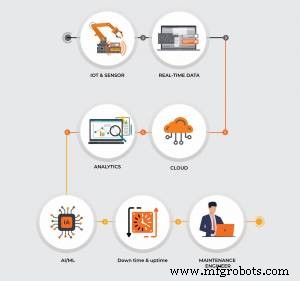
Note: The image above illustrates the predictive maintenance flow in a manufacturing plant.
Benefits of Predictive Maintenance for Manufacturing
- Accurate, real‑time condition monitoring
- Early detection of impending downtime
- Greater operational transparency
- Reduced product delays
- Optimized production schedules
- Lower maintenance costs
- Proactive failure mitigation
- Reduced repair expenditures
- Extended equipment lifespan and utilization
- Enhanced employee safety
- Higher overall profitability
- Improved demand forecasting
With the fundamentals and advantages clear, let’s examine how predictive maintenance reshapes manufacturing operations and growth.
Predictive Maintenance for Operational Improvement
Operational efficiency is the linchpin of production rate and quality. It requires aligning people, machines, and technology. PdM empowers continuous monitoring of machine performance across all operational states—peak, normal, and idle—using IoT data. By analyzing historical patterns, inefficiencies are identified and corrected before they impact output. Overall Equipment Effectiveness (OEE) is calculated from this data, driving measurable improvements in throughput and reliability.
Furthermore, PdM can identify mismatches between workforce allocation and machine utilization, enabling targeted training and process adjustments that elevate staff efficiency.
Predictive Maintenance for Machine Utilization and Management
Unplanned downtime is a costly reality for most manufacturers. PdM provides continuous insight into machine health, revealing faults before they cascade into failures. AI/ML models sift through terabytes of sensor data to pinpoint degradation trends, enabling preemptive repairs that reduce repair and labor costs. In many cases, this translates into savings of millions per year.
Predictive Maintenance for Production Quality
While IoT alone does not directly alter product quality, its integration with PdM creates a virtuous cycle. Stable, well‑maintained machines run at optimal parameters, leading to consistent product quality and throughput.
Predictive Maintenance for Demand Forecasting
Predictive maintenance turns raw operational data into actionable intelligence for demand planning. By eliminating data silos and offering full plant visibility, executives can forecast equipment availability, anticipate capacity constraints, and align production schedules with market demand—ensuring timely fulfillment and reduced inventory carrying costs.
Predictive Maintenance Use Case – Asset Management
PdM excels in monitoring assets exposed to variable environmental conditions. Continuous data collection informs maintenance schedules, predicts when an asset should be replaced, and identifies root causes of failures. Typical insights include:
- Optimal replacement timing
- Maintenance windows that minimize disruption
- Estimated asset lifespan
- Failure likelihood and causative factors
- Risk assessment of potential downtime
- Recommendations for maintenance strategy to maximize utilization
Predictive Maintenance ROI
Implementing a robust PdM program can deliver transformative returns: a tenfold increase in ROI, 25‑30% reduction in maintenance costs, 70‑75% fewer breakdowns, and 35‑45% less downtime. When expressed per labor hour, PdM costs $9 per hour of annual labor, compared to $13 for traditional preventive maintenance.
(Source: Infoq.com)
Summary
Predictive analytics is a strategic asset for manufacturers, driving cost efficiency, operational excellence, and quality while empowering accurate demand forecasting. As the field evolves, prescriptive analytics—delivering actionable root‑cause recommendations—will further elevate manufacturing performance. With the competitive advantage increasingly tied to data‑driven maintenance, it’s time to adopt predictive solutions before rivals do.
Internet of Things Technology
- Digital Factory Explained: Definition, Benefits, and Transformation Opportunities
- Predictive Maintenance Explained: How It Cuts Downtime and Drives Value
- Autonomous Maintenance: Empowering Operators to Maximize Equipment Performance
- Predictive Maintenance: A Catalyst for the Next Industrial Revolution
- Unlocking Predictive Maintenance: The Future of Manufacturing Reliability
- Implementing Multi‑Factor Authentication: Why It’s Essential for Modern Security
- Enhancing Health & Safety in Manufacturing: Proven Strategies for a Secure Workforce
- Predictive Analytics: Empowering Manufacturing Maintenance Teams
- Harnessing Predictive Analytics in Manufacturing: Proven Use Cases & Tangible Benefits
- Predictive Maintenance Explained: Why It’s Essential for Modern Facilities