



Choosing the Right Thread Treatment: Enhancing Reliability and Reducing Downtime
Proactive treatment of threaded pipes and fasteners with specialized thread treatments is essential for efficient, cost‑effective manufacturing. Threaded fastener loosening is a leading cause of equipment failure, costing industries millions in unscheduled downtime annually. Additionally, over a billion gallons of industrial fluids are lost each year to leaks, compromising safety, increasing emissions, and posing contamination risks.
Threaded fasteners maintain critical tolerances across assemblies—from light‑duty equipment to heavy machinery. To guarantee reliable performance over the entire service life, they must preserve those tolerances. Thread treatments—categorized into thread sealants, threadlockers, and anti‑seize materials—lubricate, protect, seal, and lock fasteners, thereby enhancing assembly reliability.
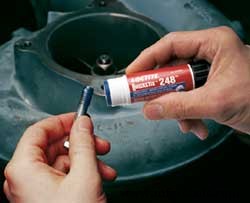
Semi‑solid stick formulations represent the latest advancement in thread treatment.
Threadlockers
Threaded fasteners are subjected to a range of differential stresses—vibration, shock, thermal expansion and contraction, and micro‑movement—that can erode clamping force and precipitate machine failure. Traditional mechanical locking devices, such as spring washers, wire retainers, and locking bolts, add cost and cannot reliably counter side‑sliding self‑loosening. They also fail to seal against corrosion and must be precisely sized for each fastener.
Liquid thread‑locking adhesives are one of the most reliable and cost‑effective solutions for keeping threaded assemblies locked and leak‑proof throughout their service life. Applied drop‑wise to threads, liquid anaerobic products fill thread grooves and cure to a hard thermoset plastic when exposed to metal ions in an oxygen‑free environment. This locks the threads together, eliminates unwanted movement, and seals against leakage and corrosion. Any excess material can be wiped away while it remains liquid.
While a properly prepared surface delivers optimal thread‑locker performance, recent anaerobic technologies reduce the need for extensive cleaning and surface preparation. New formulations cure on inactive metal, tolerate oily surfaces, and allow the cure rate to be specified. Conventional liquid products may still require surface primers for challenging substrates.
Threadlockers prevent common failures such as misalignment caused by loss of clamp load. For example, when shafts in gearboxes or motors are aligned, mounting bolts must be torqued correctly to maintain that alignment. Over time, vibration, thermal cycling, or shock can loosen these bolts, reducing clamp load and causing misalignment. Applying liquid threadlockers proactively preserves clamp load and prevents this issue.
Threadlockers come in a range of strengths tailored to specific applications, enabling fasteners to maintain critical clamp load pressures even in extreme environments. These adhesives provide high shear strength, excellent temperature resistance, rapid cure, easy dispensing, and outstanding vibration resistance. New anaerobic formulations include surface‑insensitive variants, high‑temperature grades (up to 450 °F), chemical resistance, and products engineered for severe vibration.
When selecting a thread‑locking adhesive, consider the following: A bolt previously locked can be reused simply by removing the old adhesive, applying new material, and reassembling. Threadlockers are available in low‑strength grades for easy removal, medium‑strength grades that can be removed with hand tools, and high‑strength grades offering the greatest holding power. No threadlocker is truly permanent; even the highest‑strength grades can be removed with standard hand tools after exposure to 450–500 °F for about five minutes.
Significant amounts of old threadlocker residue can be removed with a stiff brush. Light residue is compatible with a new application of threadlocker, provided it does not hinder re‑installation of the fastener.
Thread Sealants
Leaks pose costly and dangerous risks in all fluid systems—whether gas, vapor, or liquid. The tolerance for leakage varies widely; a few drops leaking from a drainage hose may be acceptable, whereas the same rate of water leaking into an electrical switchboard could be catastrophic.
Leaks most often originate at pipe joints. While designers aim to minimize the number of joints, threaded connections are unavoidable. Even with standardized fittings, tapered threads are imprecise and can become damaged during use or repair, creating spiral leak paths that tightening alone cannot eliminate. Thread sealing addresses this by blocking the leak path in pipe connections.
Mechanical sealing methods—tapes, dopes, pastes, O‑rings, and cone fittings—have limitations. Tapes act only as lubricants, can shred, clog pipes, or cause overtightening. They are manually applied, limiting automation, and offer poor vibration resistance. Pastes contain solvents that can creep or shrink, reducing chemical and vibration resistance. O‑rings require large inventories and special joint designs, and can be damaged during handling. Cone fittings demand costly machining and are fragile.
Thread sealant adhesives are liquid to paste‑like formulations that cure anaerobically. They contain no volatile solvents, so they do not evaporate over time, preserving long‑term seal integrity. Formulation modifiers and plasticizers provide lubrication during assembly, ensuring consistent torque, while the cured material creates a melt‑free seal that eliminates leak paths.
After curing, anaerobic thread sealants resist melting, eliminating leak paths. They seal and lock threads simultaneously, acting as a lubricant during assembly to promote tightening and maintain torque. Uncured sealant dissolves, preventing contamination. Once applied, these materials achieve instant low‑pressure (500 psi) seals, and many formulations can seal to pressures of 10 000 psi. They also seal pipe unions and compression fittings, offering exceptional fluid compatibility.
Threaded hydraulic fittings are a frequent source of leakage. Conventional sealants often fail over time due to shrinkage or lack of true sealing capability. Anaerobic thread sealants combine lubrication for smooth assembly with a shrink‑free seal, delivering long‑term reliability.
Anti‑Seize
Anti‑seize materials shield threaded and slip‑fitted metal parts from rust, corrosion, galling, and seizing at high temperatures. They also reduce friction, wear, and breakage in demanding operating environments.
These high‑performance greases—formulated with or without metal flakes—ensure that fasteners are easy to assemble and disassemble. At a given torque, anti‑seize guarantees consistent bolt tension, even under extreme conditions. Specific formulations target the thread material and temperature range; some products perform above 1 000 °F and even up to 2 400 °F, making them suitable for applications such as furnace door hinges that endure harsh environments.
Application typically involves brush‑applied deposits. Dipping a fastener into the material is discouraged because it can lead to over‑application, contamination, and inconsistent assembly.
New Technology
Recent advances in the stability and reactivity of thread‑locking and thread‑sealing materials have introduced semi‑solid “stick” formulations that complement liquid counterparts. Semi‑solid thread‑locking, thread‑sealing, and anti‑seize sticks perform well in scenarios where liquids are messy or might migrate into undesired areas. For instance, sealant sticks are ideal for overhead or hard‑to‑reach locations where fluids and tapes are cumbersome. Anti‑seize stick technology allows precise dispensing directly onto a part, reducing over‑application.
Sticks are especially valuable in time‑sensitive or staged assembly operations. The thread‑locking material can be applied in advance without the risk of running off the part, allowing all components to be assembled simultaneously without the laborious matching of mechanical locking devices or drop‑wise application of liquids.
Andy Bardon is an application engineer for Henkel Corporation. To learn more, visit www.loctite.com or call 800‑562‑8483.
Equipment Maintenance and Repair
- AC Analysis Configuration: Curves, Points, and Frequency Sweep Settings
- Fluoride Treatments: Science, History, and Future
- Thread: Types, History, Production, and Quality Control
- Threadlock Adhesives: Ensuring Fastener Reliability and Reducing Downtime
- Maximizing Reliability in Threaded Assemblies: The Critical Role of Thread Treatments
- Mastering C# Multithreading: Boost Performance & Efficiency
- Thread Milling vs. Tapping: Which Threading Method Is Right for Your Parts?
- Comprehensive Analysis of Aqueous Corrosion Products: Methods & Applications
- Understanding Thread Machines: Precision Threading for Metal and Plastic
- Rhodium (Rh): Properties, Chemical Resistance, and Processing Techniques