



Threadlock Adhesives: Ensuring Fastener Reliability and Reducing Downtime
Threaded fasteners are the backbone of precision in both light‑weight tools and heavy‑industrial machinery. They set and maintain critical tolerances, yet loosening is a leading cause of equipment failure, translating into millions of dollars of unscheduled downtime each year. When a fastener self‑loosen during operation, it can accelerate wear, induce fatigue, and ultimately compromise alignment or even trigger catastrophic failure.
Proactive maintenance strategies that address self‑loosening fall into two broad categories: mechanical locking devices and chemical fastener adhesives. While spring washers, wire retainers and locking bolts can be effective, they are costly, can’t reliably counter side‑sliding motion, and do not seal against corrosion. Moreover, each device must be sized for the specific fastener, leading to large inventories and higher overhead.
Figure 1 – a vibration‑versus‑clamp‑load chart – demonstrates that many mechanical locking methods lose preload over time, even under modest vibration. In contrast, chemical fastener adhesives maintain clamp load consistently over prolonged operation.
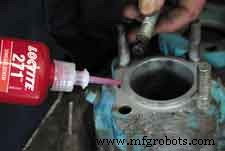
For blind‑hole jobs, apply threadlocker to both the bolt and the threads inside the blind hole.
Liquid anaerobic threadlocking adhesives have become the industry’s most reliable and cost‑effective solution for securing threaded assemblies. Applied drop‑wise to the mating threads, these liquids penetrate the groove geometry, then cure to a hard thermoset plastic when exposed to metal ions in an oxygen‑free environment. The result is a single, jointed part that resists loosening and leakage throughout its service life.
Because threaded assemblies are often disassembled for maintenance, a range of threadlocker strengths is available: low‑strength grades for frequent adjustment, medium‑strength grades that can be removed with hand tools, and high‑strength or “permanent” grades for demanding, low‑service applications. Even the most robust threadlockers can be removed with standard hand tools after a brief exposure (≈5 minutes) to 450‑ to 500‑°F air.
The required strength and viscosity of a threadlocker correlate directly with fastener size. Low‑strength lockants suit screws up to ¼‑inch, such as calibration fasteners and gauges. Medium‑strength formulations cover fasteners up to ¾‑inch used in machine tools, presses, and pumps. High‑strength lockants are ideal for fasteners up to 1‑inch in permanent assemblies like heavy equipment mounts. Low‑viscosity, penetrating lockants can wick into pre‑assembled fasteners up to ½‑inch in diameter.
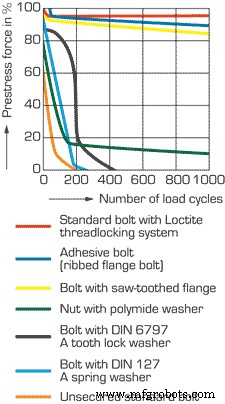
Figure 1. Vibration vs. clamp load chart.
Apply threadlocking adhesive only where the nut and bolt meet when the assembly is fully tightened; adhesive between the threads is what cures. For blind‑hole assemblies such as studs, coating both the bolt and the blind‑hole threads is essential. Otherwise, air pressure may push the liquid out during torque, leading to incomplete cure and potential failure.
The end‑use environment – temperature, chemical exposure, vibration intensity – dictates the optimal threadlocking formulation. The latest technologies deliver surface‑insensitive, high‑temperature, and chemically resistant lockants, as well as grades engineered to withstand extreme vibration.
Recent breakthroughs in stability and reactivity have introduced semi‑solid “stick” formulations that complement the traditional liquid lockants.
Andy Bardon, Senior Application Engineer, Henkel Corporation. Learn more at www.loctite.com or call 800‑562‑8483.
Equipment Maintenance and Repair
- Defining and Clarifying Reliability in Manufacturing Operations
- Operator‑Driven Reliability: Empowering Operators to Own Plant Equipment
- Surge Protection: A Key to Maximizing Equipment Reliability
- Balancing Flexibility and Reliability in Modern Manufacturing
- Eliminating Defects by Enhancing Equipment Reliability
- Common Failure Modes in Equipment Reliability Programs
- New Book: The OEE Primer – Mastering Equipment Effectiveness, Reliability & Maintainability
- Threadlockers Unveiled: Expert Guide to Threadlocking Adhesives
- 5 Key Elements That Drive Equipment Reliability Through Maintenance Planning
- Achieving Reliability and Maintainability: A Dual-Approach to Equipment Availability