



How a Proactive Shutdown Strategy Slashed Potlatch’s Maintenance Costs by 83%
By fine‑tuning the type, quality, and timing of shutdown work, Potlatch Corporation’s Cloquet, Minn. pulp and paper mill cut maintenance cost per ton by 83 %.
Effective shutdown management is the linchpin of mill performance. Poorly planned outages erode equipment reliability, compromise product quality, and erode profit margins. Mastering shutdowns transforms downtime into a strategic lever for savings.
In today’s tight‑budget environment, trimming waste is paramount. Shutdowns consume a large slice of a mill’s annual spend, yet disciplined shutdown practices can trim those costs by 30‑50 % if the post‑outage startup is smooth and predictable. With proven techniques, a mill can unlock the equivalent of several weeks of extra production each year—without cutting any essential work or extending planned outage windows.
Once the fundamentals of a successful shutdown are understood, the path to lower costs is clear. Early identification of major outage tasks, meticulous planning to ease execution, and strict control of late‑add‑on work together produce a lean, predictable schedule. This disciplined approach frees resources for continuous refinement and yearly savings.
Three pillars of a low‑cost shutdown
- The nature of the work performed during the outage.
- A finalized schedule that governs the shutdown work list.
- The rigor of the shutdown planning process.
Choosing the right shutdown work
Limiting the work list to tasks that can only be done during a major outage is essential. Anything that can be deferred to normal operating hours should be postponed. The core focus should be preventive maintenance—inspections, cleaning, and necessary repairs. This disciplined focus cuts overtime, reduces contractor spend, and yields superior documentation, often keeping the project within 3 % of its budget. For instance, during the 2001 utility outage at the Cloquet mill, the power and recovery team finished the work within 3 % of the allocated budget for two consecutive years.
Initially, many teams at Cloquet attempted to squeeze as much work as possible into each outage. The shift to a concise work list brought measurable gains in budget control, overall outage cost, equipment reliability, and planning efficiency. Contract labor for repairs fell as on‑site maintenance teams gained the capacity to handle more work during outages. The culture is gradually shifting toward a cost‑conscious mindset for every activity.
Previously, the mill was pressured to eliminate scheduled minor repair days by absorbing that work into major outages, with the intent of reducing downtime and boosting throughput. In practice, the additional overtime, expedited parts, unplanned work, and worker fatigue outweighed the perceived savings.
Minor outages remain a vital component of proactive maintenance, offering the chance to perform repairs that cannot be done while the plant is running. Each mill should establish a reliable minor downtime cadence and avoid unnecessary interruptions. At Cloquet, a consistent minor downtime schedule has translated into record production, higher quality, and greater reliability.
Balancing scheduled downtime with plant reliability is delicate. Major shutdowns support maintenance tasks carried out between outages, including minor downtime repairs. A simple metric—mean time between production loss (MTBPL) divided by mean production loss (MPL)—provides a clear gauge of whether outages and maintenance are delivering value. As shown in Figure 1, an upward trend in MTBPL relative to MPL signals improved reliability and productivity.
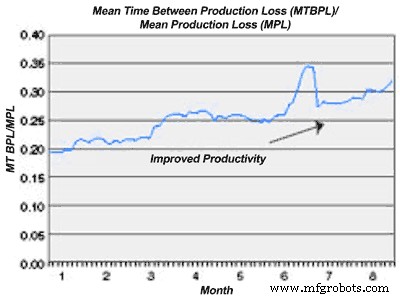
Figure 1. Increasing MTBPL versus MPL indicates that maintenance and operations are enhancing productivity.
By adjusting the interval and duration of scheduled shutdowns, the plant continually nudges toward higher uptime. Monitoring MTBPL/MPL in real time reveals success or failure, guiding decisions on whether to shorten or lengthen future outages. When the right balance is struck, everyone—maintenance and production alike—sees the benefits reflected in the data.
Creating a finalized shutdown schedule
A finalized schedule is not merely a budgeting exercise; it directly shapes mill expenditures. The schedule must blend long‑term and short‑term planning to maintain control over scope and cost.
Long‑term planning is performed three to ten years in advance and captures major work items—boiler inspections, large tank relining, sewer repairs, and power distribution checks—along with a lump‑sum allowance for incidental repairs. This foresight prevents last‑minute surprises and keeps major repairs from slipping through the cracks.
Short‑term planning, established annually, refines the long‑term plan into a detailed, actionable schedule. It incorporates estimates for smaller, routine repairs and is submitted to budget approval at least 18 months before the outage. This precision ensures that the outage scope is clear and that any changes are tightly controlled.
Changes to the schedule are permissible only up to six months before the outage, and only if the budget accounts for the new work. Enforcement of this six‑month lockout is essential; otherwise, the planning efficiency deteriorates, and parts delivery schedules become unreliable. The table below illustrates how the proactive method at Cloquet outperformed the reactive approach in 2001.
TABLE 1. Comparison of proactive and reactive shutdown methods during the 2001 major outage at Cloquet.
Proactive Shutdown Method
Reactive Shutdown Method
Jobs scheduled before lockdown
196
183
Jobs added after lockdown
0
56
Jobs added during shutdown
4
45
Planned jobs completed
193
131
Unplanned jobs completed
4
45
Total jobs demanded
200
284
Total jobs completed
197
176
Success rate (%)
99%
62%
The practice of a hard lockdown date can be controversial, but it is rooted in data. Each facility knows its historical outage workload; by reviewing repair histories and creating a detailed equipment database, planners can forecast future work accurately. As planners reuse and refine work packages year after year, the time required to plan each job shrinks, freeing resources for continuous improvement.
Beware of over‑relying on legacy budgets. Adjusting historical figures for higher productivity and updated labor/material costs ensures realistic, achievable shutdown budgets. Many mills have realized 50 % or more reductions by adopting these refined budgeting practices.
Quality planning drives cost savings
Well‑planned shutdowns translate directly into higher output, lower labor hours, and improved repair quality. A job that previously took eight hours unplanned can be completed in under two hours when it is properly planned. This efficiency boost is backed by data from Cloquet’s maintenance technicians.
Every job—preventive maintenance, repairs, routine checks, contractor work, and capital projects—must be accompanied by a comprehensive work package. Full‑time planners are essential; when planners are overloaded with supervisory or field tasks, the planning quality suffers. A well‑documented work package eliminates ambiguity, speeds execution, and reduces safety risks.
Experienced technicians play a critical role; their feedback identifies gaps in work packages, enabling iterative refinement. Over time, a repository of proven work packages reduces planning time and expands the knowledge base to the entire workforce.
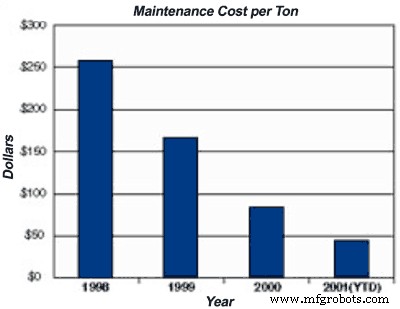
Figure 2. Maintenance cost per ton fell 83 % over four years at Cloquet, driven by improved practices and equipment upgrades.
Figure 2 shows the dramatic drop in maintenance cost per ton for Cloquet’s bleached market pulp and coated free‑sheet products. The savings stem from both enhanced maintenance procedures and significant equipment upgrades.
About the author
Dave Krings is the maintenance planning coordinator for Potlatch Corp., Minnesota Pulp and Paper Division, Cloquet, Minn.
Equipment Maintenance and Repair
- Effective Maintenance Leadership: Building Processes and Enabling Performance – Part 2
- Centralized vs. Decentralized Maintenance: Planning & Scheduling Insights
- Enhancing Plant Reliability Through Collaborative Operations and Maintenance
- US Navy Saves Over 1,000 Man‑Hours With Azima DLI’s Advanced Fleet Condition Monitoring
- Rockline Industries Cuts Operating and Maintenance Costs with LED Lighting Upgrade
- Proven Strategies to Cut Maintenance Costs Without Cutting Staff
- Proactive Maintenance: Essential Strategies for Reliability and Cost Savings
- Proactive Maintenance Safety: A Comprehensive Guide for Industrial Professionals
- Mastering Proactive Maintenance: Elevate Reliability and Reduce Downtime
- 5 Proven Strategies to Cut Maintenance Costs Effectively