



Unexpected Intruders: How Mice, Bats, and Bearing Defects Threaten Industrial Reliability
The Reliability in Action section showcases reader‑submitted case studies that illustrate real‑world challenges and solutions. Submit your own by emailing parnold@noria.com or mailing to Reliable Plant, P.O. Box 87, Fort Atkinson, WI 53538. Selected stories will earn you an official Reliable Plant T‑shirt.
Here are this issue’s contributions:
Of Mice and Men
We were experiencing intermittent trips in the static var unit that powered our rolling mill drives. The unit would shut down abruptly and display an "off" status on the operating panel. For several weeks, the problem persisted without a clear cause. When we tried to restart it from the main panel, the unit wouldn’t start; it could only be revived from the backup panel.
Suspecting a hidden fault, we opened the cabinet and heard a sizzling noise coming from an adjacent enclosure. Investigation revealed a mouse had infiltrated the 480‑volt terminal area and was chewing through the wiring. The mouse had been consuming cable, and we discovered more than 150 feet of control cable and two special I/O flat cables had been destroyed. The blue wire, apparently the tastiest, was most heavily damaged.
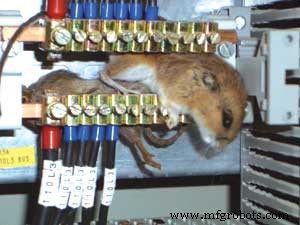
Mice and electrical wires just don’t mix.
We installed traps and bait boxes. Within two days, the mice consumed all the bait material, and by the end of the first week we removed 12 dead mice from the cabinets and traps.
As colder weather exacerbated the issue, we instituted a routine preventive maintenance program each fall to open the panduit covers and inspect for mouse activity. In the meantime, we maintain the traps and bait boxes to keep the problem at bay.
If anyone has invented a better mouse trap, I’d like to hear from you.
Joe Rachford
Process Manager, High‑Voltage Systems
Gallatin Steel
A Bat Place to Sleep
During a routine infrared inspection of our electrical components last July, I photographed an untouched 480‑volt disconnect. While opening the disconnect for the shoot, I found a bat pinned across two legs of the fused disconnect. Fortunately, no fuses had blown and the unit remained functional.
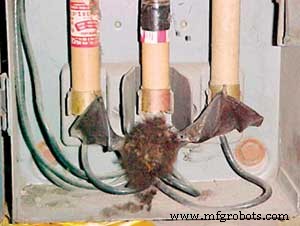
One reason to plug electrical box holes.
On closer inspection, the disconnect’s knock‑out hole was open. The bat had entered in search of a dark resting spot. This incident underscores that leaving electrical box openings unsealed can pose safety risks—not only to personnel but also to wildlife. An unintended entry point could short the disconnect, leading to equipment downtime or even a fire.
Jerry Sexton
Reliability Specialist
Commonwealth Aluminum
Uncovering a Bearing Defect
On July 26, vibration monitoring of an extruder drive motor revealed readings that surpassed the fault alarm thresholds on three parameters: vHFD, peak‑to‑peak waveform, and maximum peak waveform. The waveform displayed spikes occurring once per shaft revolution, a classic sign of inner‑race defects.
Subsequent PeakVue analysis showed clear peaks at the motor’s running speed and at the ball‑pass frequency of the inner race (BPFI). In a normal velocity spectrum, the fundamental bearing frequency typically remains absent; however, when a bearing resonates at its natural frequency, defect sidebands become apparent.
Assessing the defect’s severity, I noted a significant jump in the peak‑to‑peak waveform over a 69‑day interval. While the issue was not an emergency, I logged a work request on July 26. Production scheduling aligned with maintenance windows, and the motor was taken offline on July 29 for the bearing replacement.
During the removal, manual rotation of the shaft was smooth, indicating no mechanical binding. I preserved the removed bearings for a detailed visual inspection, photographing both inner and outer races—both exhibited clear defects—while the balls appeared intact.
Tracking this bearing defect back to March, I observed that the visible damage, though minor, was already affecting the load zone. Predicting the exact remaining life of a defected bearing is inherently uncertain. Bearing failure typically follows four stages—fatigue, crack initiation, crack propagation, and catastrophic failure—each influenced by load, speed, and operating conditions.
Given the evidence, the prudent course is replacement once a defect is confirmed. Fault levels and alert thresholds provide additional decision support, but timely action mitigates the risk of sudden downtime.
Carlos Hernandez
Reliability Technician
Engelhard
Equipment Maintenance and Repair
- Pentodes: The Fifth Element for Enhanced Tube Performance
- Why Autonomous Operator Maintenance Drives Efficiency and Workforce Empowerment
- Predictive Vibration Analysis Saves Machines—and Money
- The 10‑Second Indicator That Reveals Your Maintenance Program’s Health
- CN Tower Maintenance: Inside the Engineering Behind Toronto’s Iconic Landmark
- Diagnosing a Persistent Gearbox Noise: Lessons from a Refurbished Unit
- Top Challenges in Industrial Lubrication and How to Overcome Them
- Eliminating Fan Vibration: A Practical On‑Site Balancing Solution
- Predictive Maintenance Evolution: From Reactive Failures to Proactive Success
- The Origin of the Metal-Working Lathe: A Historical Overview