



Optimal Planning Hours for Maintenance Planners: A Balanced Approach
A few weeks ago, I was asked, “How many hours should a maintenance planner schedule each week?” The answer isn’t a simple number, but a blend of quantitative insight and practical experience.
I’m cautious about prescribing a hard quota for planners. Still, let’s examine the numbers first. A single planner typically oversees 20 to 30 technicians. To stay ahead, the planner must maintain a workload that keeps at least 20 technicians fully scheduled by week’s end.
In raw terms, 20 technicians working 40 hours a week equals 800 planned hours. However, most facilities run a preventive maintenance (PM) program that generates work orders on the fly, reducing the need for pre‑planning. If a plant allocates 20% of its hours to PM tasks, that removes 160 hours from the planner’s pool, leaving roughly 640 hours of work to plan each week.
Several variables can shift this figure. More technicians mean more planning load; fewer technicians (due to vacation, sickness, training, or downtime) lower it. Unexpected emergencies also divert time from planned work. For simplicity, we’ll use the 640‑hour benchmark.
Planners don’t just schedule; they review completed jobs, update job histories, and file work orders. Can a planner realistically handle 640 hours of planning and still keep close‑out tasks current? That’s a question I’m not satisfied with answering purely numerically.
Let’s move to a qualitative perspective. There is no one‑size‑fits‑all answer. Consider the crews first: two teams of 10 technicians each should finish about 400 hours of work weekly (after accounting for carryovers, training, and leave). Their pace should be stable, not swayed by a growing or shrinking backlog.
For planners, the backlog’s size dictates the level of detail. When the backlog is low, planners can afford to craft detailed plans. When the backlog swells, the priority shifts to quantity over precision. A simple scope, required craft skill, labor estimate, and parts list may suffice for each reactive job.
When the unplanned backlog threatens to overwhelm, I push planners to increase their output. They should be able to draft plans for all reactive work daily, and aim to have lower‑priority proactive tasks planned within a short timeframe—ideally five days for Priority 3 jobs—to give crews the flexibility to schedule effectively.
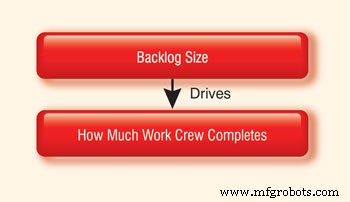
This figure displays a traditional driver of productivity.
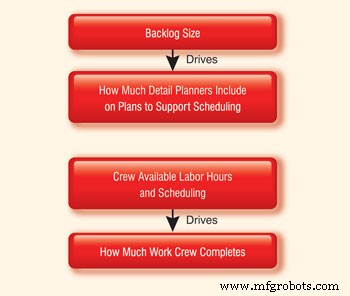
These last two figures show productivity driven by planning and scheduling.
A strict numeric metric might miss why planners exist: to enhance crew productivity. Their real role is to keep the unplanned backlog under control by balancing detail with volume.
In practice, planners vary widely. Some can keep ahead of 10 technicians; others manage up to 60. All are effective when matched appropriately to the crew size.
While this discussion doesn’t yield a definitive “right” number of planning hours, it offers a framework for thinking about planner workload and its impact on overall maintenance performance.
Doc Palmer is the author of the Maintenance Planning and Scheduling Handbook. A CMRP with nearly 25 years of hands‑on experience in the maintenance department of a major electric utility, he oversaw the overhaul of the utility’s maintenance planning organization from 1990 to 1994, leading to its expansion across all crafts and stations.
Equipment Maintenance and Repair
- Data‑Driven Prioritization of Maintenance Work Orders
- Operator‑Involved Maintenance: Do the Gains Outweigh the Hidden Costs?
- How Maintenance Planning Elevates Technicians, Supervisors, and Plant Productivity
- Effective Maintenance Leadership: Building Processes and Enabling Performance – Part 2
- What Makes a Great Maintenance Planner: Key Skills & Impact on Workforce Efficiency
- Constructing a Structured Backlog to Optimize Maintenance Scheduling
- Centralized vs. Decentralized Maintenance: Planning & Scheduling Insights
- Enhancing Plant Reliability Through Collaborative Operations and Maintenance
- Can All Maintenance Work Be Planned? A Proven Approach to Efficiency
- Strategic Maintenance Planning: Optimize Work Orders for Safety & Cost Savings