



BMW Spartanburg Plant Sets Global Benchmark with World‑Class OEE and Innovative Landfill‑Gas Energy Use
The global chairman of the board is a fervent advocate of robust plant maintenance, a philosophy that permeates every level of BMW Manufacturing’s Spartanburg, South Carolina facility.
Production, engineering and logistics staff frequently remark with a straight face that “I don’t remember any downtime in 2006” and that “the equipment isn’t a stumbling block for us.” These statements are not idle boast; they reflect real, measurable performance.
Targets for overall equipment effectiveness (OEE) exceed 90 percent, with the industry benchmark for world‑class plants set at 85 percent. Plant leaders affirm that these goals are not only attainable but have already been surpassed. Uptime in mission‑critical areas nears 100 percent.
Maintenance strategy is a long‑term, forward‑looking discipline, covering the past, present and up to seven years into the future. Reactive work comprises less than 5 percent of the overall workload. This level of reliability might sound ambitious, but it is the current reality at BMW Manufacturing’s Spartanburg plant.
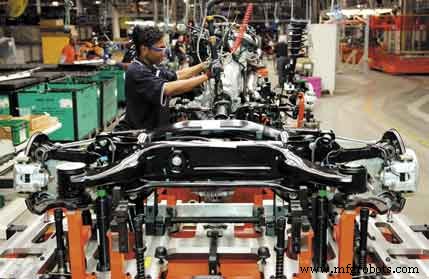
The BMW Manufacturing plant in Spartanburg, S.C., spans 4.73 million square feet and employs 4,500 workers.
High performance is the norm. Duncan Seaman, Facilities/Energy manager, describes the 14‑year‑old facility as “in super condition.” Located off I‑85 and a few miles from Greenville‑Spartanburg International Airport, the plant is the only North American site of the Munich‑based BMW Group and the sole source for the X5 sports activity vehicle, Z4 roadster, Z4 coupe, M roadster and M coupe.
More than 2,000 high‑end, technologically advanced, customization‑heavy vehicles are built here each week. BMW’s culture of performance extends from the road to the factory floor.
“We take a more stringent approach to reliability,” says Seaman. Phil Volino, Assembly Shop maintenance assistant manager, echoes that sentiment: “In whatever we do and whatever we track, we aim for 100 percent.” Herman Adams, Body Shop maintenance planning specialist, adds, “People who buy a BMW pay for engineering and quality, not for plant breakdowns.”
To reach maintenance excellence, BMW focuses on two levels:
- Macro level: Ensuring equipment can meet operational demands.
- Micro level: Planning all maintenance and scheduling it proactively, rather than reacting to downtime.
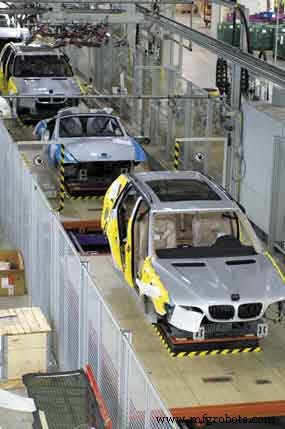
The site manufactures BMW’s X5 sports activity vehicle, Z4 roadster, M roadster, Z4 coupe and M coupe.
Reliability culture is uniquely German in its emphasis on planning. Communications manager Bunny Richardson notes, “If you spent a day here, you’d be amazed by how often the word ‘planning’ is used.” German leadership, exemplified by Dr. Norbert Reithofer, former chairman of the BMW Group, has long championed maintenance excellence, a tradition that dates back to his tenure as maintenance planner at BMW’s Munich plant in the 1980s.
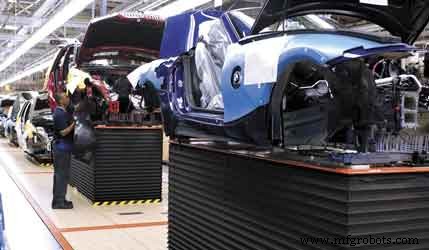
In late 2005 and early 2006, the plant transitioned from a two‑line to a one‑line assembly system, consolidating all SAV, roadster and coupe models on a single line.
Reithofer, who became chairman on September 1, 2006, previously served as Spartanburg plant president (1997‑2000). Volino says, “Dr. Reithofer’s passion for maintenance is reflected in the plant’s continued focus on this area.” Adams adds, “High‑level leadership understands that the profit center is the line’s performance, not an office.”
Local management empowers technicians, known as equipment service associates (ESAs), to shape maintenance practices to fit the plant’s unique needs.

Sherry McCraw led the successful conversion to a flexible, one‑line assembly line.
The 4.7 million‑square‑foot plant is divided into four units—Body Shop, Assembly, Paint Shop, and Facilities/Energy—each adopting a distinct maintenance approach.
- Body Shop: An integrated model where ESAs work alongside production and quality teams under the shop supervisor. The 106 ESAs work 10‑hour base shifts with two hours of mandatory overtime, exiting early if the line runs at peak performance after hour 10. ESAs are multi‑craft technicians handling preventive, predictive and corrective tasks, with predictive maintenance—infrared thermography, motor current monitoring—taking the forefront for the 477 robots that dominate the shop.
- Assembly: A more traditional structure with 65 multi‑craft ESAs reporting to assembly/installations engineering manager B.J. Watkins. Shifts mirror the Body Shop, but preventive maintenance constitutes the majority of in‑shift work. With only nine robots, 75 percent of PMs are completed while the line is running.
- Facilities/Energy: With 22 staff, including 18 ESAs, this unit relies heavily on contractors, performing 30 percent of the workload. Seaman notes, “We run lean and focus on equipment management—tasks that can be outsourced, such as changing air filters.”
While each unit operates independently, they collaborate through an eight‑person Plant Maintenance Steering Committee—representatives from each unit—providing oversight of maintenance and reliability (M&R) initiatives.

Dara Leadford, Briggs Hamilton and Cleve Beaufort discuss engineering projects related to facilities and energy.
BMW Manufacturing’s digital assets, hosted at www.bmwusfactory.com, feature nearly three dozen videos and slide shows covering plant history, layout and performance. Highlights include a time‑lapse of the one‑line conversion and a documentary on the Landfill Gas‑to‑Energy project, accessible via the site’s Media Center and Community sections.
Numbers speak loudly. Maintenance is a company‑wide responsibility—“Everybody owns maintenance, reliability, uptime and overall equipment effectiveness. It’s a team game,” says Adams. Key metrics include OEE, uptime, and reactive work percentage. OEE is calculated as Equipment Availability (EA) × Equipment Efficiency (EE) × Quality Rate (QR).
- Equipment Availability: Planned runtime minus downtime divided by planned runtime.
- Equipment Efficiency: Units produced times cycle time divided by planned runtime.
- Quality Rate: Total units minus defect units divided by total units.
Volino notes that BMW uses a unit‑goal‑based speed rather than maximum speed for calculations. Assembly’s departmental OEE target is ~93 percent, with EA at 98.5 percent and EE at 98 percent. Facilities/Energy targets 90 percent but averaged 93 percent in 2006. Uptime for critical equipment routinely exceeds 90 percent, with Assembly reporting as high as 99.4 percent and warehouse equipment achieving 99.99 percent.
Additional achievements include:
- Reactive work <5 percent of total.
- Plan adherence 88 percent, with a target of 90 percent.
Sherry McCraw emphasizes, “We don’t have many equipment problems. The equipment isn’t a stumbling block for us.”
Key enablers of this performance include:
- Root Cause Analysis: Five‑why investigations are standard for breakdowns >10 minutes, ensuring true causes are addressed.
- Lean Six Sigma: Four master black belts, 18 black belts and 20+ green belts run data‑driven projects across the plant.
- Standardization: Transition to Siemens PLCs across the plant aligns equipment globally, simplifying support and increasing uptime.
- Design for Maintainability: The one‑line conversion moved control cabinets upstairs for easier access and reduced interference from production.
- Condition Monitoring: Sensors now track critical components, feeding data into the plant’s CMMS and SAP systems for proactive work orders.
- Total Productive Maintenance (TPM): TPM activities vary by unit, fostering ownership among production workers and contractors.
- Continuous Change: A seven‑year cycle of new car lines and equipment keeps maintenance processes refreshed and aligned with cutting‑edge technology.
- Long‑Term Planning: Excel‑based seven‑year maintenance plans identify major and minor activities, ensuring asset sustainability.
The plant’s environmental leadership is equally impressive. The Landfill Gas‑to‑Energy project, initiated in 1999 after discussions with the EPA’s Landfill Methane Outreach Program, captures methane from the nearby Palmetto Landfill via a 9.5‑mile pipeline and powers turbine generators on site.
This project delivers three core benefits:
- Reduces greenhouse gas emissions, equating to the removal of 61,000 U.S. vehicles per year.
- Converts methane to electricity and heat for the plant.
- Generates significant cost savings.
Today, 63 percent of the plant’s total energy comes from landfill gas, making BMW the first auto company worldwide to power its paint shop with green energy.
For more on landfill gas and its applications, visit www.epa.gov/lmop.
BMW Spartanburg’s journey illustrates that excellence is a continuous process. Five years ago, CMMS utilization was minimal; today, SAP tracks preventive maintenance, predictive maintenance is routine, and OEE goals are met or exceeded. Yet leadership acknowledges that change is essential: “If you aren’t changing, you are falling behind,” says Bill Ramsey, warehouse logistics manager.
Sherry McCraw concludes, “The bar has been raised. Our customers raised it. Now, we have to perform at that higher level.” In the words of BMW’s iconic slogan, the “ultimate driving machine” begins with the ultimate reliability machine.
Plant Highlights
- Plant: BMW Manufacturing, Spartanburg, S.C. (first production: September 1994)
- Size: 4.73 million square feet; 1,150 acres
- Employment: 4,500 non‑union workers, 200+ in maintenance
- Products: X5 SAV, Z4 roadster, M roadster, Z4 coupe, M coupe
- Capacity: ~2,000 units/week; 104,632 units in 2006 (65,876 X5, 29,331 Z4, 9,425 coupes)
- Milestones: 1 millionth vehicle on February 28, 2006; first car: 318i on September 8, 1994
- Energy Innovation: Landfill gas fuels 63 percent of plant energy; reduces CO₂ equivalent to 61,000 vehicles per year
Equipment Maintenance and Repair
- Launching Reliable Plant: Your Trusted Guide to Maintenance Excellence
- Celebrating Excellence: Reliable Plant’s First‑Year Awards and Milestones
- BMW Spartanburg Plant Sets Global Benchmark with World‑Class OEE and Innovative Landfill‑Gas Energy Use
- Marinette Plant Sets New Standards for Reliability and OEE Excellence
- Remembering Nate Gooden: A Legacy of Leadership and Innovation
- Bridging Plant Leaders: My Role as a Matchmaker in Industrial Excellence
- 6 Proven Techniques to Error‑Proof Your Plant Operations
- Defining World‑Class Maintenance: Metrics, Mindset, and Continuous Improvement
- CSP Expands Huntington, IN Plant with New $33.5M Composite Pickup Box Facility
- Plant Maintenance Demystified: Best Practices for Modern Industries