



Case Study: Honda Lincoln Plant – Engineering Excellence & Reliability
The Honda manufacturing complex in Lincoln, Alabama, is engineered with the precision and cleanliness one would expect from a medical facility.
The thoughtfully designed grounds, featuring lush green lawns, vibrant foliage, and a covered circular driveway, create the impression of entering a high‑end office complex rather than a sprawling 4,500‑employee plant.
During a recent tour covering roughly 25% of the plant's 3.1‑million‑square‑foot footprint, the only foreign object debris observed outside a production area was a single screw on the floor.
The sense of order mirrors that of a surgeon’s cart: every tool has a designated place, and everything is precisely where it belongs.
White uniforms and lab‑coat‑style jackets, worn by all Honda employees, reinforce a culture of uniformity and professionalism.
Workers patrol the floor with clipboards, jotting notes and recording data to populate extensive performance dashboards.
Superior operations, proactive maintenance, and a focus on flexibility, wellness, and reliability define Honda’s manufacturing ethos.
Healthy manufacturing is the cornerstone of Honda’s philosophy.
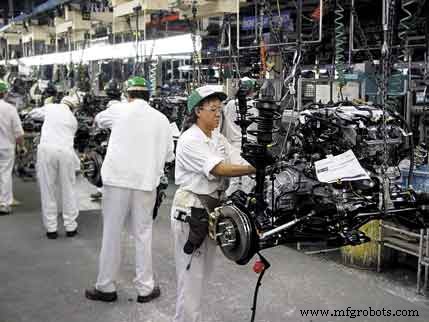
Drivetrain components are added to 3.5‑liter V‑6 engines at the Honda plant in Lincoln, Alabama.
Partnerships in Reliability
The Lincoln plant earns high praise for its maintenance and reliability program.
Internal and external teams collaborate to keep the environment productive and free of disruptions.
The operations split into production maintenance—responsible for the capital assets that directly build vehicles—and plant services—ensuring the performance of all other fixed assets.
"I’m responsible for new construction, existing buildings, utilities distribution, environmental and general services, which takes into account janitorial, uniforms, pool cars, security and maintaining areas such as the cafeteria, locker rooms and credit union," says Plant Services Division Manager Mark LaRue.
Plant services comprises 12 Honda employees and roughly 70 contract associates. BE&K Inc. provides 45 of those contractors, while other firms handle water treatment, grounds care, and more.
"This was new for Honda…" says LaRue. "This was the first site that outsourced its facilities maintenance. It’s kind of the grand experiment. One of the things that we learned beforehand and also after the fact was that it’s very important to keep pushing these different groups together and keep the emphasis on teamwork. Teamwork can’t be a buzzword or catchphrase. We have to really, truly be partners. We are partners to the extent that BE&K is integral to our operations on monthly reporting. When we get into the budgeting cycle of the year, they are working to develop budgets."
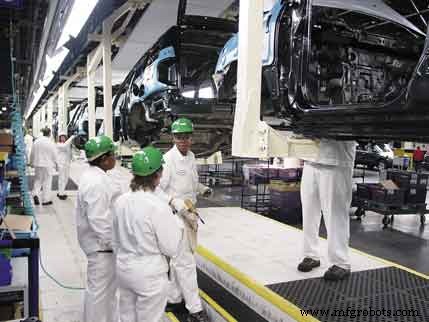
Underbody wiring and tubing is added to Honda Pilot sport utility vehicles at the plant.
The two departments operate on an integrated operate‑and‑maintain model.
"The person who is splitting the air compressor is the same person who is operating the air compressor. We want these people to have that touch‑feel to operations and not be disconnected," says LaRue.
That synergy, combined with the uniform code, makes it difficult to distinguish Honda plant‑service staff from contractors.
That is intentional, says LaRue.
"In facilities and in maintenance for this plant as a whole, we have a motto: ‘We want to remove the distractions that take the focus away from building a car,’" he says. "Fundamentally, we are here to make cars. We make money by making cars. Facilities does not. In the scheme of things, you have people who make cars and people who don’t. If you don’t make cars, you are a support department. So, we take our support very seriously. We want to create a productive environment."
Production maintenance drives uptime, reliability, and overall equipment effectiveness, using preventive and predictive techniques to prevent downtime.
Plant services ensures a productive environment by delivering reliable utilities, comfortable workspaces, and clean shared areas.
"You must have reliable utilities. You must have a comfortable workspace. You must have clean, functional common areas," says LaRue. "If an assembly line worker comes into work and it’s cold when he hits the line, he’s going to be thinking about how cold it is as opposed to how he’s doing his process to make a car. We think we have a direct connection to the vehicle."
It begins before employees even step inside.
"When the associates drive into work, we want them to feel like they are coming to a nice place to work," he says. "The landscaping – that’s very deliberate. It’s not for public image; it’s primarily for our associates. They come in. It looks nice and it’s clean. That really sets the tone for how we want to be making a vehicle. We remove the distractions."
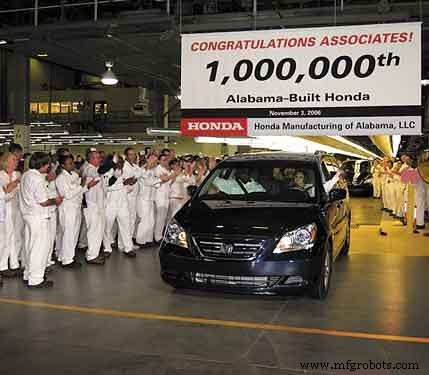
Associates celebrate the 1 millionth Honda vehicle and V‑6 engine built in Alabama.
Analysis Wheel
Breakdowns distract teams; Honda’s Lincoln site mitigates this by employing a problem‑analysis wheel that is activated when an unexpected failure occurs.
The first spoke, Problem Analysis, involves a detailed review of the incident.
"We get into some pretty detailed problem analysis when we have a failure," says LaRue. "For instance, the chillers in Line 1 shut down simultaneously one day in July. Losing your air conditioning in July in Alabama is not fun. It also factors into the painting process because we supply water there at a certain temperature. If it goes up a few degrees, they can’t keep the proper environment and have to shut down."
The next spoke, Emergency Response, evaluates the response time; in the July chiller outage, it took two hours to bring the units back online in manual mode.
The subsequent spokes, True Root Cause and PM Analysis, determine whether the underlying issue is mechanical, software, or procedural. In this case, the root cause was a firmware problem in the PLC, not a process error. No preventive‑maintenance changes were needed, but the analysis informs future updates.
Information Sharing disseminates lessons across Honda’s global network, ensuring that costly problems are avoided elsewhere.
"Problems cost you money. They are expensive. If you pay for that lesson in one location, you don’t want to pay for it in other locations. You need to get the word out," LaRue emphasizes.
Clean and Green
The Honda plant in Lincoln, Ala., is clean and green. Since it began production in 2001, it has been a zero‑landfill site. Each year, the site sends zero pounds of trash to the landfill.
"We have a very extensive recycling program," says plant services manager Mark LaRue. "That which isn’t recycled goes into waste energy. We also look to conserve water and energy. We have some fantastic results with our air emissions. Even things such as the resin sand for low‑pressure die casting are recycled and used."
Detect and Diagnose
Honda’s plant combines advanced monitoring tools with human expertise to preempt failures.
While predictive technologies flag potential issues, experienced technicians perform physical inspections to catch subtle cues like odors or leaks.
During a recent walk‑around, an ozone odor from a switching device was detected and repaired before production was affected.
Cleanliness is a prerequisite for early detection: wiped‑down equipment, clear aisles, and minimal clutter enable quick identification of leaks.
Data is the backbone of this approach.
"Honda is very much a data‑driven organization," says LaRue. "All of the presidents of Honda have been engineers. We are very much an engineering company. So consequently, when you get a bunch of engineers together, they naturally want to look at data."
Color‑coded dashboards track safety, environment, quality, delivery, cost, training, and morale—green for good, yellow for caution, red for issues.
Deviations are identified swiftly and shared with Honda sites worldwide.
Just the Facts
Plant: Honda Manufacturing of Alabama in Lincoln, Ala. The site, which began producing vehicles in November 2001, is located 40 miles east of Birmingham.
Plant size: 3.1 million square feet.
Site size: 1,350 acres.
Plant employment: 4,500 employees.
Products: Honda Odyssey minivan, Honda Pilot SUV and V‑6 engines. The plant has an annual production capacity of 300,000 vehicles and V‑6 engines.
Operations: Stamping, welding, painting, plastic injection molding, casting, machining, assembly and subassembly, engine assembly, testing, and quality assurance.
FYI: On November 3, the plant marked the production of its 1 millionth Honda vehicle and engine.
The Right Attitude
Soichiro Honda famously said, "Superior products do not come from a workplace marred by disorder and dirt."
With diagnostic rigor and surgical precision, the maintenance and plant‑services teams eliminate clutter and distractions, creating a productive, efficient, and reliable environment.
Healthy manufacturing—this is the essence of Honda.
Equipment Maintenance and Repair
- Eli Lilly BHI Plant: A Reliability Success Story
- Unlocking the True Value of a Plant Acquisition
- Rebuilding Reliability at Century Aluminum’s Ravenswood Smelter
- High-Performance Maintenance at CCM Tecate: A Proven TPM Success Story
- Predictive Maintenance Case Study: Real-World Vibration, Infrared, Oil, and Motor Current Analysis
- Why Standing Work Orders Streamline Maintenance Management
- Mastering Time Studies on the Production Floor: A Practical Guide
- Diagnosing a Persistent Gearbox Noise: Lessons from a Refurbished Unit
- Case Study: How Small Charmilles Components Led to Major Issues—and How We Fixed Them
- Case Study: Enhancing Additive Manufacturing Efficiency with RoboDK