



Why Life‑Cycle Cost Analysis Delivers Tangible ROI
Industrial leaders often debate the merits of life‑cycle cost (LCC) analysis as a strategy for reducing total ownership expenses while enhancing asset performance. Yet, few organizations have adopted a systematic, sustained LCC program.
The consensus is clear: integrating LCC principles improves long‑term asset value. The challenge lies in the fact that project engineers are rewarded on initial budget and schedule metrics, not on LCC outcomes. This creates a natural bias toward minimizing upfront spend, even when a modest increase can prevent costly downstream surprises.
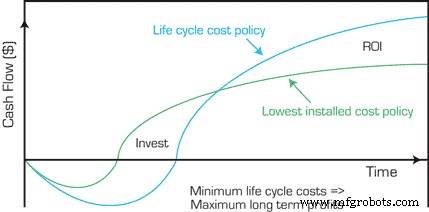
Figure 1. Life cycle cost and cash flow.
Figure 1 illustrates the core LCC concept: a slightly higher initial investment and a brief extension of the project schedule can generate long‑term returns that far outweigh the immediate cost.
Determining the payback period is challenging, which often deters project teams from embracing LCC. To clarify, consider the data from a large chemical manufacturer:
In the first two years after plant startup, maintenance costs were 3% higher than the asset’s replacement value. This excess reflected two primary causes:
- Components that did not meet functional requirements.
- Early‑life failures resulting from sub‑optimal installation and startup.
These maintenance overruns excluded any production losses, which are typically several times larger (often five times the maintenance cost) depending on the product’s gross margin.
Improved design and installation practices can mitigate these risks, reducing maintenance, production downtime, and safety incidents—all of which drive up total cost of ownership.
Figure 3 from a Fortune 500 manufacturer highlights startup production losses. In Scenario 1, the plant operated at 70% of design capacity for six months and reached full capacity after an additional year. Scenario 2 assumes a more robust design that enables 100% capacity within the first six months.
The value of the lost production is the area under the two curves. For Scenario 2, the cumulative capacity is 125% of a year’s output; for Scenario 1, it is 102.5%. The difference—22.5% of annual production—represents a tangible revenue loss.
To illustrate the economic impact, consider the following example:
- Initial capital cost: $100 million
- Annual production value: $100 million
- Annual gross profit: $30 million
- Maintenance costs: $6 million (Yr 1), $5 million (Yr 2), $4 million (Yr 3)
Scenario 1 incurs an additional $3 million in maintenance and loses 22.5% of a year’s gross profit ($6.75 million). Total loss: $9.75 million. If an extra $10 million were invested upfront to eliminate the issues that caused the higher maintenance and production losses, the return would be realized within the first 18 months of operation.
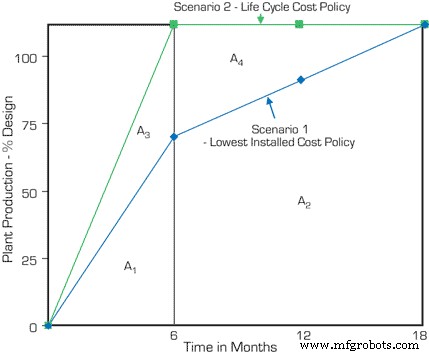
Figure 3. Startup losses – two scenarios.
Summary
Develop custom scenarios for your organization and quantify the benefits of LCC. A modest 10% increase in the capital budget—focused on eliminating design flaws—can be recouped in roughly 18 months, while also reducing long‑term production, cost, and safety risks. Apply this approach to the next five major projects to validate its effectiveness over a five‑year horizon.
Ron Moore, managing partner of The RM Group, is the author of “Making Common Sense Common Practice: Models for Manufacturing Excellence” (third edition) and “Selecting the Right Manufacturing Improvement Tools – What Tool? When?”, both published by Elsevier Books, Butterworth‑Heinemann. Contact: 865‑675‑7647 or RonsRMGp@aol.com.
Equipment Maintenance and Repair
- DDS Delivers Cost Savings and Performance in Mission‑Critical Systems
- Building a Strong Business Case for MES in Additive Manufacturing
- Why an Additive Manufacturing Execution System Is Essential for Spare Parts Production
- Why Hollow‑Shaft Torque Motors Are Transforming Machine Drives
- Why Standing Work Orders Streamline Maintenance Management
- Strategically Position Your Business to Capitalize on the Upcoming Economic Upswing
- Revolutionizing Mass Production: The Key Advantages of 3D Printing
- How to Choose the Perfect Power Generator for Your Business
- Life Cycle Cost Analysis: A Comprehensive Guide
- How to Calculate the Total Life‑Cycle Cost of Your Compressor System