



Mastering Time Studies on the Production Floor: A Practical Guide

From modern armed forces to Silicon Valley start‑ups, many leaders turn to Frederick Winslow Taylor’s principles of scientific management to cut waste and boost performance. One cornerstone of that approach is the time study, a method that pinpoints the exact duration of every task on the plant floor.
Time and motion studies are not casual experiments—they demand careful planning and disciplined execution. This article outlines a step‑by‑step process and highlights key pitfalls to avoid so you can achieve reliable results on the first try.
What Is a Time Study?
The British Standards Institution (BSI) defines a time study as: “Observing, recording, and rating of human work to establish the times required by a qualified worker to perform specified work under stated conditions at a defined rate of working.”
In practice, a time study examines every activity that contributes to production—whether it involves manual labor, machine operation, or real‑time decision making. It is most effective for predictable, repetitive tasks common in manufacturing settings.
By measuring the duration of a task performed by multiple workers, you calculate the standard time, which represents the average time a well‑trained operator would need to complete that task.
Observers typically use a stopwatch and clipboard for basic studies, but modern plants can leverage video, computer vision, and specialized software for greater precision.
Why Conduct a Time Study?
When executed correctly, a time study offers a granular view of plant efficiency. Standard time is an essential metric for managers seeking to:
- Plan realistic production schedules
- Allocate manpower and equipment optimally
- Benchmark against industry standards
- Balance workloads across employees
- Set target times and incentive wages
- Eliminate unnecessary motions and reduce worker effort
- Improve maintenance planning for routine tasks
Beyond cost savings, time studies enhance worker welfare by identifying unsafe or inefficient movements, enabling safer, more ergonomic workspaces.
Essential Requirements for a Successful Study
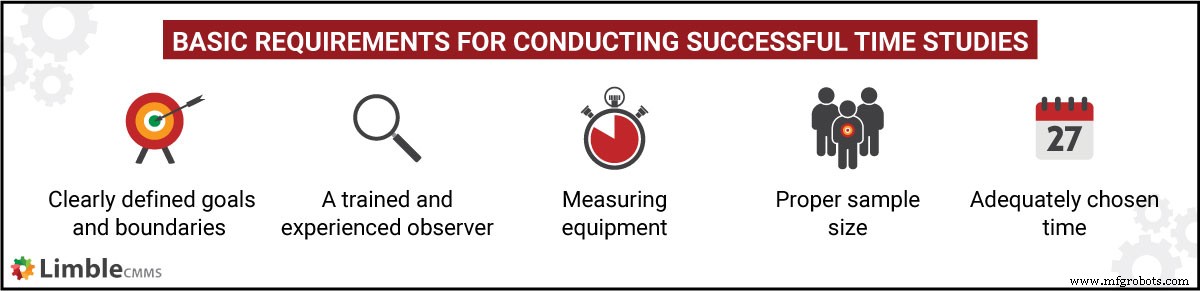
Regardless of industry, effective time studies share five core prerequisites:
1. Clearly Defined Goals and Boundaries
Specify objectives—speeding up production, eliminating waste, or both—and select the processes to focus on. Verify if existing standard times are available for comparison.
2. Trained and Experienced Observer
Prefer industrial engineers with workplace optimization certification. A skilled observer can maintain a neutral, unobtrusive position to avoid influencing worker behavior.
3. Appropriate Equipment
Basic tools include a stopwatch and clipboard, but modern approaches use CCTV, sensors, or dedicated software to capture time data remotely, mitigating the Hawthorne effect.
4. Representative Sample Size
Choose a balanced group of average‑performance, well‑trained workers rather than the top performers, to ensure realistic standard times.
5. Suitable Observation Period
Record during typical production cycles—not peak demand periods—to reduce error margin and capture normal workflow conditions.
Step‑by‑Step Process
- Select Tasks: Align with study goals and production priorities.
- Analyze Tasks: Compare against industry standards; if none exist, rely on expert judgment to set a baseline.
- Choose Workers: Use a representative sample of trained operators.
- Determine Sample Size: Balance data accuracy with time and budget constraints.
- Communicate to Staff: Explain purpose and reassure that the study aims to improve efficiency, not performance evaluations.
- Observe & Record: Use continuous, snap‑back, or accumulated timing methods; advanced tools can automate data capture.
- Calculate Standard Time: Apply the formulas detailed below.
With the results, the company can draw actionable insights aligned with its initial objectives.
Calculating Standard Time
The calculation follows three stages:
- Average Time: Mean of recorded times after excluding outliers.
- Normal Time: Adjusted for worker performance using rating factors.
- Standard Time: Normal time modified by allowances for real‑world conditions.
1. Average Time
Compute the arithmetic mean of all observed times, discarding any abnormal values.
2. Rating Factors
Rate each worker’s performance relative to the ideal 100% using systems such as:
- Pace/Speed Rating
- Westinghouse System
- Objective Rating
- Synthetic Rating
Apply the rating factor (e.g., 90% or 120%) to the average time to estimate the normal time.
3. Normal Time
Normal Time = Average Time × (Rating Factor ÷ 100)
Example image: 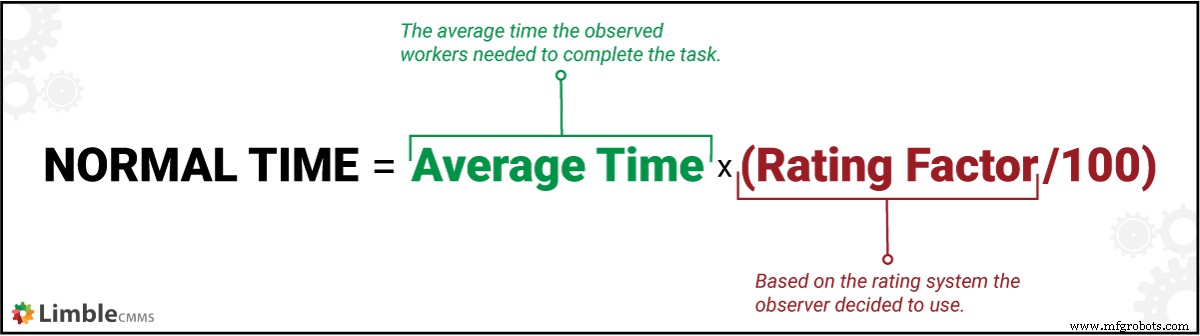
4. Allowances
Adjust for unavoidable disruptions using the following categories, expressed as percentages:
- Relaxation Allowance: Personal breaks, fatigue, environmental factors.
- Interference Allowance: Downtime due to simultaneous machine use.
- Process Allowance: Scheduled downtime, machine faults, power interruptions.
- Contingency Allowance: Unexpected breaks or emergency maintenance.
- Special Allowance: Startup, shutdown, cleaning, or changeover activities.
5. Standard Time
Standard Time = Normal Time ÷ (1 – Allowance %)
Example image: 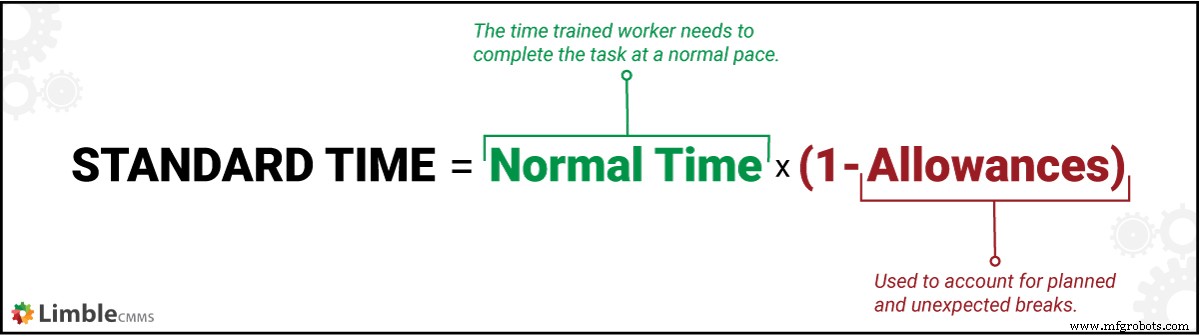
Manufacturing Time Study Example
Consider a new plant producing backplates for car brake pads. Workers average 33 minutes per batch. The industry benchmark is 30 minutes.
Observations reveal workers run 10% slower than the benchmark, so the speed rating is set at 90%.
Allowances applied: relaxation 7%, interference 5%, special 8% (total 20%).
- Average Time: 33 min
- Speed Rating: 90%
- Allowances: 20%
Normal Time = 33 min × 0.90 = 29.7 min (≈30 min).
Standard Time = 30 min ÷ (1 – 0.20) = 37.5 min.
The study highlights a 4.5‑minute gap between observed and standard times, indicating room for process improvements and allowance optimization. For example, reducing interference or special allowances—while respecting employee rights—can boost productivity.
Equipment failure is a common source of interruption. Deploying a modern CMMS fosters proactive maintenance and reduces downtime.
Continuous Improvement: The Key to Long‑Term Success
Eliminating waste requires lean maintenance and a culture of continuous improvement. Time studies provide the granular data needed to benchmark, identify bottlenecks, and validate the impact of changes. With modern sensors and analytics, you can automate data capture and focus on strategic decisions. Yet, even a basic stopwatch and clipboard can yield valuable insights if applied rigorously.
Equipment Maintenance and Repair
- How COVID‑19 is Reshaping Manufacturing: Production, Demand, and Supply Chain Impacts
- How the Industrial Internet of Things is Revolutionizing Manufacturing
- Bridging the Gap: How Maintenance and Production Can Collaborate for Factory Success
- Case Study: Honda Lincoln Plant – Engineering Excellence & Reliability
- Wrench Time: Definition, Importance, and Measurement
- Boost Shop Floor Productivity: Proven Strategies to Maximize Employee Performance
- Cutting Automotive Production Costs: Proven Strategies for OEMs & Tier Suppliers
- Optimizing Production Floor Efficiency with Cloud Technology
- Master Bottleneck Analysis: Identify, Evaluate, and Resolve Production Constraints
- 4 Ways to Improve Plant Maintenance During Low Production Periods