



Case Study: ABB Drives Upgrade Elevates Slitter‑Rewinder Performance at a Major Paper Mill
The United States, according to the Federal Network for Sustainability, consumes roughly 8 million tons of office paper each year—enough to build a 20‑foot‑high wall stretching 6,815 miles. To keep pace with this demand, paper mills relentlessly pursue efficiency and quality improvements. Among the many machines involved in papermaking, the slitter‑rewinder is indispensable.
A slitter‑rewinder unwinds massive rolls from the main papermaking line, slices them into smaller sections, and rewinds them into manageable rolls for distribution. As a final production step, any fault in this machine can halt the entire mill.
Comprising multiple motors and control units, the slitter‑rewinder is one of the most sophisticated pieces of equipment in a mill. Central to its operation is tension control, which dictates the quality of the paper rolls. Consistent forces must be applied throughout the process to ensure flawless web tracking, precise slitting, and proper roll density profiles.
Beyond nip control, the roll’s quality hinges on drive performance. The winder must run as a coordinated system, delivering tight speed and torque control through continuous stop‑to‑full‑speed and deceleration cycles. Minor inaccuracies can cause sheet breaks, rough edges, telescoping, offsets, or tie‑ups, resulting in downtime, rejected rolls, and lost profit.
Objective: Continuous High‑Speed Production
To boost productivity and efficiency, a leading paper mill in the southeastern United States opted to rebuild its slitter‑rewinder and integrate the latest technology. The upgrade aimed to enhance roll quality, increase machine speed to the maximum level, and eliminate costly shutdowns.
The mill partnered with SDS Inc., a U.S.‑based systems integrator specializing in control design for paper and web handling. SDS evaluated the existing system and delivered a cost‑effective solution that leveraged current motors and components, installed ABB’s state‑of‑the‑art ACS800 AC drives alongside the new DCS800 DC drives—the most advanced DC drive of its class—and complemented them with SDS’s Intelli‑Wind, a popular two‑drum winder HMI offering TNT control, recipes, numeric and graphical set‑points, permissives, and diagnostics.
SDS engineers visited the plant multiple times to assess the situation. They identified several issues plaguing the existing slitter‑rewinder.
“It’s imperative to understand every stakeholder’s perspective,” says John Parker, senior sales engineer at SDS. “The maintenance crew raised concerns about component failure and the need for precise temperature control in the drive room to prevent analog drift. Production wanted higher uptime, better roll quality, and modern equipment. Our partnership with ABB enabled us to meet these objectives.”
Outdated Equipment: Inefficient and Costly to Maintain
Both ABB and SDS experts noted that the mill operated with drive systems 25–30 years old—a growing trend among manufacturers. The slitter‑rewinder’s drive system was becoming increasingly expensive to repair, with obsolete components that could no longer be replaced. Analog equipment required constant attention due to drift, and old wiring began to fracture at hinge points. Mechanical assemblies holding thyristor assemblies and fuses were beyond repair, and power modules faced structural integrity issues.
Craig Tierno, senior application engineer at SDS, explained that replacing analog regulators with digital counterparts while keeping the existing power bridge was impractical. The SCRs inside the power modules were no longer dependable, so SDS recommended a full drive and control system upgrade to improve reliability and performance.
“If a DC power module is still within its life cycle, we usually suggest retrofitting it with a new digital, high‑performance front end (DFE) to enhance regulation while keeping the existing SCRs,” Tierno said. “In this case, that wasn’t viable.”
New Technology Synergizes with Drives
During the search for a drive solution, SDS discovered that ABB was developing a new DC drive compatible with its AC products, sharing the same software tools and communication modules. This compatibility made it possible to integrate both DC and AC components seamlessly.
North America still hosts a large installed base of DC motors across a wide horsepower and speed range. These motors can live long with proper maintenance, so customers aren’t typically eager to replace them. Finding a supplier like ABB that continually innovates control technology for these motors gave SDS a clear advantage from the outset.
The retrofit installed four ABB DCS800 drives. The first managed the 500‑horsepower unwind motor that regulates tension for the jumbo parent roll. The second controlled the 50‑horsepower lead‑in roll that transports paper to the slitter. The third and fourth drives handled the 250‑horsepower front and rear drums, which provide machine speed reference and profiling torque to the rewound roll. All DC drives were sized to tolerate 200 % current limit for one minute due to the large rolls and demanding torque.
Two ACS800 AC drives, each rated at 15 HP, powered the rider roll ends, supplying vertical force for acceleration and deceleration torque. Motor frame size was chosen based on horsepower and ventilation style, as the motors are mounted within a moving rider‑roll frame.
New Load Cells for Tension Control
The old load cells on the unwind section were replaced with ABB’s PillowBlock‑style Pressductor transducers (PFTL units). These units were selected for their direct physical compatibility and pre‑calibration, enhancing tension control while cutting installation time and cost.
Compatible Platforms; Retrofit with Existing DC Motors
Integrators found the DCS800 an ideal match for the mill’s engineering and IT staff, who were already familiar with DC drive operation and commissioning. ABB’s complementary ACS800, with a similar look and feel, made transitioning to AC smooth.
“Ensuring the DC drives complemented the AC product on the same platform was critical,” Tierno said. “This synergy enables retrofitters to provide cutting‑edge technology and outstanding regulation at a fraction of the cost of a full power system replacement.”
Master Control via Winder‑Operating Software
In tandem with the drives, SDS installed its iWind winder‑operating software, engineered to optimize roll profile and quality. The software offers automatic stopping, product recipes, numeric and graphical set‑points, permissives, and full diagnostics. The intuitive interface merges control equipment directly with the drive hardware, simplifying troubleshooting and maintenance.
Focused on tension, nip, and torque (TNT), SDS designed an architecture that met the mill’s need for improved roll quality. The automatic stopping feature addressed issues with product length and diameter, while permissive and diagnostic pages gave operators rapid assistance, reducing maintenance calls. The recipe system allowed operations to set up orders quickly and maintain product consistency.
Pre‑Built Elevated Panels Enable Five‑Day Installation
The retrofit leveraged existing construction—a clean, open‑panel design that required minimal control‑room space. Instead of floor‑mounted cabinets, all power modules, circuit breakers, and components were arranged on elevated panels. This approach allowed SDS to pre‑build a separate sub‑panel for each drive, testing the drives individually and collectively before demolition of the old equipment. Thorough testing of communications, application software, and drive functionality preceded installation and commissioning.
Setup and commissioning proceeded smoothly. SDS engineers spent about four weeks engineering schematics, creating drive and controller software, and building the panels. Following a two‑week testing phase, the team installed the new equipment within the five‑day contingency required by the mill. Engineers remained on site for several days after start‑up to ensure a seamless transition for plant operators.
Winning Combination Enables Optimal Uptime
Since installing the DCS800 and ACS800 drives, complemented by iWind software, the mill has achieved its goals: higher production, top‑speed efficiency, superior roll quality, reduced maintenance, and minimal shutdowns. They have virtually eliminated the previous shutdowns caused by component malfunctions.
“We’re pleased with ABB’s products and support, and plan to continue using ABB for future projects,” Parker said. “Currently, we have eight paper‑manufacturing projects underway, for which we recommend ABB’s ACS800, DCR‑ or DCS‑800 for various applications.”
Tierno added, “Our relationship with ABB and the team in New Berlin has been highly rewarding. They’ve provided excellent product delivery and training on the new DCS800.”
ABB products give SDS the resources and flexibility needed to satisfy each customer’s specific needs and budget.
ABB and SDS have another reason to celebrate: this paper mill installation marks the first time a DCS800 has been integrated into a complete system package in the United States. With the DCS800’s near‑unlimited scalability, the team looks forward to supplying drives and software to customers for many years to come.
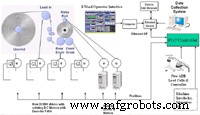
Schematic of DC and AC drive retrofit of slitter‑rewinder at a large southeastern paper mill’s facility.
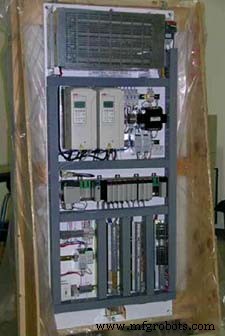
Master Panel, which contains the ABB ACS800 Rider Roll AC Drives and the Master Controller.
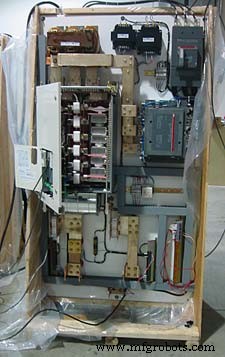
Unwind Drive – the new ABB DCS800 during system testing.
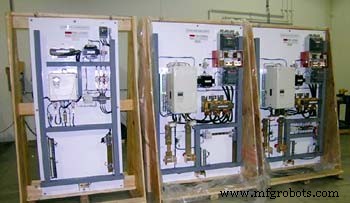
From left to right: Paper Roll, Front Drum, Rear Drum panels with ABB DCS800 DC Drives. Pre‑building the panels made it possible to install the entire retrofit of the slitter‑rewinder within five days.
To learn more about this subject, visit www.abb.us/drives or contact Thomas Junger, product line manager, ABB Inc., at 262‑785‑3377 or Thomas.junger@us.abb.com.
Equipment Maintenance and Repair
- Eli Lilly BHI Plant: A Reliability Success Story
- Catalyst Paper Enhances Mill Performance with Ivara Reliability Initiative
- Case Study: Honda Lincoln Plant – Engineering Excellence & Reliability
- Rebuilding Reliability at Century Aluminum’s Ravenswood Smelter
- High-Performance Maintenance at CCM Tecate: A Proven TPM Success Story
- The $10 Million Turbine Repair: Cost Cutting, Best Practices, and Legal Consequences
- Predictive Maintenance Case Study: Real-World Vibration, Infrared, Oil, and Motor Current Analysis
- Myllykoski Paper Mill Boosts OEE by 7% and Cuts Maintenance Costs 10% with ABB Full Service
- Repair vs. Replace: A 10‑Year‑Old Grinder Case Study
- Rapid Response: How We Resolved a Machine Downtime Crisis for a Leading Beauty Manufacturer