



Proactive Condition Monitoring: Root‑Cause Analysis of a 450‑HP Electric Motor Failure
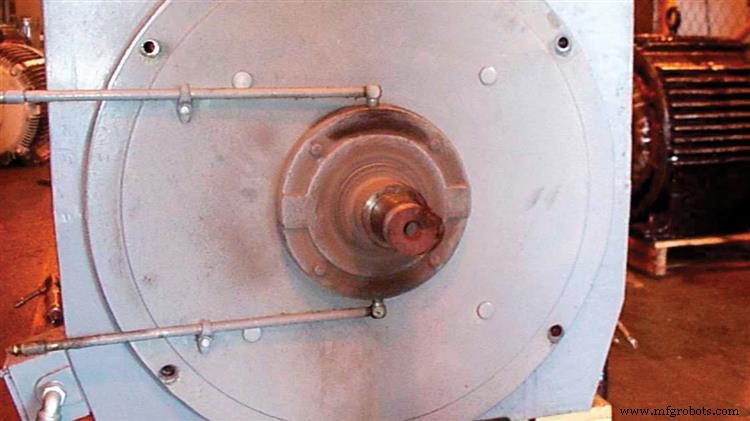
Reliability teams often focus on the technology that detects problems and the cost savings from preventing unplanned outages. Yet we frequently stop at the surface: we fix the physical defect but miss the underlying latent cause. A more proactive approach—tracing a detected issue back to its root cause—yields deeper plant‑wide benefits. The following case study illustrates this philosophy with a 450‑horsepower, 1,200 rpm, 4,160‑volt electric motor (see Photo 1).
During a routine vibration inspection, an analyst observed a sharp rise in vibration from <0.1 in/s to 0.25 in/s (Graph 1). No other machine‑train changes were noted. Spectral analysis of the motor’s outbound bearing revealed a pronounced peak at 7,200 rpm and another at 71× the motor speed (Graph 2).
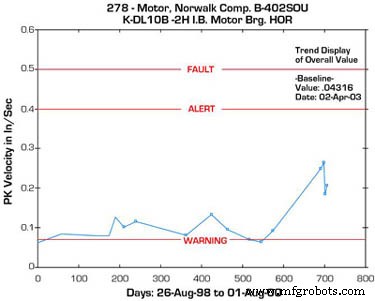
Photo 1. The 450‑HP motor at the Eastman Chemical plant.
The initial hypothesis was an electrical fault, so the motor‑analysis team performed current and power analyses (Graph 3), which returned normal results. A deeper, high‑resolution vibration spectrum was then collected, pinpointing a 7,239 cpm peak that matched the ball‑pass frequency outer race (BPFO) of the in‑board bearing. Given prior experience with this application, the decision was made to replace the motor during an upcoming scheduled maintenance window.
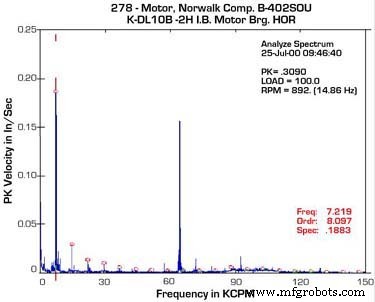
Graph 2. Outbound bearing spectrum.
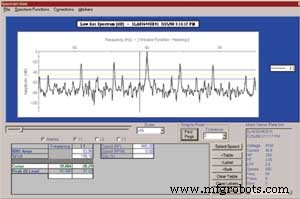
Graph 3. Current analysis readings.
Don’t Stop Here—Seek the Root Cause
Many reliability teams stop after fixing the identified defect, claiming a cost‑saving victory. To truly maximize the value of condition‑monitoring data, we must trace the failure back to its latent cause and apply the learning throughout the plant.
The motor‑analysis team followed the motor to a local repair shop to confirm the bearing issue and uncover the root cause. Upon inspection, the grease fill tube contained Interlube Red Hi‑Lo grease, while the plant specification called for Exxon Polyrex EM (Photo 2). Disassembly revealed that the grease had hardened, and further analysis showed the bearing had been previously rebuilt with Chevron Black Pearl grease. The incompatible greases caused hardening and outer‑race damage.
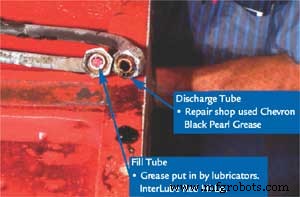
Photo 2. Grease fill and discharge tubes reveal incompatibility.
Additionally, the motor employed a spherical roller bearing in a belt‑drive application, which is not optimal for the radial loads. The decision was made to replace it with a cylindrical roller bearing to increase load capacity.
Don’t Stop Here Either
After correcting the bearing and grease specification, the next step was to investigate how the wrong greases entered the system and whether other motors were affected. Questions arose: How did the wrong grease get into this bearing? Are other motors using non‑specified greases? Why did the repair shop deviate from plant specifications?
Key actions taken based on the root‑cause analysis:
- Communicated findings to the Lubrication Services Group to eliminate the non‑specified grease from all plant equipment. The Interlube Red Hi‑Lo was removed from all lubrication inventories.
- Held a joint meeting with the motor repair shop to discuss the impact of mixing incompatible greases and set future expectations.
- Developed a new repair specification that explicitly includes the correct grease, a change from the previous specification that omitted this detail.
- Established a dedicated motor‑repair evaluation process and team to monitor and address similar failures.
This case demonstrates the tangible benefits of advancing a condition‑monitoring program beyond surface fixes. By proactively identifying latent causes, we can implement plant‑wide solutions that enhance reliability and reduce risk.
Tom Whittemore Jr., Reliability Technologies Group, Eastman Chemical Company – Tennessee Operations.
Equipment Maintenance and Repair
- Eli Lilly BHI Plant: A Reliability Success Story
- Real‑Time Lubrication Monitoring: How Portable FT‑IR Drives Proactive Maintenance
- Rebuilding Reliability at Century Aluminum’s Ravenswood Smelter
- High-Performance Maintenance at CCM Tecate: A Proven TPM Success Story
- Wireless Technology Transforms Condition Monitoring for Industrial Reliability
- Remote Motor Condition Monitoring: Harnessing Internet-Enabled Predictive Analytics
- Avoiding Common Pitfalls in Condition Monitoring for Factory Maintenance Success
- Industry 4.0: Transforming Asset Condition Monitoring for Unmatched Efficiency
- How Machine Condition Monitoring Ensures Continuous Factory Operations
- Predictive Maintenance vs. Condition Monitoring: Which Strategy Drives Business Success?