



Rebuilding Reliability at Century Aluminum’s Ravenswood Smelter
"I read Reliable Plant magazine’s articles on companies that have achieved a high level of excellence and payback in the area of reliability. I’ve had a vision of Century Aluminum someday being on the cover of your magazine…in three or so years. But, perhaps now is the time for a story about a company in great need of reliability improvement—one that realizes the need, has the want‑to and has made the decision to embark on the journey. It’s a crazy idea, but maybe it is time."
- e‑mail from Lowell Pistelli, Century Aluminum’s corporate reliability excellence manager, to Reliable Plant in February 2008
It is time.
Century Aluminum’s Ravenswood smelter offers a compelling example for traditional manufacturing plants that still rely on firefighting to keep equipment running. While a handful of plants—Toyota, DuPont, Eli Lilly—are best‑in‑class in reliability, the majority of U.S. plants face an uphill battle. They must double their effort to achieve half the progress of the best‑in‑class. When the pressure mounts, some plants decide that change is inevitable. That decision marks a critical step in the reliability maturity journey.
“We want to be a reliable plant,” says Scott Carte, the reliability excellence facilitator for the Ravenswood smelting plant. “When you are reliable, you keep accurate data so you can make informed decisions. You avoid unplanned shutdowns, schedule planned maintenance, eliminate failure causes, and earn respect not for reacting but for preventing.”
Progress starts with a candid self‑assessment and the courage to admit problems. “We have to be open about it,” Carte explains. “The first step is admitting that you have a problem.” That admission marks the line in the sand between past and future.
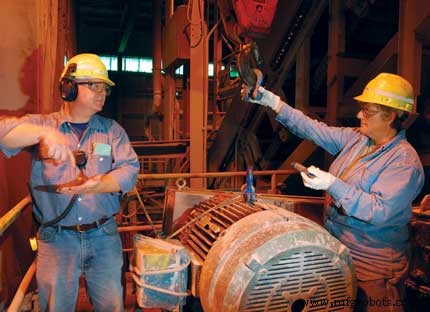
Jeff Carpenter (left) and Linda Sibley prepare to hoist a motor.
Photos by Ed Connors, Ed’s Photogenics
For 50 years the Ravenswood plant operated in a reactive mode: frequent breakdowns, band‑aid repairs, skewed incentives, finger‑pointing, and a lack of data. “Fifty years of being in a reactive mode,” says millwright Paul Roach, who has worked there for a decade. Plant manager Jim Chapman confirms, “What we have done for the past 50 years is work in a breakdown mentality. That is the way they have been trained and that is what the expectation has been.”
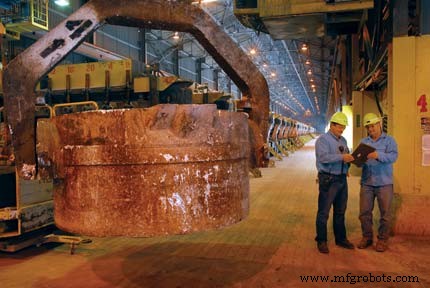
The plant employs 175 maintenance workers, including 150 in skilled trades positions.
Photos by Ed Connors, Ed’s Photogenics
The reasons for this reactive culture are many:
- Size: Ravenswood is a low‑amperage smelter (93 kA) competing against plants that draw three to four times more power. The belief was that hustle could compensate for muscle.
- Quota focus: “We’ve considered it more of a production plant,” says millwright Linda Sibley, 32 years on site. “The philosophy has been, ‘It’s what goes out the door that counts. It’s not how well the machinery is running.’”
- Perceived excellence: “We’re good at reactive maintenance,” says Roach. “When it’s an emergency, we shine.”
- Cost assumptions: “We thought we were saving money by not spending on equipment,” says Carte. The reality is that reactive maintenance increases total cost and limits viability.
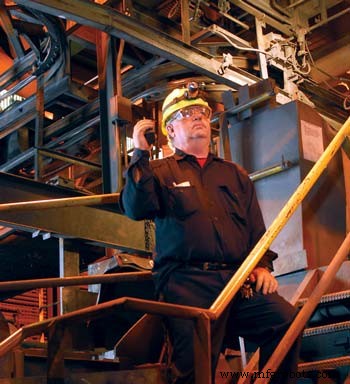
Electrician Clyde Whitney has worked 32 years at the plant.
Cleaning out past practices is like decluttering an attic: you review each box, decide what to keep, discard what’s obsolete, and confront what no longer fits. The process can be cathartic. “It’s OK to question, vent, and admit,” says Jack Payne, a millwright with a decade at the plant. “When your whole day is centered on saving the world, it’s hard to get much accomplished.”
In the last 15 years, maintenance was in “survival mode.” “We started adding planners again three years ago,” says maintenance planner Todd Harrison. “We now have three planners for 150 maintenance tradesmen. We have done some planning, but in such a reactive mode it’s next to impossible to do much planning. It’s all about putting out fires.”
Preventive work was scarce: “You try to stay on the preventive maintenance schedule, but you don’t have a chance to do the PMs because of all the emergencies,” says electrician Clyde Whitney.
Reviewing and rationalizing PMs was also limited. “Probably one‑third of the PMs are no good,” says maintenance manager Jim Doeffinger, who has been at the plant since 1980. “We waste time doing irrelevant PMs. We need time to go through them all.”
“Everybody is tired of the Band‑Aid effect,” says operator John Wilson. “It’s ‘put a Band‑Aid on it, get it up and get it running.’ The biggest need is to have the time, personnel and materials to fix stuff right.”
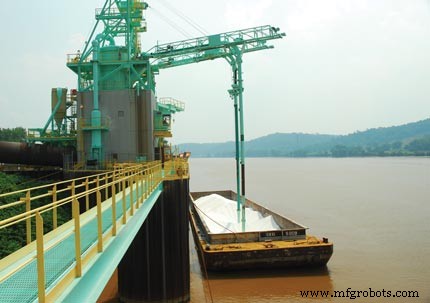
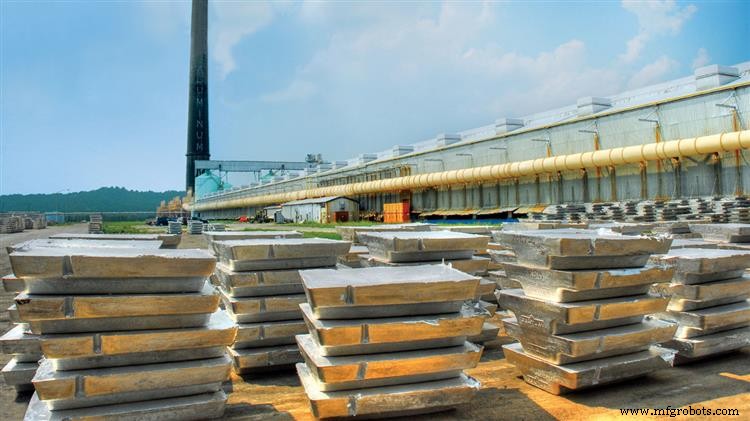
Century Aluminum’s Ravenswood site is situated adjacent to the Ohio River.
Plant managers and skilled tradespeople know the lack of resources—not skill—has been the real barrier. “People want to fix things right,” says Carte. “It frustrates and disappoints them when they have to patch and do repairs that they know won’t be a permanent fix.”
Whitney adds, “The two main ingredients are the manpower and the materials. It’s not a matter of skills or knowledge. It’s a matter of means.”
“We do some root cause, but it’s all after the fact,” says Doeffinger. “We just want to know why it failed. It didn’t change anything.” The gap between knowledge and action is common in traditional plants.
Information is scarce: “We haven’t even put tickets in for some stuff right now, so you don’t know what work is being done by some people,” says Carte. “We hardly have any data, so we don’t have a history of what’s been going on. What failures have we worked on in the past? What’s the root cause? We need that data to predict future failures.”
“The relationship between maintenance and production has been poor— to the point of cussing each other out,” says Carte. The tension is amplified by the harsh smelting environment, but blaming one side only wastes time. “Everyone is to blame. We are all in this together.”
“We’re not doing this for bragging rights,” says Carte. “It’s to give ourselves a future.”
**The Seeds of Success**
Change is most effective when it is a company‑wide initiative. Century Aluminum realized this in summer 2007 when it decided that a plant‑wide reliability program was necessary for the future of Ravenswood and the global aluminum market.
“We tried change in the past with just maintenance, but it only goes so far,” says Carte. “It doesn’t work. You aren’t developing, educating, making people aware on the production side. They aren’t part of it at all. Without joint effort, it’s doomed to fail.”
Plant manager Chapman echoes this: “When you say ‘reliability,’ everyone thinks ‘maintenance.’ We got together and discussed this. Some of our pitfalls in the past have been that production has never been on board.”
Two key personnel moves signaled a shift. In July 2007, Lowell Pistelli—30 years with the company—was promoted to corporate reliability excellence manager. In the same month, Scott Carte, a lifelong production worker, was appointed as the plant’s reliability facilitator, breaking the silo mindset.
“That was a visible way to get out of the silo thinking,” says Doeffinger. “The plant picked the right person for the job. His desire to make it work stands out.”
Carte gained acceptance through open dialogue and by demonstrating that he had the maintenance crew’s back as well as that of production. “Jim told them, ‘We have Scott running it. It’s good to have someone from production leading this. It’s important to tie maintenance and production together,’” says Carte.
Operators are ready to join the effort. “By improving equipment uptime, we will have a less stressful environment,” says Greg Greathouse, a pot‑room cell operator with six years at Ravenswood. “Having the equipment run when we need it helps us do the job safely and correctly.”
Corporate leadership has provided vision, sponsorship, funding and the high‑level endorsement needed. CEO Wayne Hale’s mission is to make common sense common practice. “While he believes in expansion and growth, he also believes in preserving the assets that we have,” says Pistelli. “Reliability is key to preserving those assets and operating them to their full capability.”
Plant manager Chapman channels time and resources to the initiative and serves as the executive sponsor of the steering committee. “Never before have we seen this type of support from up above,” says Jeff Carpenter, maintenance/production supervisor. “That is a very good sign.”
**Milestones on the Road**
The plant is less than a year into its reliability journey—an effort that may span five or more years to reach a “good” level, and even longer to reach excellence. Milestones include:
- Reliability case study: In October 2007, Century Aluminum hired Life Cycle Engineering (LCE). The first action was sending managers to an LCE “opportunity case workshop” in Charleston, SC, which highlighted the cost difference between reactive and proactive plants.
- Initial assessment: LCE performed a full site evaluation from November to December 2007. The report gave Ravenswood an initial score of 0.159 on a 0.000‑1.000 scale (reactive = 0.000‑0.399). This baseline confirmed the need for change.
- Master plan: In March, LCE finalized a personalized roadmap to move the plant from reactive to proactive, defining action items and timelines.
- Steering committee: In April, Chapman and Carte, with LCE, created a cross‑functional steering committee (five managers, two trades). The committee includes a purchasing manager, material handling manager, services manager, technical manager, maintenance manager, cell operator and millwright. All members received change‑management training.
- Focus groups: In May and June, five focus groups—work control, operational improvement, planning & scheduling, material management, reliability engineering—each with seven people (mostly trades) were formed to address specific areas.
- Communication: To counter rumors, Carte created brochures and signage in May, then a detailed brochure in June outlining goals, deliverables and early progress.
- Current state mapping: Focus groups used “brown paper” exercises in June and July to map existing processes, revealing the tangled “spaghetti junction” of current practices.
- Future state mapping: In August, groups began “white paper” activities to design desired future processes.
- Pilot area: In June, the steering committee selected the rodding area—critical to continuous operation—as the test site for focused reliability projects. Six months of prescribed, measurable changes were planned.
**Hope for the Future**
Change is challenging; the same practices that have lasted decades can re‑emerge if vigilance lapses. Reliability improvement is a long‑term process, with 3‑5 years to reach solid reliability and another 3‑5 to achieve excellence. Fatigue and competing priorities—such as a feasibility study to increase amperage—can divert focus. “If we get halfway there in five years, there will be tremendous improvements,” says Doeffinger. “We have to retain focus and hang in there.”
However, corporate confidence remains high. “The company and its leaders see a future for this place,” says Carte. “We want to do the right things while the aluminum market is good to make us viable for a long‑term future.”
Future plans include expanding predictive maintenance with oil, vibration, and thermography analysis, and increasing staffing—planners, schedulers, and reliability engineers—to support the infrastructure. “From a maintenance standpoint, this is heaven,” says Doeffinger.
**A Noble Cause**
For many, the plant is more than a job—it’s heritage. “We really love this plant,” says Pistelli. “Scott’s dad worked here. My dad worked here. It gave us our livelihood and still does.” The focus on reliability is a noble cause that preserves both people and production.
**About Century Aluminum**
Company: Century Aluminum owns primary aluminum capacity in the United States and Iceland, and has interests in alumina and bauxite assets in the U.S. and Jamaica. Corporate offices are in Monterey, California.
Focus plant: The Ravenswood, West Virginia facility was built in 1957 by Kaiser Aluminum and is one of the world’s oldest operating smelters. The plant celebrated its 50th anniversary on September 22, 2007.
Plant employment: Approximately 675 employees, including 175 maintenance workers (25 managers, 150 skilled trades). The plant is the second‑largest employer in Jackson County. Trades workers are represented by United Steelworkers Local 5668.
Plant products: Molten primary aluminum and low‑profile primary aluminum products. The plant produces 375 million pounds of aluminum annually, supplying customers such as Alcan (until 1999), GM, Ford, Toyota, Boeing and the U.S. space program.
The Making of a New Maintenance Hero
Like many traditional plants, Ravenswood has long celebrated reactive heroes—mechanics who fix breakdowns on the spot. “People are used to being rewarded for a breakdown that they got back online,” says plant manager Jim Chapman.
The plant is now cultivating proactive heroes: “The guy who identifies a minor issue and fixes it before it leads to a major stoppage, who has ideas on making machines more robust and sees them through to completion—he needs to be held up as a hero,” says reliability facilitator Scott Carte.
Getting there requires education of both workers and managers. “If everything is planned, then what good am I? They won’t need me anymore to be the hero,” says maintenance manager Jim Doeffinger. “It’s a change, and some people will be scared.”
Spelling Out the Details of the Initiative
Scott Carte created a flyer this past spring titled “The Bridge to the Future: Reliability Excellence.” The flyer outlines:
- What is Rx? Reliability excellence— a method to extend asset life, improve business, and go beyond a maintenance program. Implementation takes years.
- Why are we doing Rx? It’s the opportunity for Ravenswood to reach full reliability, lower costs and increase profitability—one of the cornerstones of a long‑term future.
- What’s in it for me? A proactive work environment where employees are valued, do the job right, and rely on equipment when needed.
- How will we implement Rx? Teams from various functions form focus groups that tackle work control, material management, reliability engineering, operational improvement, and planning & scheduling. Groups produce brown‑paper and white‑paper maps, then implement changes in a pilot area before rolling them out plant‑wide.
Bonding with SMRP
Century Aluminum gains best‑practice knowledge through its partnership with the Society for Maintenance & Reliability Professionals (SMRP). Ravenswood leaders first engaged with reliability practices as a charter member of the Mid‑Ohio Valley Maintenance Council, meeting leaders from GE, DuPont and others. They then helped form an SMRP chapter and became an executive sponsor.
The company now serves as a proxy for CMRP exams at a local vocation school and is a sustaining sponsor. One employee, Kayne Grace, is a certified CMRP; others plan to take the exam soon.
Equipment Maintenance and Repair
- Eli Lilly BHI Plant: A Reliability Success Story
- Case Study: Honda Lincoln Plant – Engineering Excellence & Reliability
- Alcoa Warrick Power Plant: From Reliability Crisis to $440M Capital Success
- Why Functional Diversification Drives Plant Reliability Success
- High-Performance Maintenance at CCM Tecate: A Proven TPM Success Story
- Reliability Engineering Fundamentals for Plant Engineers
- Predictive Maintenance Case Study: Real-World Vibration, Infrared, Oil, and Motor Current Analysis
- Repair vs. Replace: A 10‑Year‑Old Grinder Case Study
- Aeromotions Accelerates Racing Innovation: 3D‑Printed Carbon Fiber Wing Bases Hit 150 MPH
- Case Study: Swagelok Drives Innovation in Lightfoot Defence’s Military Refrigeration Systems