



Reliability Engineering Fundamentals for Plant Engineers

Manufacturing leaders increasingly embed reliability thinking into strategy, design, procurement, operations, and maintenance. Originally rooted in aviation, reliability engineering now drives plant uptime, supports lean initiatives, and safeguards capital investment.
This guide introduces the most practical reliability methods for plant engineers, covering:
- Core reliability metrics: failure rate, MTBF/MTTF, and availability
- The exponential distribution – the foundation of many reliability models
- Weibull analysis for uncovering failure‑time dependencies
- Designing a field‑data collection system that fuels evidence‑based decisions
Reliability Engineering: A Brief History
The need for dependable machines dates back to the ancient Noria pump, which supplied communities with water. Modern reliability engineering, however, gained momentum after World II as aviation accidents revealed the business cost of failures. Research by MIT’s Arnold Barnett showed aviation incidents attracted 138.2 New York Times front‑page stories per 1,000 deaths—far more than other causes—highlighting the public‑relations and financial stakes of unreliability. Military and aerospace sectors adopted rigorous reliability standards that today underpin many industrial applications.
What Is Reliability Engineering?
Reliability engineering is the science of ensuring parts, products, and systems perform without failure over their intended life. For plant engineers, it means quantifying risk, diagnosing failure modes, and guiding maintenance, design, and procurement to maximize uptime and reduce life‑cycle cost.
Key approaches now include:
- Reliability‑Centered Maintenance (RCM) and Failure‑Mode Effects Analysis (FMEA/FMECA)
- Root‑Cause Analysis (RCA) and condition‑based monitoring
- Lifecycle cost analysis and change‑management frameworks
While qualitative methods remain valuable, quantitative reliability tools unlock deeper insight. A firm grasp of basic statistics—mean, variance, confidence intervals—and probability distributions equips plant engineers to interpret failure data and drive continuous improvement.
Foundational Reliability Metrics
Failure Rate (λ) and MTBF/MTTF
Failure rate represents the expected number of failures per unit time and is calculated as:
For repairable items, MTBF (Mean Time Between Failures) equals 1/λ; for non‑repairable items, MTTF (Mean Time To Failure) follows the same relationship.
Example: Five motors run a combined 50 years and fail five times. λ = 5 / 50 yr = 0.1 failures/yr; MTBF = 10 yr.
The Exponential Distribution
When the failure rate is constant, reliability over time t is:
Using the motor example (λ = 0.1 yr⁻¹), the probability of running six years without failure is 54.9 %. The exponential model also defines MTBF as the time at which reliability drops to 36.8 %.
Weibull Distribution
Weibull analysis flexibly captures early‑life, constant, and wear‑out failure behaviors. Plotting log‑log cumulative failure percentages versus log‑time yields a straight line whose slope (β) identifies the failure pattern:
- β < 1 : infant‑mortality (early failures)
- β ≈ 1 : constant rate (exponential)
- β > 3.5 : wear‑out (time‑dependent)
The Weibull reliability function is: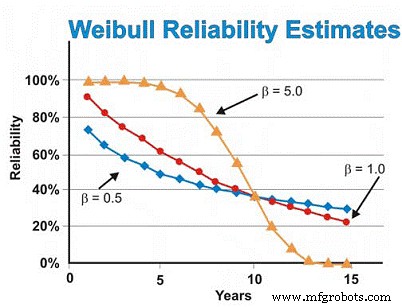
With β = 0.5 (early failures), the 6‑year reliability drops to ~46 %. With β = 5 (wear‑out), it rises to ~93 %. Understanding β allows targeted interventions—improved design for infant failures or scheduled overhaul for wear‑out.
System Reliability Modeling
Series Systems
In a series configuration, the system fails if any component fails. System reliability is the product of individual reliabilities:
Rs(t) = R1(t) × R2(t) × … × Rn(t)
Example: Three subsystems each 90 % reliable → Rs = 0.9³ = 72.9 %.
Parallel Systems
Redundant components increase overall reliability. For two identical components in parallel, Rs = 1 – (1 – R)². With R = 90 %, Rs = 99 %.
r‑out‑of‑n Systems
These systems require at least r functioning units out of n. Reliability is calculated via a cumulative binomial sum:
Rs = Σ_{k=0}^{r-1} C(n,k) p^{n-k} (1-p)^k
Example: Four pulverizers, three must run, each with 90 % reliability → Rs ≈ 95 %.
Collecting Field Data
Accurate reliability analysis hinges on robust data. Adopt standardized taxonomy (IEC 300‑3‑2, DOE NE‑1004‑92) and capture:
- System details and operating context
- Environmental conditions
- Failure events with timestamps and causes
Good data break the “random trap” and reveal time‑dependent patterns that inform preventive maintenance schedules and design improvements.
Next Steps for Plant Engineers
Deepen your knowledge of:
- Weibull and exponential distributions
- Gaussian and log‑normal models
- Statistical confidence intervals
- Bayesian reliability methods
- Stress‑strength interference analysis
- Reliability growth and management strategies
Consider earning the ASQ Certified Reliability Engineer (CRE) credential to solidify your expertise.
References
- Troyer, D. (2006). Strategic Plant Reliability Management Course Book. Noria Publishing.
- Bernowski, K. (1997). “Safety in the Skies.” Quality Progress, Jan.
- Dovich, R. (1990). Reliability Statistics. ASQ Quality Press.
- Krishnamoorthi, K.S. (1992). Reliability Methods for Engineers. ASQ Quality Press.
- MIL‑STD‑721
- IEC Standard 300‑3‑3
- DOE Standard NE‑1004‑92
Appendix: Key Reliability Terms (MIL‑STD‑721)
- Availability – Proportion of time an item is ready for use.
- Reliability – Probability of failure‑free operation over a specified interval.
- MTBF / MTTF – Mean time between failures (repairable) or to failure (non‑repairable).
- Failure Rate (λ) – Failures per unit life expended.
- Mean Time To Repair (MTTR) – Average repair duration.
- Failure Modes & Effects Analysis (FMEA) – Systematic identification of potential failures.
Equipment Maintenance and Repair
- The Core Responsibilities of a Reliability Engineer: Safeguarding Asset Performance
- Why Data Is the Cornerstone of Reliability Engineering
- Certified Reliability Engineer (CRE): The Essential Credential for Plant Reliability Professionals
- Eli Lilly BHI Plant: A Reliability Success Story
- The Key to Reliability Success: Culture Change Over Technology
- Eco‑Friendly Paint Clean‑Up: Proven Practices for Maintenance Professionals
- Preventing Tunnel Vision: A Proactive Approach to Plant Safety and Reliability
- Design Engineering for Energy‑Efficient Power Plant Generation Systems
- Shaping Tomorrow: The Evolving Role of Maintenance Engineers in Modern Factories
- How to Pick the Ideal Wheel Loader for Your Waste Management Facility