



Rethinking OEE: Turning Equipment Efficiency into Business Success
In this article, I challenge the conventional view of overall equipment effectiveness (OEE) — availability × yield × quality — and invite you to consider it as a comprehensive measure of overall business effectiveness.
As a seasoned educator and consultant in reliability management, I’ve seen many organizations struggle to define their own OEE. Availability, in particular, is frequently misinterpreted, leading to distorted metrics and missed opportunities for real improvement.
For business purposes, availability is best expressed simply as the number of operating hours in a year divided by 8,760 (the total hours in a calendar year). In other words, it is the ratio of actual running time to elapsed time. In manufacturing, availability combined with yield tells you how much product you can sell.
Problems arise when companies tweak the denominator of the availability equation, often to make the metric look better. This is akin to placing part of your weight on a bathroom counter while stepping on the scale – the numbers look appealing, but the reality remains unchanged.
Reducing the denominator by an hour implies that the lost hour is entirely outside management control. In reality, only truly “acts of God” (hurricanes, floods) are outside of control; preparedness determines the impact of such events.
Below are three common pitfalls that erode the denominator of the availability calculation, and a more inclusive model that aligns OEE with the full spectrum of business performance.
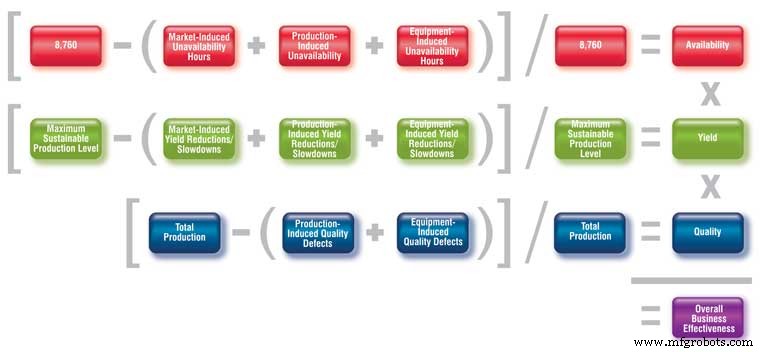
To accurately diagnose issues, availability, yield, and quality defects must be classified as market‑, production‑, or equipment‑induced.
1) Marketing Downtime: Many firms assume that if the plant is available but the market isn’t demanding the product, those hours shouldn’t penalize OEE. Yet marketing downtime still erodes profit, RONA (Return on Net Assets), and shareholder value. Addressing this requires revisiting product mix, pricing, and promotion, or, if the market gap is insurmountable, reducing net operating assets.
2) Production Downtime: Time spent on changeovers, cleaning, decontamination, and regulatory inspections often slips into the availability metric. Ignoring these activities hides opportunities for SMED (Single‑Minute Exchange of Die) improvements and more efficient shutdown/startup procedures. In food‑processing, for example, mandatory cleaning safeguards safety but also reduces available hours; measuring it accurately keeps us motivated to adopt technologies that extend safe operating time.
3) Planned Maintenance Downtime: Some organizations treat scheduled maintenance as “free” by removing it from the denominator. Planned downtime is actually a valuable indicator of preventive strategy. Including it in the availability calculation encourages proactive maintenance planning, better shutdown management, and design for maintainability.
With these insights, overall business effectiveness (OBE) can be expressed as:
OBE = Availability × Yield × Quality (identical to OEE mathematically) but with a more holistic definition of availability:
Availability = (Dm + Dp + Def + Dpm) / 8,760
where:
- Dm = Marketing downtime
- Dp = Production downtime
- Def = Equipment forced downtime
- Dpm = Planned maintenance downtime
Track each downtime component separately and develop a standardized taxonomy for classifying downtime events. This granularity empowers you to target specific root causes and drive tangible improvements.
Although this column focuses on availability, the same classification logic applies to yield and quality. Classifying yield losses as market‑, production‑, or equipment‑driven clarifies the underlying drivers. Similarly, breaking down quality defects by industry‑specific characteristics enhances corrective actions.
Valid metrics illuminate threats and opportunities, enabling data‑driven decisions. Compromising metric integrity for a “feel‑good” number ultimately harms stakeholders and the organization’s performance.
Keep your OEE (or OBE) pure and trustworthy, then dedicate your energy to operating the plant at peak efficiency. Beware of generic “world‑class OEE” benchmarks that range from 80% to 90%—these averages can be misleading and either unattainable or deceptively easy, depending on the industry. Manipulating metrics to hit arbitrary targets leads to complacency or distortion.
Focus on real, economically justified reliability improvements and let your metrics guide you toward genuine operational excellence.
Equipment Maintenance and Repair
- Maintenance Best Practices to Boost Overall Equipment Effectiveness (OEE)
- Drew Troyer on Maximizing Plant Reliability Through Overall Equipment Effectiveness (OEE)
- New Book: The OEE Primer – Mastering Equipment Effectiveness, Reliability & Maintainability
- Bridging the Gap: Adding Cost to Overall Equipment Effectiveness (OEE)
- Leveraging Overall Equipment Effectiveness (OEE) to Drive Plant Performance and Employee Engagement
- Unlocking Production Excellence: Mastering Overall Equipment Effectiveness (OEE)
- Mastering OEE: A Practical Guide to Maximizing Production Efficiency
- Your Complete Guide to Mastering OEE for Lean Manufacturing Success
- Mastering Overall Equipment Effectiveness: A Practical Guide for Manufacturers
- Mastering Overall Equipment Effectiveness: Boost Manufacturing Productivity