



Maximizing the Value of Your CMMS/EAM System: Strategies for Integration and Predictive Maintenance
Many organizations today fall short of realizing the full potential of their computerized maintenance management systems (CMMS) or enterprise asset management (EAM) platforms. Industry studies reveal that only 5–10 % of available CMMS/EAM features are actively used in many cases, with 20–30 % reflecting moderate adoption. The most successful firms exceed 40 % of the capabilities, translating to significant operational and financial gains. Why does this disparity exist?
Current Landscape and Emerging Trends
Despite rapid technological evolution, a substantial number of companies still rely on legacy paper‑based processes or isolated software modules. This fragmentation hampers real‑time decision making and obscures the true value of CMMS/EAM investments.
Embracing a World of Continuous Change
Change is the only constant in today’s business environment. Whether it’s the gradual shift from steam to electric power or the sudden adoption of high‑speed broadband, organizations must build resilient support systems that can adapt to evolving operational demands. Acknowledging and planning for change is the first step toward sustained performance.
Integrated Connectivity as a Competitive Edge
With global connectivity via VOIP, web conferencing, and satellite links, businesses can operate seamlessly across borders. Major system integrators—including Accenture, Cap Gemini, IBM, and Deloitte—are generating billions by weaving disparate software into unified decision‑support frameworks. Effective data movement, real‑time analytics, and business intelligence are becoming core corporate capabilities.
From Niche Solutions to Unified Platforms
Historically, many enterprises chose best‑of‑breed niche applications for HR, inventory, procurement, and transportation. While suitable in isolation, these silos now demand interoperability. Estimates suggest that up to 70 % of IT budgets are consumed by maintaining and integrating legacy applications. Switching to a common, pre‑connected ERP or EAM platform can dramatically reduce this burden.
Empowering Operators to Reduce Downtime
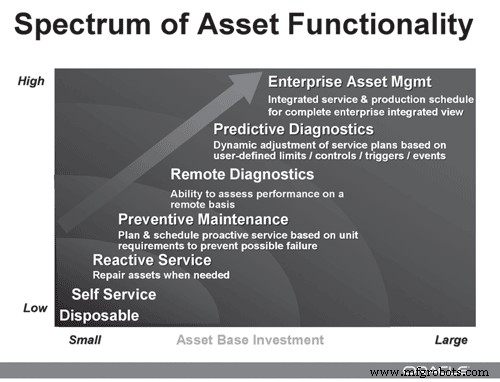
Surveys show that nearly 30 % of service visits could be avoided with proper operator training. Modern equipment often includes onboard diagnostics that enable fault identification and remote troubleshooting. Customer‑replaceable units (CRUs) and predictive alerts further shorten maintenance windows and improve uptime.
Preventive Maintenance: A Strategic Investment
Periodic servicing—oil changes, filter replacements, and component checks—ensures that mechanical systems maintain their original integrity. While short‑term savings may tempt firms to use lower‑quality consumables, the long‑term cost of premature asset replacement outweighs these gains. In high‑stakes environments such as aviation, predictive maintenance has driven reliability to Six‑Sigma levels (99.999 % uptime).
Maintenance as a Business Driver, Not a Cost Center
Maintenance underpins safety, quality, and regulatory compliance. From fire extinguishers to elevators, documented inspections guarantee operational readiness. Consistent, high‑quality service providers and reputable consumables are essential for sustaining asset performance and extending asset life cycles.
Harnessing Data for Predictive Insight
Real‑time telemetry—temperature, pressure, vibration—allows operators to anticipate failures before they occur. Predictive models, built on historical usage data, enable proactive asset management and more accurate capital budgeting. By integrating maintenance data with production and logistics, organizations achieve a holistic view of asset health.
The EAM Advantage: Single Source of Truth
An integrated EAM platform consolidates all asset data, turning information into actionable insights. Automated alerts, remote monitoring, and self‑diagnosis empower technicians to intervene before performance degrades. This proactive stance transforms maintenance from firefighting to strategic planning.
Conclusion
In today’s competitive landscape, only firms that fully leverage their CMMS/EAM systems—aligned with enterprise information architecture—will gain a decisive advantage. By embracing integration, predictive maintenance, and real‑time analytics, organizations can unlock maximum value, enhance reliability, and drive sustainable growth.
Computer and communication technologies such as BPEL and SOA are rapidly becoming standard tools in the maintenance community. With data storage and network costs falling, the barrier to deploying sophisticated EAM solutions is lower than ever.
About the authors
Dave Loesch is the Senior Director of Enterprise Asset Management at Oracle, and Stephen Slade is the Senior Director for Applications and Industries Marketing. For more information, visit www.oracle.com.
Equipment Maintenance and Repair
- Maximizing the Potential of STL Files for Flawless 3D Printing
- Unlocking IoT Data: How Business Rules Management Drives Enterprise Value
- Maximize ROI: 11 Proven Strategies to Unlock Your EAM System’s Full Potential
- Maximizing the Performance of Your Industrial Physical Assets
- Maximize Efficiency: Expert Tips for Your Warehouse Scanning System
- Maximize ROI from Your Lead Generation Investment
- Optimizing Excavator and Hauler Pairings for Maximum Efficiency and Profit in Mining
- Maximize Warehouse Efficiency: Proven Strategies to Optimize Space & Boost Profits
- Maximize Your CMMS Trial: Tips for Successful Evaluation
- Maximize Efficiency and Precision with Your Benchtop Surface Grinder