



Preventing Equipment Failures with CBM Tools: The Two-Out-of-Three Rule
Preventing Equipment Failures with CBM Tools: The Two-Out-of-Three Rule
Reliability engineers are tasked with designing and sustaining robust predictive and preventive maintenance programs that cut unscheduled downtime, boost production, and elevate overall equipment reliability. Understanding how assets perform—and being able to predict and halt failures before they occur—is critical. By combining advanced monitoring technologies, engineers can present decisive evidence to management when an asset shows signs of impending failure.
Combining Oil, Vibration, and Thermographic Analysis
Integrating oil analysis, vibration analysis, and infrared thermography—often called the “two out of three technology rule”—provides a confidence level of 95 % or higher that an asset truly needs to be taken out of service for maintenance. This approach, known in reliability engineering as the Bomb Report, highlights correlated anomalies across two or more technologies, making it a powerful tool for executive decision‑making.
Key Payback Technologies
- Oil Analysis
- Vibration Analysis
- Infrared Thermography
These three methods are essential for a comprehensive condition assessment. A well‑designed monitoring program integrates them to improve performance, reduce failures, and mitigate downtime.
Technology-Specific Problem Detection
Vibration Analysis
Vibration monitoring captures waveform trends and pattern recognition to detect faults such as:
- Bearing failure or misalignment (fan, pump, motor)
- Coupling lock‑up or failure
- Unbalance (fan or motor)
- Resonances (belt frequency, sheave/pulley alignment)
- Lubrication issues
- Electrical faults
- Structural problems
- Belts
- Gears
Oil Analysis
Oil testing evaluates fluid properties, contaminants, and wear debris—akin to a “blood test” for machinery. Industry data indicates that over 70 % of failures are lubricant related. Oil analysis can detect both fluid and machine defects early, serving as the first line of defense. Typical reports include:
- Presence of foreign fluids or destructive surface contaminants
- Overall fluid physical and chemical condition
- Type, amount, and morphology of machine wear materials
Infrared Thermography
Thermography identifies heat patterns and temperature differences, revealing hot spots caused by electrical resistance or excess friction. It is valuable for assessing moisture, thickness, bonding, capacitance, and friction, and is particularly useful for detecting heat loss in mechanical equipment. Common anomaly categories include:
- Motors
- Bearings
- Couplings
- Belts and sheaves
- Steam traps
- Heat exchangers
- Electrical components (most frequent use)
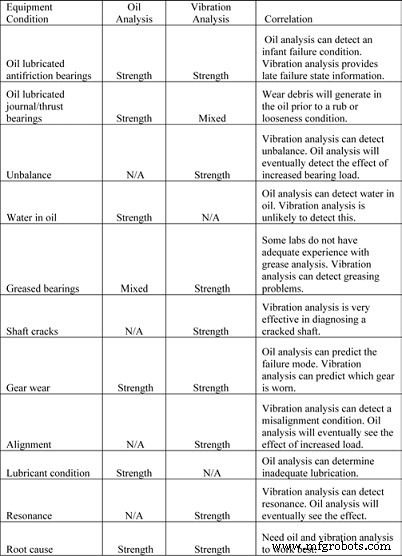
Strengths and Weaknesses of Vibration + Oil Analysis
Technology
Correlative Method
Indication
When Used
| Vibration | Time sequence | Wear particle build‑up precedes significant vibration increase in most instances | Routinely (monthly) |
| Thermal analysis | Time coincident | With major wear particle production (near end of bearing life); occurs as the bearings fail | When bearing degradation is suspected |
| Advance filtration/debris analysis | Time sequence / coincident | Major bearing damage has occurred when significant amounts of material appear in the lubricating system filters | Routinely with each filter cleaning or change |
Correlation of Lubricant Wear and Vibration/Thermography
The Bomb Report
The Bomb Report is an executive‑level summary that highlights:
- Asset location
- Date of confirmed problem
- Nature of the issue
- Required corrective actions
- Short‑ and long‑term repair options
- Issued work orders
- Predictive/preventive technologies used to detect the problem
- All supporting reliability data
Presenting a Bomb Report grabs management’s attention and drives the urgency of corrective action. Relying on a single data point—such as a marginal oil spike—can lead to unnecessary downtime. The confidence threshold of 95 % or higher is achieved when two or more technologies corroborate an anomaly.
Reliability engineers must be versed in multiple monitoring methods to appreciate each technique’s strengths and limitations. Choosing the right combination—oil with vibration, or vibration with thermography—depends on the specific situation and the information each tool provides.
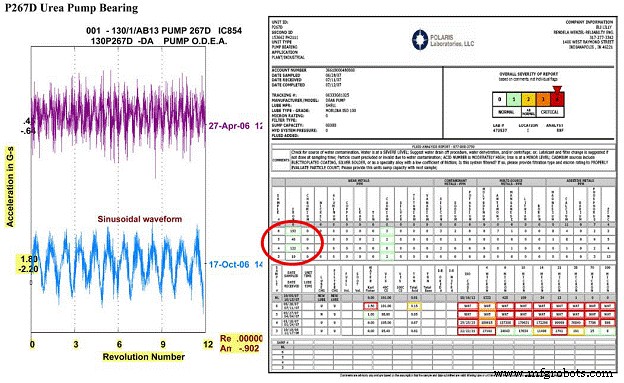
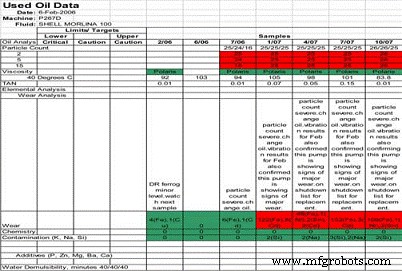
Example of Correlation Between Technologies
Two Out of Three Technology Rule of Thumb
- At least one technology is used on every major piece of equipment (700 currently monitored)
- If an anomaly is observed, confirm it with another technology
- Two technologies confirming a production concern triggers corrective action
- Issue work orders and track follow‑up
- Trend results to verify PM effectiveness (MTTR, MTBF, statistical analysis)
- No two machines are alike; treat each uniquely
- Document successes to build business cases for upgrades (EVA, cost benefit, payback, NPV, executive summary)
Conclusion
Correlating multiple monitoring technologies dramatically improves diagnostic accuracy and enables maintenance teams to preempt outages. By following the “two out of three” rule, reliability engineers can confidently decide when to rebuild, replace, or perform targeted maintenance, ensuring sustained equipment reliability and operational excellence.
Equipment Maintenance and Repair
- Preventing Heavy‑Duty Freight Damage: Expert Shipping Strategies for CNC Equipment
- Maintaining an Accurate Equipment Registry: Best Practices for Reliability and Compliance
- Preventing Costly Downtime from Power Outages in Petrochemical Plants
- Launching a Reliability Program: A Proven Roadmap
- Protect Your Electronics: Expert Strategies to Prevent Rodent Damage
- Preventing Common Heavy Machinery Failures: Essential Maintenance Tips
- Strategic Financing Solutions for Manufacturing Equipment and Tools
- Proven Techniques for Corrosion Prevention in Metal Equipment
- 7 Proven Strategies to Eliminate Heavy Equipment Accidents on Construction Sites
- Safeguarding Workers: Proven Strategies to Prevent Heavy Equipment Injuries