



Crowning: A Proven Method to Reduce Gear Train Noise and Correct Misalignment
Gear designers have long struggled with noisy gear trains, especially as modern gearboxes demand higher power output, higher RPM, and greater efficiency. Reducing vibration and noise without inflating costs remains a critical challenge.
Common strategies include enlarging the pinion to lessen undercut, incorporating noise‑absorbing materials such as phenolic or Delrin, and switching to helical gear trains. Additional approaches involve tightening manufacturing tolerances for superior gear quality, redesigning gearbox acoustics, experimenting with gear ratios to dampen harmonic amplification, and optimizing material hardness to minimize heat‑treatment distortion or eliminate the need for it altogether. Careful attention to gear geometry is also essential for maximizing contact and reducing wear.
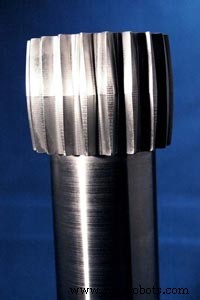
Figure 1.
Crowning, or barreling, modifies the tooth’s chordal thickness along its axis, creating a center‑contact point that eliminates end bearing. This simple geometric change delivers significant benefits.
First, it mitigates misalignment caused by inaccuracies in casting, housing, shafting, gearboxes, or bearing journals. Second, it reduces lead errors that lead to uneven wear and binding due to eccentricities. With a center‑contact gear, backlash can be minimized, allowing the gear to wear in rather than wear out.
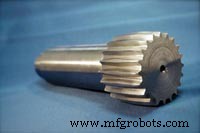
Figure 2.
Shaving—performed after rough hobbing or shaping—has traditionally been the finishing operation to produce the desired crown, especially for coarse‑pitch gears. Modern gear machines can now crown during cutting, eliminating the need for a separate shaving step.
Two shaving techniques produce the crown: rocking the table during reciprocation, which offers adjustable crown depth, and plunge feeding, which is faster but can increase cutter wear. Shaving improves profile quality and reduces tooth errors through cutting and burnishing actions.
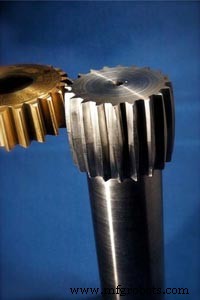
Figure 3.
Other crowning methods include using a crown cam in a shaper’s back‑off mechanism. The gear’s radius is calculated based on the desired crown and pressure angle, though the blocks used for this process can be costly.
Advanced gear equipment now offers two popular crowning‑while‑hobbing techniques. The first employs a hydrocopying or mechanical follower to template the cutter’s center distance, enabling taper hobbing or even sinusoidal waveforms. The second, CNC hobbing, allows virtually any desired tooth profile, though equipment cost remains high; however, payback periods have shortened in recent years.
Modern CNC shapers can crown without a dedicated cam. For example, our Gleason Pfauter P 300 ES achieves crown by cutting a slight right‑ and left‑hand helix along the tooth face, leaving the root diameter straight. The Bourn & Koch Fellows MS 450 with a U‑axis can program the cutter spindle to move in and out during the stroke, creating a deeper cut at the ends and a shallower cut at the crown’s peak.
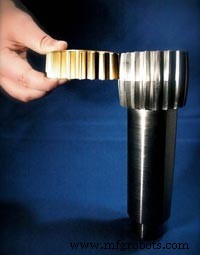
Figure 4.
Who benefits from this technology today? Heavy‑loaded gear applications—such as hydraulic wobble motors and aircraft actuator pinions—rely on crowning to address misalignment rather than just noise. While only a few U.S. manufacturers apply crowning to fine‑pitch gearing, those who have adopted it report five to ten times noise reduction, along with lower vibration, wear, and power draw.
Ideal candidates include small fractional‑horsepower motor manufacturers and any operation dealing with spur or helical pinions prone to noise or misalignment. Crowning has been more extensively developed in Europe due to longer availability of foreign gear hobbing equipment.
American gear manufacturers should consider integrating crowning into their production lines to gain a competitive edge in noise reduction, alignment precision, and overall efficiency.
Equipment Maintenance and Repair
- Essential Checklist for Laser Alignment & Soft Foot Prevention
- Condition‑Based Maintenance: Sensors & Systems for Predictive Asset Management
- Transforming Operations & Maintenance: A Practical Guide to Effective Planning
- Trelleborg Unveils Active Force Cancellation System for Quieter, More Efficient Vehicles
- 5 Proven Rules to Strengthen Operations & Maintenance Partnerships
- Gear System Insights: Backlash, Breathers, Oil Selection & Load Management
- Infinity Gears: 41‑Stage Gearbox Achieving 346 Quintillion‑Year Rotation
- Parallel vs. Crossed Helical Gears: Key Differences Explained
- Choosing Between Helical Gears and Helical Rack & Pinion Systems
- Understanding Planetary Gear Reduction: Compact, High‑Torque Solutions