



Boost Asset Availability with Advanced Machine Learning – Proven Industrial Success
Machine learning (ML) has evolved from a niche tool for large corporations to a readily deployable asset‑monitoring solution. Today, short‑term trials and cloud‑based platforms allow manufacturers to integrate ML without the heavy upfront costs of a decade ago.
Machine Learning for Improved Manufacturing Equipment Availability
ML models identify failure precursors at the earliest stages, mirroring the classic PF curve logic: the sooner a fault is detected, the less downtime and maintenance it incurs. The process starts with a comprehensive asset model that captures all relevant process and equipment parameters—typically 10–30 variables, sometimes approaching 100. For example, a pump model may include suction pressure, discharge pressure, valve position, bearing temperature and vibration.
Historical data, usually a full year to capture seasonal variations, forms the training dataset. An operator‑qualified engineer flags periods of “good” operation to include, and “bad” operation to exclude, ensuring the model learns from accurate, high‑quality data. The trained model generates an operational matrix that defines expected parameter ranges for every operating condition.
Once deployed, the matrix continuously monitors real‑time data. If a parameter diverges beyond a set threshold, the system triggers an alert. The alert is triaged as: 1) valid—plant resources address the issue; 2) inconclusive—continue monitoring and gather more data; 3) false positive—re‑train the model with updated data.
Managing these models demands dedicated expertise. A typical full‑time resource allocates 40% of their time to model upkeep, 40% to incident resolution with plant teams, and 20% to evaluating the return on investment from the ML program.
Machine Learning Results
ML applications reveal subtle shifts invisible to human operators. Below are real‑world examples illustrating how early alerts prevented costly downtime.
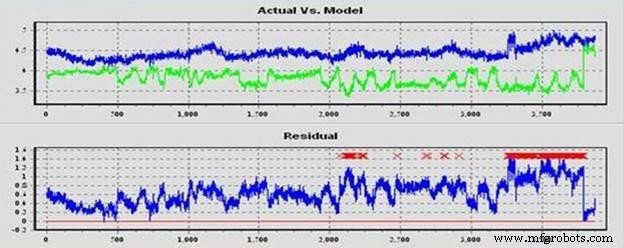
Figure 1. Fan bearing vibration increase
In this case, a rise in bearing vibration signaled a hidden oil leak. Prompt inspection identified the leak at the bearing cap connection, allowing corrective action before bearing damage occurred.
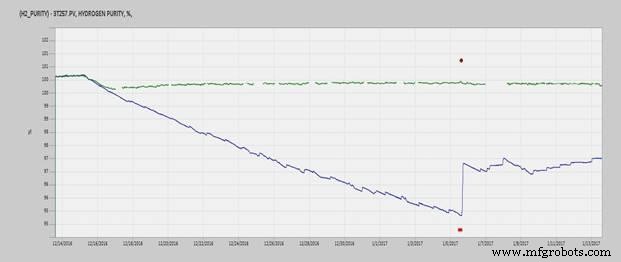
Figure 2. Generator hydrogen purity
A month‑long, gradual decline in hydrogen purity was detected early, giving crews time to address the issue without a shutdown.
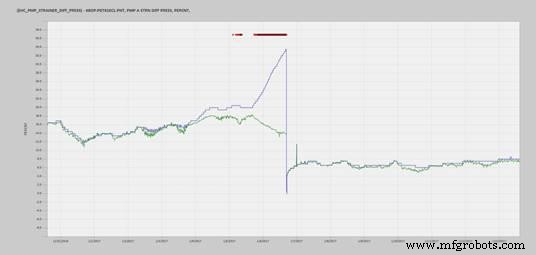
Figure 3. EHC pump strainer
An increasing differential pressure across an EHC pump strainer prompted a pump swap, averting a potential turbine trip.
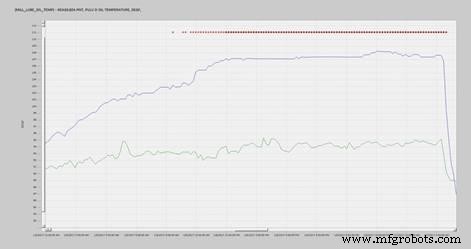
Figure 4. Pulverizer oil temperature
A temperature rise in the lubrication system led to the replacement of a failed cooling water valve, restoring normal operation.
Additional examples from a second ML platform further demonstrate consistent predictive accuracy across diverse equipment types. In each instance, the software identified deviations, generated alerts, and facilitated timely plant responses, confirming the high value of post‑detection communication.
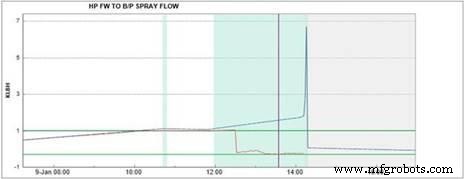
Figure 5. High‑pressure spray flow
When the spray flow deviated from the model at 1,000 lb/hr, an alert allowed operators to investigate and correct the issue before an alarm occurred.
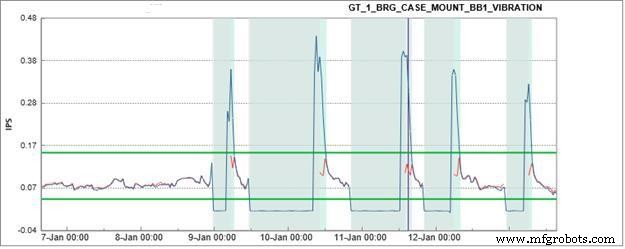
Figure 6. Combustion turbine vibration
During startup, a loose vibration sensor triggered an alarm in one scenario, illustrating how even small mechanical changes can be flagged promptly.
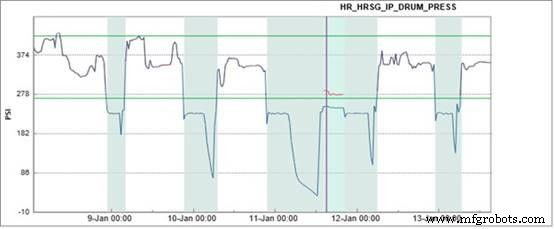
Figure 7. HRSG drum pressure
In another startup scenario, a pressure drop led to an alarm. The plant took the unit offline for valve repair, after which the model and actual values returned to alignment.
Future Applications of Machine Learning
We anticipate ML becoming a standard component of Distributed Control Systems (DCS). The DCS will generate parameter predictions, compare them with real data, and deliver actionable alerts to operators. As the system learns corrective actions, operator involvement will diminish, moving toward self‑optimizing plants—a vision already realized in autonomous vehicles such as Tesla’s autopilot.
Deploying ML in industrial settings now requires specialized skills, but the lower entry barrier and decreasing costs are driving wider adoption. In the coming years, consumer‑grade ML solutions may enter the factory floor, further democratizing advanced analytics.
Equipment Maintenance and Repair
- How SCADA Boosts Production Efficiency: A Comprehensive Guide
- How AI and ML Revolutionize Asset Tracking: Enhancing Accuracy, Efficiency, and Insight
- How AI, Data Science, and Machine Learning Drive Next‑Generation Website Design
- Integrating Machine Learning into Enterprise Operations: A Practical Guide
- How Machine Learning Can Safeguard Your Competitive Edge
- Leveraging Machine Learning to Reduce Manufacturing Emissions and Fight Climate Change
- Mastering Machine Availability: Calculation & Enhancement Strategies
- Automating Data Quality to Accelerate AI & ML Success
- Enhancing Machine Accuracy for Precise Manufacturing
- Boost Productivity with a Beam Coping Machine: Precision and Efficiency in Structural Fabrication