



Mastering Maintenance Storerooms: Proven Strategies for Inventory Excellence
This article was written by Jason Afara, solutions engineer at Fiix with over seven years as a maintenance manager and planner.
Production equipment is like a professional athlete—both worth millions and essential to results. Just as a baseball player needs the right bat, your maintenance team needs the right parts. Small mistakes can cause major downtime and revenue loss.
This guide dives deep into inventory tracking and the best practices for organizing your maintenance storeroom, making your team, and the entire operation, more efficient, cost‑effective, and safer.
4 Secrets to Managing Inventory
Read more
Table of contents
- Parts acquisition
- Spare parts and work orders
- Securing your maintenance storeroom
- Organizing your maintenance storeroom
- Optimizing your inventory tracking
- Inventory tracking: A pillar for maintenance teams
Track and optimize your parts with this inventory management template
Parts acquisition
The cost of spare parts can add up quickly. Understanding how you spend on inventory—and how you spend it—helps keep budgets on target and operations smooth.
Ordering parts
Ask these questions to refine your purchasing process:



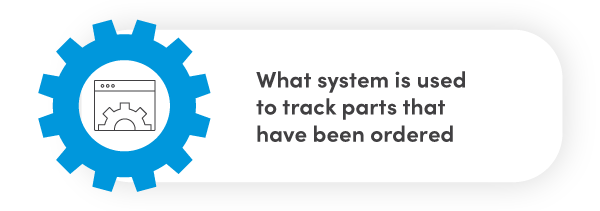

The goal is twofold: accurately track inventory spending against budgets, and streamline the process. A single purchase that requires multiple approvals can stall critical work and erode trust.
Using the wrong bearing can shut down a critical machine, costing hours of production and thousands of dollars.
Efficiency starts with an approval threshold that balances autonomy with risk. Monitor spending for red flags and investigate when necessary.
Working with vendors
Strong vendor relationships are foundational to a robust inventory program. Ask these questions to optimize collaboration:




Timely payment and regular invoice reviews reduce delivery delays. Keep open communication so parts arrive when you need them.
Receiving parts
Coordinate deliveries with these checkpoints:

Is the storeroom staffed 24/7? If not, how are parts stored after hours and accessed?

Do vendors ship to a dedicated area? Are partial orders accepted? Is inspection mandatory before recording in the system? Is the process captured in one integrated system? Accurate records are critical when a line goes down and you need the part immediately.
Spare parts and work orders
With hundreds or thousands of work orders, each tied to at least one spare part, organization is essential. These steps keep the workflow smooth.
Issuing parts to work orders
Answer these questions:
- Who adds the part to the work order?
- How is part usage monitored to avoid ad‑hoc changes during troubleshooting?
Adding a part instantly reflects cost on the work order. Accurate cost attribution lets leadership compare maintenance spend and make informed decisions—whether to buy new equipment or hire additional staff.
Staging parts for PMs
Preventive maintenance requires dedicated kits. Consider:
- Is there a designated area for PM kits?
- Who assembles these kits?
Pre‑building kits eliminates delays during scheduled maintenance and ensures the team has everything ready.
Learn how to build a perfect preventive maintenance checklist
Read more
Securing your maintenance storeroom
Protecting inventory reduces theft, misuse, and unnecessary costs. Prioritize security in these ways:
Access to the stockroom
High-value parts demand controlled access. Evaluate:
- Who is allowed in? Typically, maintenance staff and production supervisors, but you can expand access if tracked responsibly.
- What locking system is in place?
- Are there cameras at entry points, and how are they monitored?
A key‑pass system or badge reader limits access. Segment large storerooms into zones with different access levels to prevent unauthorized use of common parts like batteries.
Camera coverage provides accountability, especially when a part disappears or is used without proper documentation.
Vendor relationships must be strong; delayed payments can halt production by postponing critical parts.
Organizing your maintenance storeroom
Effective organization means parts are easily located, protected, and ready for use. Two common methods:
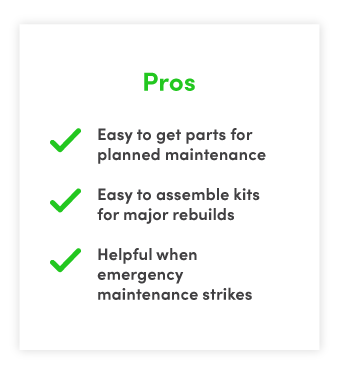
Organizing parts by asset
- Quick access for planned maintenance.
- Efficient kit assembly for rebuilds.
- Immediate retrieval during emergencies.
Downside: duplication across assets increases space and cost.
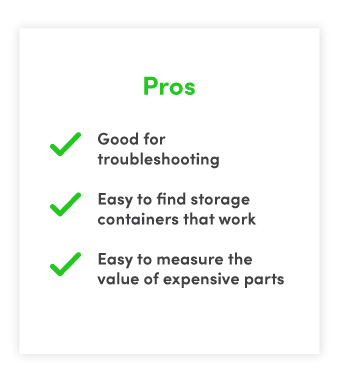
Organizing parts by type
- Facilitates troubleshooting when a specific part is scarce.
- Highlights high‑cost components like motors or VFDs.
- Allows use of specialized storage—e.g., dust‑free bearing cabinets.
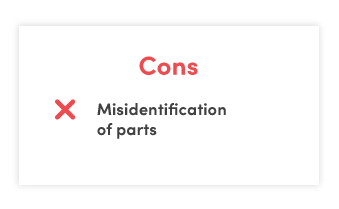
Risk: selecting the wrong variant can extend downtime. QR codes or barcodes on containers mitigate this risk.

Other considerations
- What weight capacity does your racking need?
- Which parts are critical and should have dedicated storage?
- Are high‑reach parts stored safely?
- Do heat‑sensitive parts need climate control?
- Is a vendor‑managed system tracking small items like bolts?
- What is the minimum and maximum stock level?
- Are parts standardized by make or model?
Limiting access to high‑value inventory reduces theft and saves money.
Optimizing your inventory tracking
Data‑driven inventory decisions unlock hidden value, improve asset health, and reduce headaches. Implement these pillars:
Critical spares
Identify critical spares by starting with your critical assets. Engage maintenance personnel to capture all essential components. This prevents catastrophic failures and unnecessary downtime.
Cycle counts
Regular cycle counts keep records accurate, avoid stockouts, and control costs. Ask:
- How frequently are cycle counts performed?
- During a count, how are parts usage restrictions handled?
- Who conducts the count and who verifies accuracy?
Reporting
Monthly or quarterly inventory value reports reveal trends and inform budget decisions. Consider:
- Reporting frequency.
- Data scope—full inventory or top‑value items.
- Change metrics between periods.
Want more free inventory management templates? Check out our template hub
Inventory tracking: A pillar of exceptional maintenance
Five key takeaways for a thriving inventory program:
- Define clear processes for receiving and ordering parts.
- Cross‑train staff to cover absences.
- Run frequent reports to gauge stock value.
- Collaboratively design storeroom layout and seek diverse input.
- Continuously assess strengths and weaknesses, then improve.
Equipment Maintenance and Repair
- How Face‑Time Coaching Transforms Maintenance Supervision
- Mastering Maintenance Storeroom Organization for Peak Productivity
- Bridging Gaps in MRO Management: Proven Strategies for Seamless Supply Chain Coordination
- Top Performance in Maintenance & Reliability: Proven Strategies for Long‑Term Success
- Mastering Draft Angles in Injection Molding: Design Principles & Proven Best Practices
- Hydraulic System Care: Proven Best Practices & Maintenance Tips
- Proven Strategies for Efficient CAD Model and 3D File Management
- Maximize Corrective Maintenance with Effective Issue Tracking Software
- Mastering Maintenance Scheduling: Proven Best Practices for Optimal Asset Management
- Optimize Industrial Robot Performance: Trusted Maintenance & Support