



Harnessing Equipment Maintenance Logs for Data-Driven Asset Management
In the unpredictable world of maintenance, one constant stands out: equipment maintenance logs. These daily records are not just paperwork—they’re the backbone of a data‑driven maintenance strategy.
By treating these logs as a strategic asset, you can unlock insights that drive reliability, reduce downtime, and extend the life of your equipment.
Table of contents
- How to create a great equipment maintenance log
- Equipment maintenance log template
- Six ways to use the data in equipment maintenance logs
- How to extract actionable data from a log
- Beyond the basics: Leveraging logs for strategic advantage
How to create a great equipment maintenance log
Accurate data starts with a well‑designed log. Think of it as the blueprint for your maintenance program. The design should answer three core questions:
- What asset and maintenance information is most critical?
- How granular does the detail need to be?
- Who will use the log and for what purpose?
Most effective logs separate asset details from maintenance actions and place the former at the top for quick reference.
- Equipment name (follow a consistent naming convention – see guidelines)
- Serial number
- Facility location
- Manufacturer (name, part number, contact, manufacture date)
- Purchase date
- Commissioning date
Followed by the maintenance narrative:
- Task date
- Brief task description
- Technician name
- Next scheduled maintenance
- Observations, notes, or safety remarks
Keep it simple. As Fiix solutions engineer Jason Afara advises, “A log should be as easy to read as it is to write. The effort invested should match the value gained.”
Accuracy hinges on three proven practices:
- Use a standard template for every asset to maintain a common baseline.
- Store logs digitally in a secure, central repository.
- Implement a hand‑off routine during shift changes to keep everyone informed.
Equipment maintenance log template
The template below reflects the structure Jason applied while leading a maintenance team.
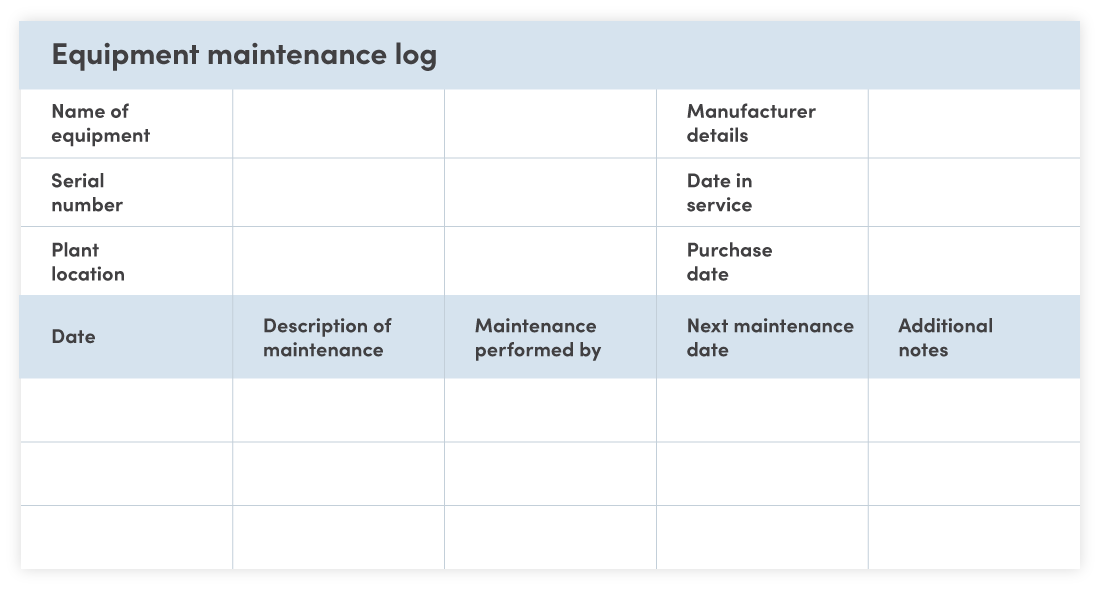
Feel free to tailor the template to your organization’s needs, but ensure it captures the essentials and remains user‑friendly.
Six ways to use the data in equipment maintenance logs
When maintained diligently, logs become a goldmine for future‑proofing your assets and processes.
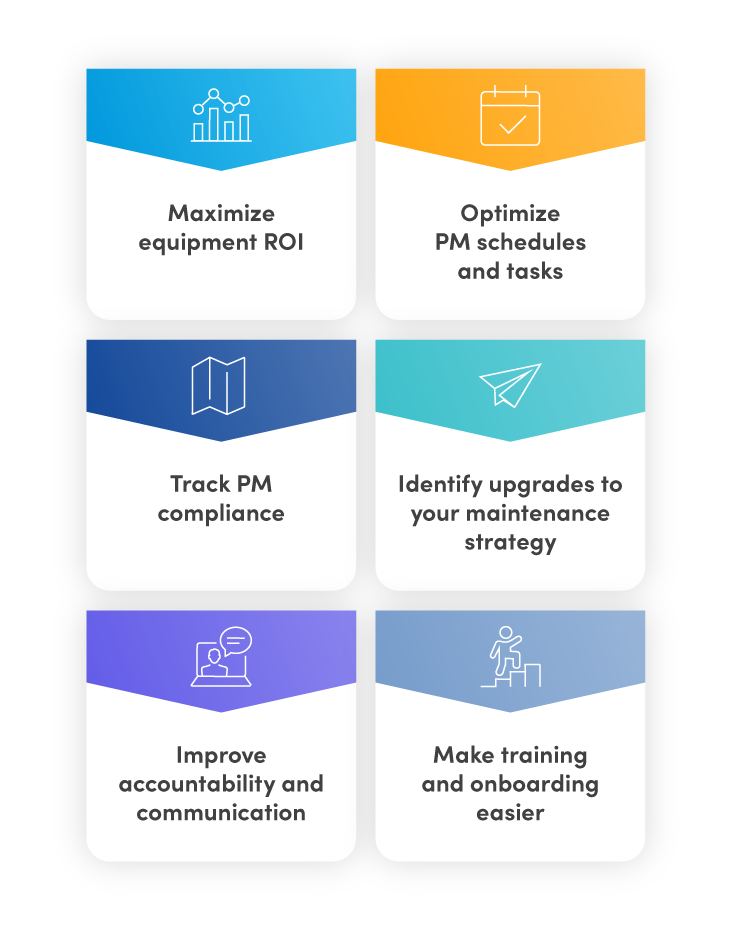
#1 Maximize equipment ROI
By comparing supplier performance over time, logs help you choose the most reliable vendors, lowering repair costs and boosting output. They also signal when a replacement is more economical than repeated fixes, preserving your investment and enhancing resale value.
#2 Optimize preventive maintenance schedules and tasks
Logs reveal patterns—e.g., a machine failing immediately after a scheduled job—indicating that the maintenance routine needs adjustment. They also provide a history of how past issues were resolved, enabling technicians to execute preventive work more efficiently.
#3 Track preventive maintenance compliance
Visible, timestamped records eliminate guesswork. You can instantly identify overdue tasks, flag compliance gaps, and proactively address risks before they trigger downtime.
Ensure a seamless hand‑off between shifts: share completed work, outstanding items, and safety notes to maintain continuity.
#4 Identify opportunities to upgrade your maintenance strategy
Logs surface trends that question the status quo. Is a run‑to‑fail strategy more cost‑effective than preventive maintenance? Is a particular asset a candidate for condition‑based monitoring? Data, not intuition, drives these strategic shifts.
#5 Improve accountability and communication
Logs embed accountability by recording who performed each task. They also serve as a communication bridge across shifts, ensuring knowledge transfer and reducing knowledge silos.
#6 Make training and onboarding easier
New technicians gain rapid context from detailed logs—age of the equipment, common failure modes, and procedural history—cutting the learning curve and reducing mistakes.
How to extract actionable data from a log
Raw data is only useful if it’s accurate, accessible, and actionable. A modern CMMS (Computer‑Aided Maintenance Management System) delivers on all fronts:
- Access logs from any internet‑connected device, anywhere.
- Automate data syncing with integrated systems, ensuring real‑time accuracy.
- Align logs with your maintenance calendar for seamless scheduling.
- Search and filter by asset, task, date, or technician to uncover insights.
- Store data securely in the cloud, eliminating loss or damage risks.
- Attach photos or videos to illustrate issues, enhancing clarity.
Beyond the basics: Leveraging logs for strategic advantage
Equipment maintenance logs may seem routine, but they’re a powerful catalyst for data‑driven decision‑making. A well‑structured template, disciplined processes, and the right technology transform these logs from administrative paperwork into a strategic asset that fuels continuous improvement.
As the U.S. Department of Energy reports, organizations that systematically manage maintenance records experience up to a 20% reduction in unscheduled downtime. By unlocking the insights hidden in your logs, you can turn that data into tangible performance gains.
Equipment Maintenance and Repair
- How Industrial Maintenance Has Evolved: From Reactive to Predictive
- Comprehensive Preventive Maintenance Checklist: Boost Equipment Lifespan & Reduce Downtime
- How to Build a Reliable Equipment List for Condition‑Based Maintenance Success
- Why Proactive Equipment Maintenance Drives Manufacturing Efficiency & Cost Savings
- Mandatory Routine Maintenance: Boosting Equipment Safety and Longevity
- Why Regular Maintenance Is Critical for Construction Equipment Reliability
- How Automation Enhances Equipment Reliability: Boosting Maintenance, Data, and Quality
- How Regular Equipment Inspections Cut Maintenance Costs & Prevent Downtime
- Four Proven Strategies to Mitigate Equipment Failure Risks
- How Business Reports Enhance Equipment Maintenance & Reliability