



Fault Detection & Diagnostics: Enhancing Equipment Reliability and Maintenance Efficiency
Understanding the causes of equipment failures and implementing proactive detection and diagnosis strategies are foundational to modern maintenance practices.
This article provides a comprehensive overview of Fault Detection and Diagnostics (FDD) and how it elevates asset reliability while streamlining maintenance workflows.
The Evolution of Fault Detection and Diagnostics
Historically, maintenance relied on reactive repairs and rigid time‑based schedules. Professionals were limited by the technology available for collecting, storing, and analysing equipment health data.
Advancements in microprocessors, automation, real‑time data acquisition, and FDD systems have revolutionised how we approach maintenance, enabling predictive and prescriptive strategies that reduce downtime and extend asset life.
What FDD Brings to Equipment Maintenance
FDD aims to optimise maintenance costs while simultaneously improving the reliability, availability, maintainability, and safety (RAMS) of equipment. It does so by continuously monitoring condition data, detecting anomalies, and feeding fault diagnostics algorithms that generate alerts for operators and, in some cases, trigger automated containment actions to restore normal operation.
Core Components of an Effective FDD System
At its heart, FDD performs fault detection, isolation, identification, and evaluation. These processes often run concurrently, but each plays a distinct role:
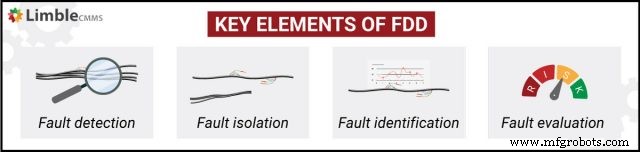
1. Fault Detection
Fault detection is the first and most critical step. It must identify the presence of a fault before it escalates into a breakdown. Accuracy here determines the effectiveness of downstream processes.
Two principal approaches exist:
- Model‑based detection: Relies on mathematical models that embody the physical relationships within the system. When a rule is violated, the algorithm flags a fault.
- Knowledge‑based detection: Uses historical performance data to establish a normal operating signature and flags deviations through statistical or machine‑learning techniques.
Model‑Based Detection Example
Time‑Domain Reflectometry (TDR) is a classic model‑based method for detecting faults in underground cables. By analysing the return‑signal time and velocity, TDR distinguishes between open‑circuit and short‑circuit faults.
In a bottle‑filling line, a simple rule such as “bottles cannot be capped until filled” can trigger a fault alert if the capping mechanism fails, preventing downstream packaging disruptions.
Knowledge‑Based Detection Example
Establish a baseline by capturing parameters like voltage, current, vibration, temperature, and pressure during normal operation. Continuous monitoring then compares live data against this baseline using machine‑learning models to detect subtle deviations indicative of impending failures, such as motor bearing wear.
2. Fault Isolation
Isolation narrows the fault to the most granular replaceable component, minimizing downtime and repair effort. Effective isolation often leverages the same algorithms that detect the fault, providing location data in real time.
For instance, TDR not only confirms a fault in a cable but also pinpoints its exact location by timing the reflected pulse. Similarly, in a conveyor system, isolation can identify whether the issue lies in the capping control card or the packaging module.
3. Fault Identification
Identification determines the failure mode, its magnitude, and root cause. The process typically involves three steps:
- Characterising the failure mode by analysing its time‑variant signature.
- Quantifying the fault size to assess tolerance and necessary remediation.
- Tracing root causes using data‑driven models that correlate sensor signatures with known failure mechanisms.
For example, a high‑voltage three‑phase induction motor may exhibit a doubled stator current frequency when rotor bars are broken. FDD algorithms detect this pattern, infer the mechanical fault, and display the root cause on a live dashboard.
Automated root‑cause diagnostics dramatically cut troubleshooting time, reduce downtime, improve mean‑time‑to‑repair, and boost plant reliability.
4. Fault Evaluation
Evaluation assesses the fault’s impact on system performance, safety, environment, and financials. This step informs maintenance strategy selection—whether to run to failure, preventive, or predictive maintenance—and guides capital replacement decisions.
For instance, a rapidly increasing failure rate that has minimal operational impact may warrant a run‑to‑failure approach, whereas a high‑impact fault would trigger a stringent predictive maintenance program, despite higher costs.
Optimising Maintenance with FDD
FDD transforms maintenance from a reactive to a predictive discipline. Advanced computing, big‑data analytics, and machine‑learning have turned traditional fault detection into fully automated fault‑management systems that detect, diagnose, and correct issues autonomously.
Reliability engineers now use FDD insights to forecast equipment health, schedule maintenance precisely, and allocate resources efficiently—often integrating these capabilities with their Computerized Maintenance Management System (CMMS).
By harnessing FDD, organisations can extend asset life, reduce unplanned downtime, and achieve significant cost savings across the equipment lifecycle.
Equipment Maintenance and Repair
- Maximize Plant Uptime with ATS’s Expert Third‑Party Maintenance Solutions
- Choose Maintenance Wisely: Let Risk and Equipment Guide Your Strategy
- How Healthcare Spending Mirrors Equipment Maintenance: Lessons for Long‑Term Reliability
- Lean Machines for World-Class Manufacturing and Maintenance: A Practical Guide to Equipment Excellence
- 3 Essential Tips for Successful Industrial Equipment Rental & Maintenance
- Maximizing Machinery Longevity: Professional Heavy Equipment Repair & Maintenance Guide
- Integrating Total Productive Maintenance with Industrial IoT for Optimal Manufacturing Efficiency
- Heavy Equipment Maintenance: Proven Dos & Don’ts for Longevity
- Professional Facility & Industrial Maintenance Services
- Expert Construction Equipment Maintenance: Prevent Costs & Boost Longevity