



Selecting the Optimal Failure Analysis Technique for Reliable Equipment

Learning from past failures is the best way to understand and prevent future equipment breakdowns. In practice, that learning process falls under the umbrella of failure analysis.
These days, there are plenty of failure analysis techniques to choose from. They all come with a specific set of advantages, challenges, and use cases. Let’s see what is available, what steps you need to take, and what are the right techniques for your situation.
What is failure analysis?
Failure analysis is the process of collecting and analyzing failure data, usually to identify the root cause of an asset malfunction/breakdown. This information can be used to improve machine/component design, adjust maintenance schedules, and improve maintenance processes. Ultimately, its goal is to improve asset reliability.
The failure analysis process is generally done after a failure has already occurred. It is an integral part of the RCA (Root Cause Analysis) process. However, it can also be used to determine various factors that could cause a potential failure – so we can select and apply the right prevention methods.
Depending on its purpose, failure analysis can be performed by plant and maintenance engineers, reliability engineers, or failure analysis engineers.
Maintenance engineers conduct primary failure analysis based on their knowledge of the plant operations. If the internal team doesn’t have the required expertise, it is advisable to hire consultants that provide failure analysis services.
Last but not least, reliability engineers employ different failure analysis techniques to improve fault tolerance and ensure the robustness of their system.
Common use cases for failure analysis
The most common reasons to conduct failure analysis are discussed below.
Identifying the root failure causes
In many cases, machine failures are surface-level manifestations of deeper problems that were not addressed in time. Sometimes, a combination of different factors leads to an unexpected breakdown.
Since breakdowns are so expensive and disruptive, maintenance teams need to put a lot of effort into preventing them. Aside from routine maintenance, identifying root failure causes – and eliminating them – is the best way to keep breakdowns at bay.
Preventing potential failures
A machine or system has many interconnected and interdependent components. These components do not have the same probability of causing a system-wide failure. Information and data on the system can be used to analyze the probabilities of potential failures.
Tests and simulations can be run to find the weakest links and improve them – be it through design tweaks or by changing operating and maintenance recommendations.
Improving product design
As we just alluded to in the previous paragraph, failure analysis can be done to improve equipment or component design. Engineers can employ different failure analysis techniques to identify potential issues in their designs.
On a more practical side, they can also conduct destructive testing to evaluate the characteristics of components and materials they plan to use in their final product.
The insights gained from these tests and analyses are used to create or improve product quality.
Ensuring compliance
Regulations and standards imposed by governments or industry bodies often require failure analysis. Failure analysis methods are used to ensure the product adheres to the required standards.
Liability assessment
Legal proceedings related to failures require the cause of a failure to be analyzed. The same is done as a part of specific insurance claim settlements to ensure the conditions in the contract are met. In such cases, failure analysis might be a legal requirement.
Naturally, the result of failure analysis can also be used as protection from litigation.
Steps for conducting failure analysis
Failure analysis techniques vary widely based on the specific use cases. That being said, steps for conducting failure analysis follow the same pattern.
Step #1: Define the problem
A well-defined problem statement is essential for any deep analysis. Failure analysis requires the engineers to define the problem as clearly and concisely as possible. The problem statement should contain details about:
- the failure that occurred
- the data that needs to be collected
- the failure analysis technique to be used
- the expectations for the failure analysis (goals)
Step #2: Collect failure data
All relevant data has to be collected. This includes both quantitative data and qualitative data.
Quantitative data refers to the operations data, maintenance data, age of the machine, etc. It can be obtained:
- from maintenance records
- from CMMS database or any other tool used to monitor asset health and performance
- through troubleshooting
- by performing a visual inspection (as a part of failure investigation)
Qualitative data cannot be easily quantified. Such data is obtained by interviewing machine operators, maintenance technicians, operations managers, etc. All relevant data concerning the failure should be collected.
Step #3: Create a failure timeline
Root causes result in a chain reaction that forms the surface-level failures we observe. The collected failure data can shed light on the event sequences that happened. With enough information, the team performing the analysis can create a failure timeline. This serves as a visual and mental aid to the analysis process.
Hopefully, the timeline will provide clarity into the cause-and-effect relationship between the events.
Step #4: Select useful data and discard the rest
The timeline created in the previous step is also used to identify useful data. Quantitative and qualitative data collected in step #2 is mapped to the events in the timeline. The data that finds a place in the timeline is useful for the final analysis.
The rest of the data can be discarded as it is not relevant to the events that caused the failure. This way, failure analysis teams won’t waste time and effort analyzing irrelevant information.
Step #5: Administer the chosen failure analysis technique
The next step is to conduct the chosen failure analysis technique (we will discuss them in the next section). The method selected depends on the specific use case, industry, and the experience of failure analysis engineers conducting the analysis.
Step #6: Review results, test and apply a solution
The result of failure analysis is studied in detail. In most instances, the purpose of failure analysis is to implement remedies that can prevent future failures. Different solutions proposed are tested and the best solution is used to improve the system/machine.
Common failure analysis techniques
Failure analysis is not an exact science. It is a curious exploration of the true cause behind failures and it can be considered a craft.
Still, failure analysis cannot be done without any structure. Over the years, engineers developed quite a few techniques that can be used as a framework to analyze all kinds of failures.
The most popular failure analysis techniques are discussed below.
5 Whys
5 Whys represents a simple methodology used to identify cause and effect relationships between events. It is based on asking “why” the initial problem happened. The first answer then forms the basis for the next “why” question. We keep asking this until we get to something fundamental or completely outside of our control.
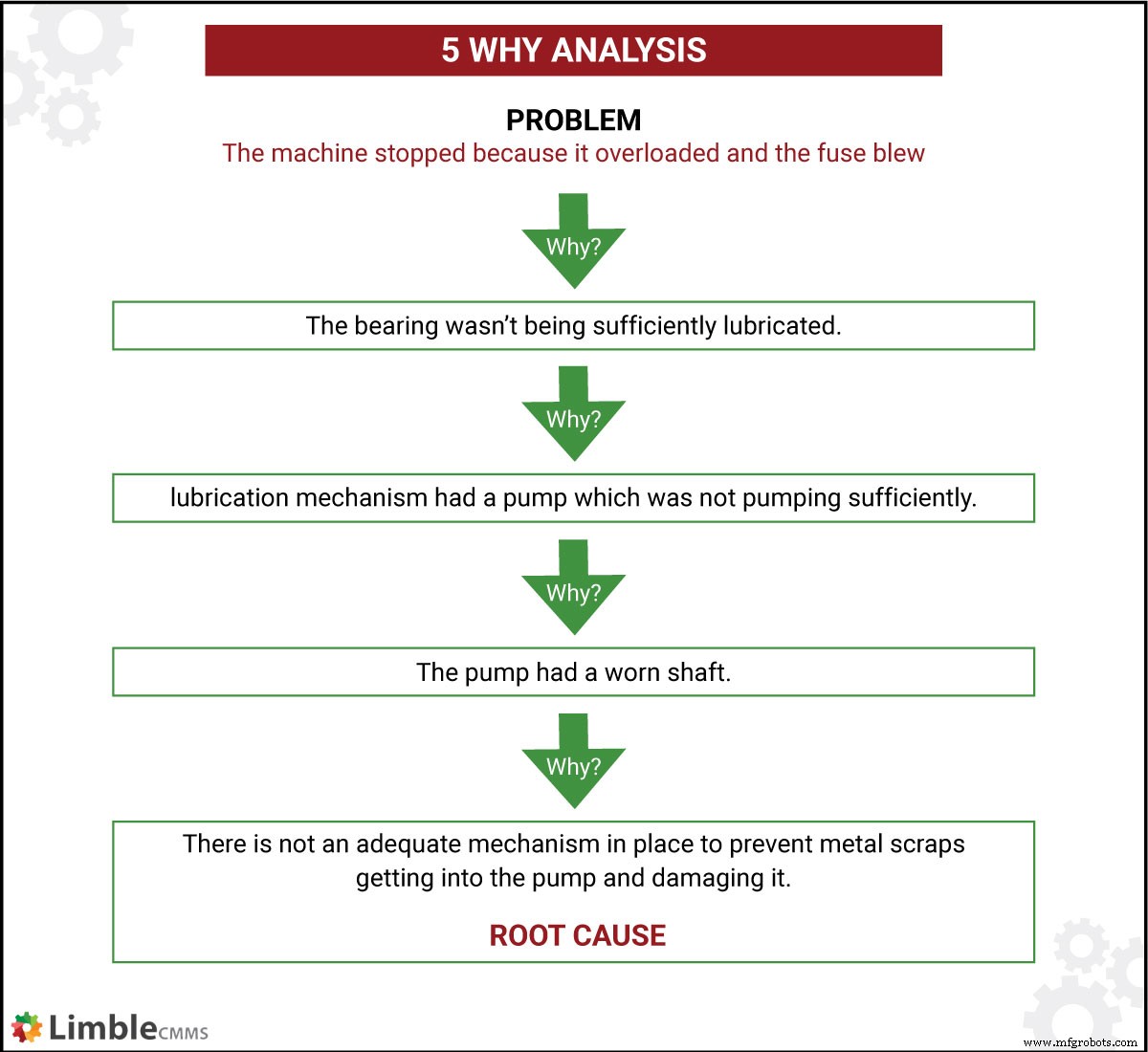
Recommended reading: 5 Whys: The Ultimate Root Cause Analysis Tool.
Fishbone Diagram/Ishikawa Diagram
Fishbone diagram (a.k.a. Ishikawa diagram) is a failure analysis technique that is visualized in the form of a fishbone. The head represents the problem we are analyzing while the bones represent potential causes.
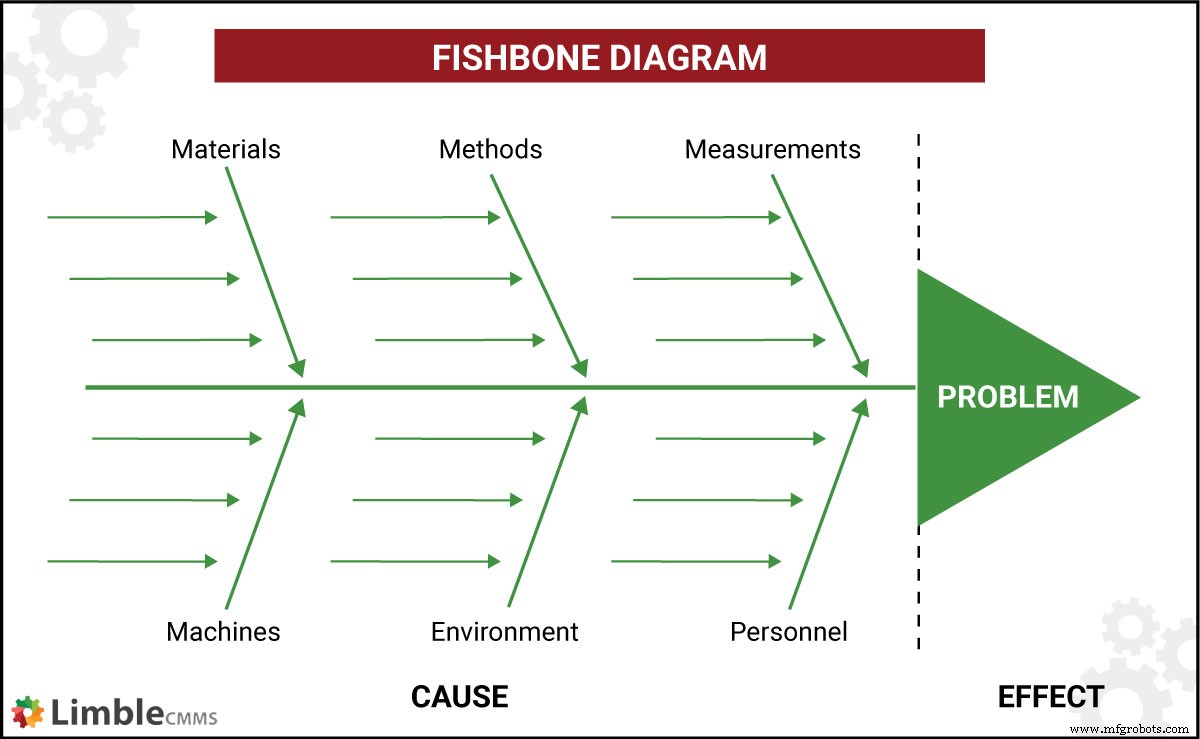
The whole diagram is predicated on the idea that multiple factors can lead to the failure/event/effect we are investigating. It is widely used for process improvement in the medical field, aerospace industry, and IT.
Recommended reading: How to Use the Fishbone Tool for Root Cause Analysis.
Failure modes and effects analysis (FMEA)
FMEA is a preemptive failure analysis technique. It is used to predict potential failures with the help of past data and future projections. It takes a look at the potential ways in which a machine fails and the consequences of each such failure.
Failure modes and effects analysis is a preventive fault analysis technique where each part of a system is brought under the scrutiny of an expert team. It serves as a framework to instigate rigorous brainstorming sessions.
The technique is extensively used in reliability engineering, safety engineering, and quality control.
Recommended reading: FMEA & FMECA: How To Perform Failure Mode And Effects Analysis.
Fault Tree Analysis (FTA)
Fault tree analysis makes use of boolean logic relationships to identify the root cause of the failure. It tries to model how failure propagates through a system. This helps reliability engineers create well-defined systems with proper redundancies where component failures do not always cascade into system-wide failures.
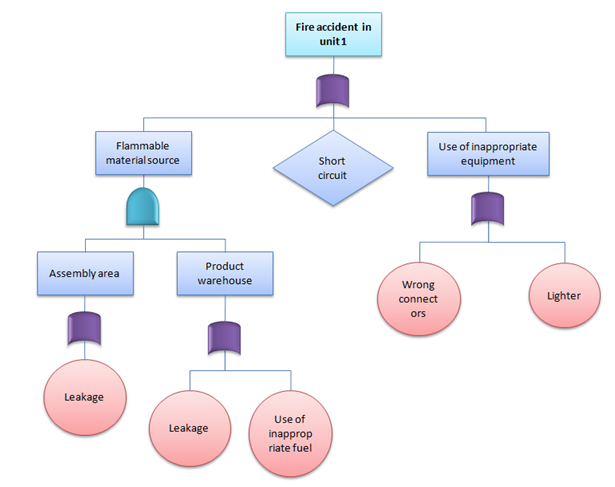
Image source
FTA is widely used in the aeronautical industry, power generation, and defense.
Recommended reading: What Is Fault Tree Analysis And How To Perform It.
Pareto charts
As a rule of thumb, in any system, 80% of the results (or failures) are caused by 20% of all potential reasons.
The principle is dubbed the Pareto principle (some know it as the 80-20 rule). This skew between cause and effect is evident in many different distributions, from wealth distribution among people and countries to failure causes in a machine.
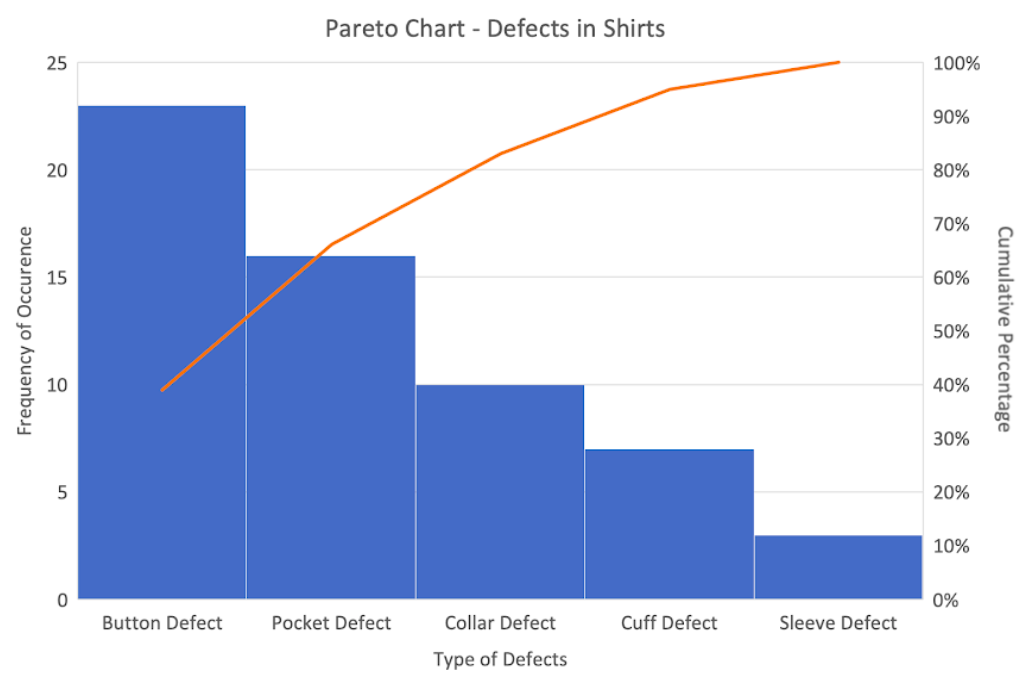
Image source
Pareto charts are quantitative tools to identify the root causes that cause the most number of failures. They are widely used in scenarios where multiple root causes have to be addressed but the resources are scarce.
Recommended reading: How to Conduct Root Cause Analysis Using Pareto Charts.
Barrier analysis
Barrier analysis is a root cause analysis methodology that determines the barriers to the safety of the target. Here the target is defined as the component or machine or system that is to be protected from failure.
The various pathways that could cause machine failure are identified. Elements in these pathways that act as barriers to safe operation are determined. They are altered to eliminate the problems in the system.
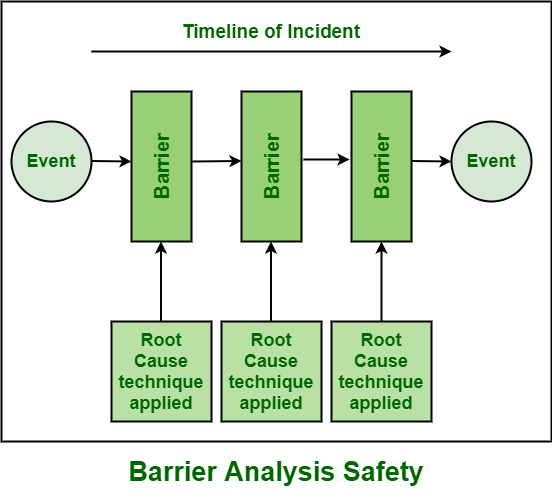
Image Source
Barrier analysis identifies the impediments to successful operations. The barriers are circumvented or eliminated as a result. It is a root cause analysis technique widely used in the IT industry.
Recommended reading: Sample of a Barrier Analysis for Root Cause Investigations.
A quick comparison of failure analysis techniques
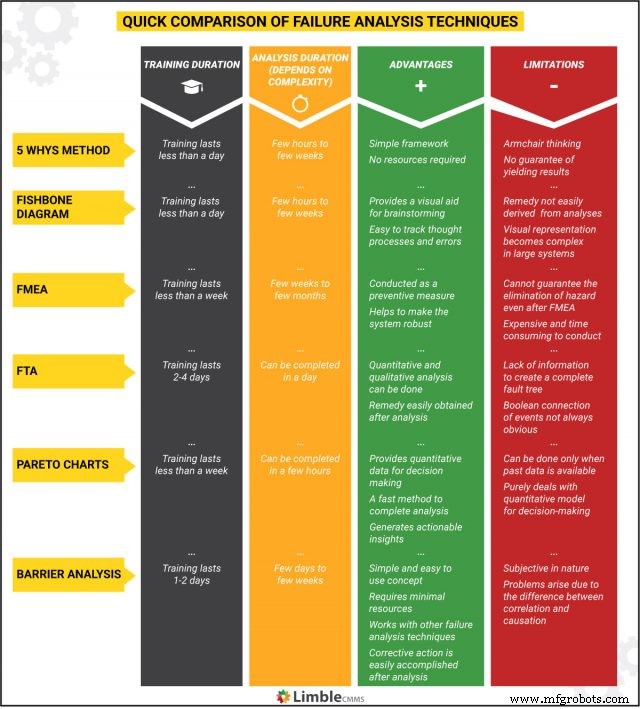
Below is a quick table that compares FA techniques based on the time needed to train your internal team to use them, how long it takes to conduct each, as well as the main advantages and limitations of the respective failure analysis methods.
Key takeaways
Failure analysis is a versatile tool that has many purposes. It can be used to investigate past failures, understand failure mechanisms, and predict the modes of future failures.
There is no ‘one size fits all solution’ to conduct failure analysis. The technique selection will depend on the goal of the analysis, available resources, access to relevant data, and what the failure analysis team knows and prefers to use.
Equipment Maintenance and Repair
- 5 Expert Tips for Selecting the Right CNC Repair Service
- Choosing the Right Failure Analysis Tool: A Practical Guide for Reliability Professionals
- 5 Essential Criteria for Selecting Reliable Open‑Source Code
- Maximize Long-Term ROI: Expert Guide to Choosing Robotic Welding Consumables
- Select the Ideal Trash Pump for Reliable Dewatering
- 5 Essential Tips for Selecting the Ideal Order Management System
- How to Select the Ideal Attachment for Your Equipment Rental
- How to Pick the Best Equipment for Landscaping Projects
- How to Select the Ideal Insurance Coverage for Your Heavy Equipment
- How to Select the Ideal Compact Equipment for Your Farm