



Understanding Maintainability: The Key to Reliable Asset Management

Maintainability is a buzzword in discussions of maintenance and reliability, yet many still miss its true essence. In this article we unpack the concept, show how it can be measured, and explain how thoughtful asset design elevates maintainability.
What Is Maintainability?
Maintainability is a cornerstone for equipment manufacturers, operators, and asset managers alike. In its simplest form, it refers to the “ease of performing maintenance.”
Consider the everyday scenario of replacing a flat car tire. The fact that spare tires fit any rim and that each wheel bolt can be tightened with a single wrench size illustrates maintainability in practice.
Asset managers—who keep complex, critical machinery running across diverse industries—face the same challenge whenever an asset stops. Their goal: restore functionality quickly while minimizing maintenance costs. The easier a repair or routine service can be executed, the higher the asset’s maintainability.
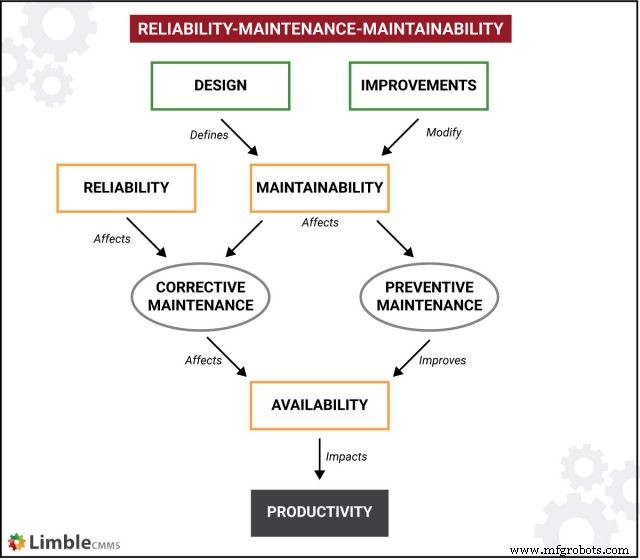
Maintainability in the context of reliability and maintenance
Reliability, availability, and maintainability are intertwined concepts that empower asset managers to assess and improve any asset‑management program.
The RAM Framework: Reliability, Availability, Maintainability
The acronym RAM represents a holistic framework that guides asset design and operation toward minimal downtime and reduced lifecycle costs. RAM analysis evaluates:
- Reliability: The probability that an asset performs its intended function under specified conditions for a given period. It is often quantified by mean time between failures (MTBF).
- Maintainability: How quickly a unit or system can be repaired, determining downtime patterns. It is measured by mean time to repair (MTTR). Lower MTTR indicates higher maintainability.
- Availability: The proportion of uptime over a defined interval, calculated from both MTBF and MTTR.
RAM studies are essential tools for any facility that relies on physical assets, enabling the optimization of operational performance.
Can Maintainability Be Measured?
A key metric for maintainability is the maintenance cost relative to the replacement asset value (RAV). Tracking this percentage ensures expenses stay within industry benchmarks. Lower maintenance costs correlate with higher maintainability.
In summary, high maintainability is reflected in both low MTTR and low maintenance costs.
Achieving the desired maintainability requires a rigorous analysis during the design phase, focusing on:
- Utilizing readily available materials and components
- Standard fitting and bolting connections
- Enabling clear fault identification
- Ensuring straightforward assembly and disassembly
- Other design best practices
Designing for Maintainability
Industry standards, best practices, and maintainability requirements converge into six key categories that guide designers toward highly maintainable assets.

1) Standardization
Minimizing part variety reduces inventory, tooling, and training needs. For example, using standardized USB connectors allows a single port to accommodate a wide range of devices without compromising functionality.
In industrial contexts, standardizing bolt sizes and fastener types simplifies assembly and maintenance, often by increasing the number of smaller fasteners rather than using larger ones.
2) Modularization
Building complex machines from modular sub‑assemblies enables independent maintenance of each block. Benefits include:
- Easy disassembly and reassembly, improving accessibility for repairs.
- Cost‑effective sub‑assembly replacement versus component repair.
- System‑level upgrades by swapping modules instead of whole equipment.
Examples span consumer electronics—where screens or drives can be swapped—to power turbines, where blades are modularly attached to rotors.
3) Interchangeability
Employing standard, generic parts allows users to source compatible spares from the market when originals are unavailable, reducing lead times and costs. A typical illustration is the interchangeable bearing sizes used by major manufacturers.
4) Malfunction Annunciation
Real‑time fault detection alerts operators before catastrophic failure. In vehicles, a temperature gauge warns of overheating; in industrial plants, sensors monitor temperature, pressure, and vibration, raising alarms that feed into CMMS for proactive scheduling.
5) Fault Isolation
Design features that quickly pinpoint root causes save time and money. Appliances often display error codes (e.g., E1 for a blocked washing‑machine discharge pipe). Advanced monitoring can pinpoint the exact component needing attention, eliminating costly trial‑and‑error repairs.
6) Identification and Tagging
Unique, meaningful tags—such as “E-123” for heat exchangers or “P-456” for pumps—streamline communication, record‑keeping, and parts procurement. CMMS systems can retrieve specific maintenance histories and instructions based on these tags.
Additional Strategies to Boost Maintainability
While procurement decisions set the baseline, organizations can influence maintainability through operational practices:
- Keep preventive maintenance checklists, drawings, logs, and procedures readily accessible—ideally via a CMMS mobile app.
- Invest in continuous training for maintenance staff to handle even simple tasks efficiently.
- Standardize equipment and MRO inventory to reduce tool and skill variety.
- Implement standardized operating procedures to cut human error and boost productivity.
- Prioritize proactive maintenance to preempt major breakdowns that demand extensive resources.
These incremental changes compound over time, yielding significant performance gains.
Reduce Reactive Maintenance by 73.2%
See the Results Red Hawk Enjoys With Limble
Read Our
Case Study

Key Takeaways
Maintenance professionals aim to keep equipment operating with minimal interruptions. Achieving this requires adherence to asset reliability and maintainability best practices.
Key performance indicators such as MTTR and maintenance cost per replacement asset value offer clear, actionable metrics.
Designing for maintainability—through standardization, modularity, fault detection, and robust identification—significantly reduces downtime and costs.
Adopting a CMMS platform further streamlines maintenance execution, amplifying overall facility maintainability.
Equipment Maintenance and Repair
- Why Companies Are Building Custom Voice Agents to Secure Data and Drive Automation
- Strategic Asset Management: Unlocking Sustainable Operational Excellence
- Top Benefits of Asset Tracking for Business Success
- Best Practices for Safely Disposing of Equipment: Protecting the Environment and Your Business
- Plant Maintenance Explained: Types, Objectives, and Key Benefits
- 5 Proven Steps to Optimize Your Asset Maintenance Process
- Understanding Periodic Maintenance: Core Principles and Benefits
- Essential Features of Predictive Maintenance Systems for Optimal Asset Management
- Unplanned vs Unscheduled Maintenance: Key Differences Explained
- Predictive Maintenance Techniques: Boost Asset Reliability & Cut Costs