



Choosing the Right Failure Analysis Tool: A Practical Guide for Reliability Professionals
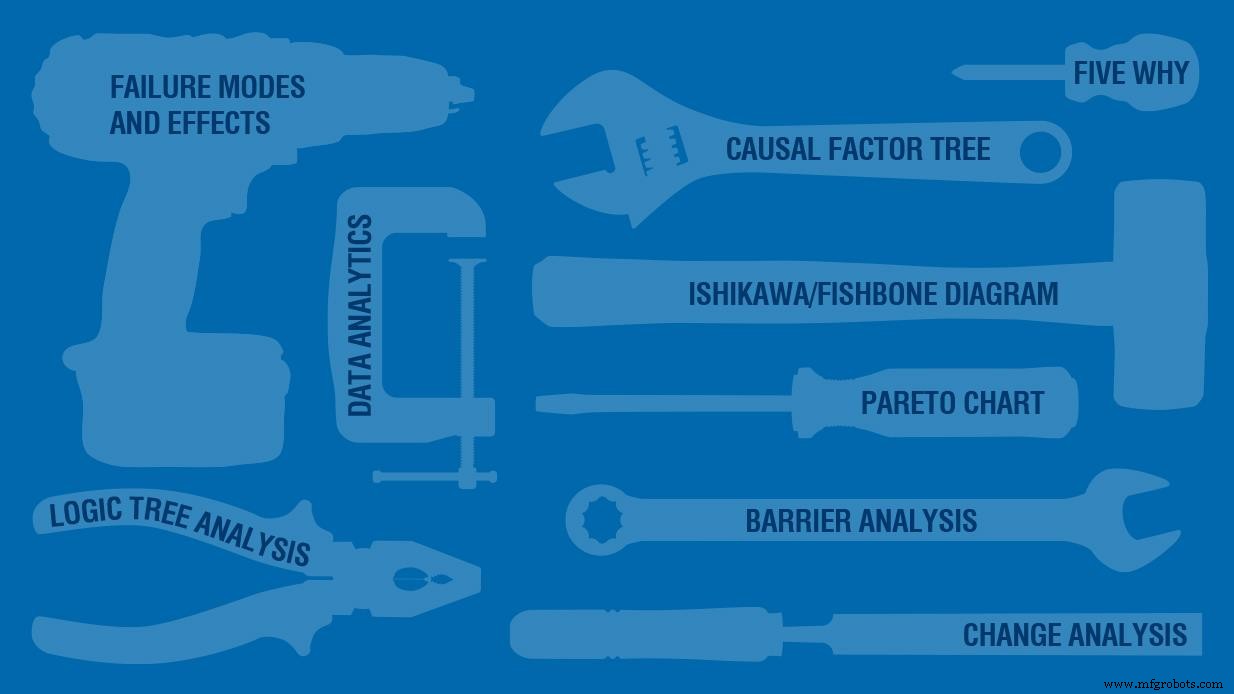
Introduction
In complex industrial environments, equipment and process failures can be costly and disruptive. Reliability and maintenance teams must select the most appropriate analytical method to diagnose issues quickly, avoid unnecessary work, and prevent recurrence.
While many root‑cause analysis (RCA) frameworks exist, each is designed for specific contexts—safety investigations, production quality, business processes, equipment failures, or system‑wide risk management. Choosing the right tool depends on the problem’s scope, required depth, and available resources.
Key Questions to Guide Your Choice
- What is the current impact of the problem?
- What could happen if the problem remains unresolved?
- What risk level is acceptable from legal, contractual, and ethical perspectives?
- What balance of risk, cost, and benefit will deliver an acceptable outcome?
Root‑Cause Analysis Frameworks
Below is a concise overview of the most widely used RCA methods, highlighting their core strengths and limitations. Use this as a quick reference when evaluating which tool to deploy.
1. Five Whys
Iteratively asks “why” until the underlying cause is revealed. Ideal for mechanical or chemical problems where a single causal chain is evident.
Advantages
- Requires minimal team size—often one or two people.
- Fast and flexible, allowing quick resolution for component‑level failures.
- Easy to learn and apply in the field.
Limitations
- Assumes a single cause per effect; multiple concurrent causes may be overlooked.
- Effectiveness drops for human or organizational root causes.
- Complex problems may require multiple independent chains of questioning.

Figure 1. Five whys scenario
2. Ishikawa / Fishbone Diagram
A visual cause‑effect diagram that categorizes potential causes into branches resembling a fish skeleton.
Advantages
- Encourages team collaboration and idea generation.
- Provides a clear visual summary of possible root causes.
Limitations
- May become unwieldy with many contributors; requires disciplined pruning.
- Best suited for problems with a single failure mode; complex multi‑cause scenarios can be harder to manage.
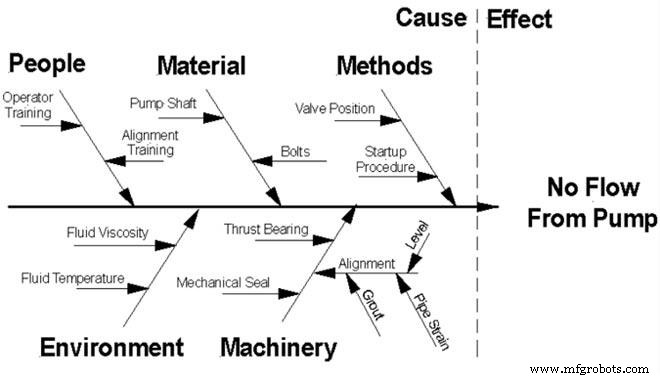
Figure 2. Ishikawa/Fishbone diagram
3. Causal Factor Tree / Fault Tree Analysis
Combines the “why” approach with a logical tree structure, allowing multiple parallel causes to be mapped and tested for necessity, sufficiency, and existence.
Advantages
- Clear hierarchical representation of causal relationships.
- Handles multiple scenarios and can incorporate other tools’ results.
- Suitable for both physical and human root causes.
Limitations
- Complexity can hinder readability, especially with time‑dependent events.
- Identifies knowledge gaps but does not provide solutions for filling them.
- Stopping points may be subjective.
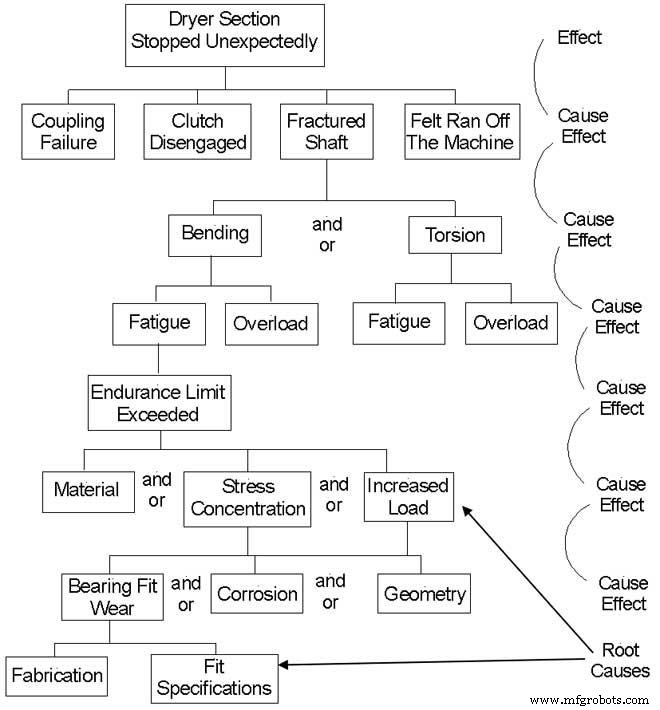
Figure 3. Causal factor tree example
4. Failure Modes and Effects Analysis (FMEA)
A systematic, “what‑if” approach that catalogs potential failure modes, their effects, and associated risks. Often combined with criticality analysis or fault tree techniques.
Advantages
- Provides detailed contingency planning for high‑risk failures.
- Can be performed at component or system level.
- Identifies high‑priority failure modes for corrective action.
Limitations
- Time‑intensive—can span weeks or months.
- May dilute effort on low‑impact scenarios.
- Does not address combined failures or human factors unless explicitly included.
- Typically examines failure hazards rather than normal operation conditions.
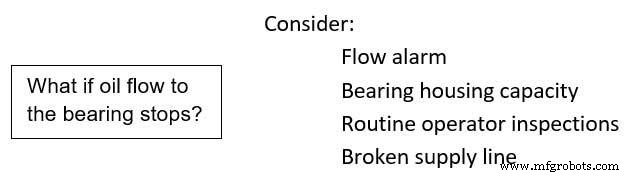
Figure 4. FMEA “what‑if” example
5. Barrier Analysis
Evaluates pathways through which a hazard can impact a target and identifies existing or missing barriers to protect against that hazard.
Advantages
- Conceptually simple and quick to apply.
- Works well as a complement to other RCA methods.
- Results translate directly into corrective actions.
Limitations
- Highly subjective; results can vary between analysts.
- Can conflate causes with countermeasures if not carefully documented.
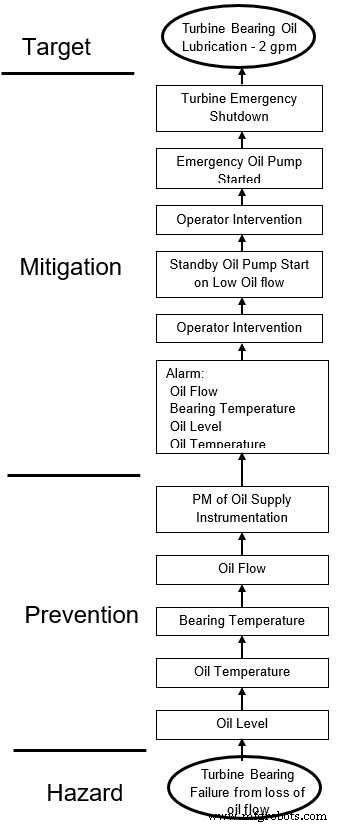
Figure 6. Barrier analysis of turbine lubrication monitoring system
6. Change Analysis / Kepner‑Tregoe
Compares a current, problematic state to a desired or baseline state, identifying the minimal changes that explain the deviation.
Advantages
- Effective for functional failures with clear baseline data.
- Results are readily actionable.
- Integrates smoothly with other analysis techniques.
Limitations
- Requires a well‑defined comparison baseline.
- Best suited for single, discrete deviations.
- Only identifies direct causes; further investigation may be needed.
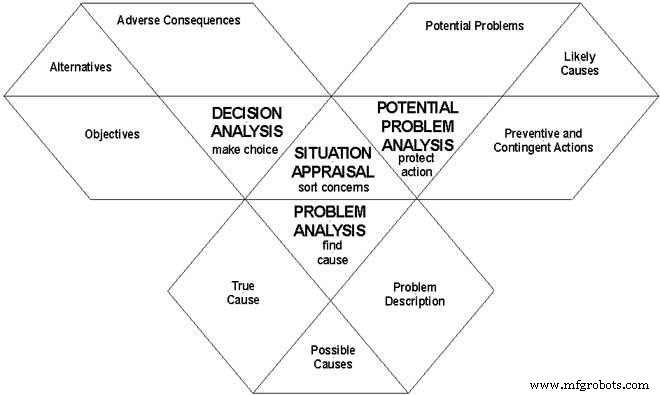
Figure 7. Kepner‑Tregoe model
7. Statistical Tools & Data Analytics
Statistical techniques such as Pareto charts, MTBF/MTTR calculations, and data‑driven analytics uncover trends and hidden relationships in maintenance data.
Pareto Analysis
- Identifies the “vital few” problems that account for the majority of failures.
- Easy to generate with any spreadsheet or charting tool.
- Can produce significant cost savings—one example reduced maintenance spend by over $1 million per year.
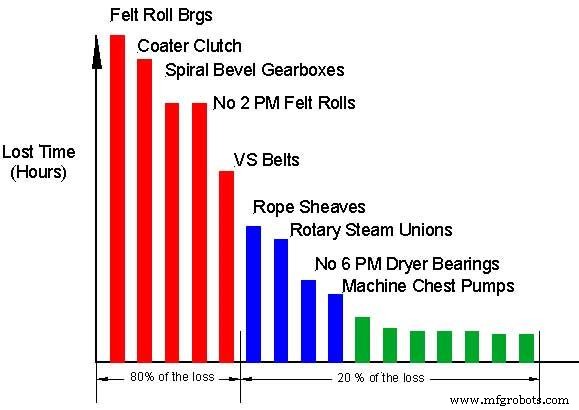
Figure 8. Pareto chart
Data Analytics
- Leverages IoT sensors and statistical modeling to validate hypotheses or discover new relationships.
- Supports predictive maintenance and real‑time process optimization.
- Bridges the knowledge gap left by a shrinking experienced workforce.
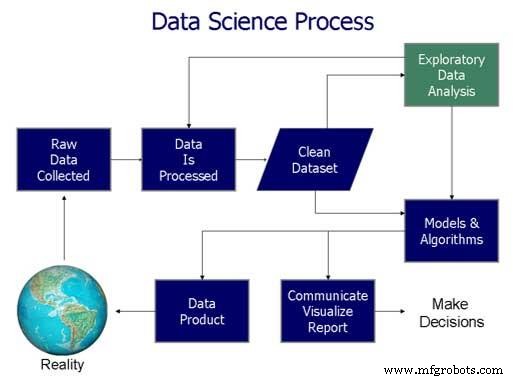
Figure 9. Data science process flow chart
Common Pitfalls in Root‑Cause Analysis
- Overreliance on a single model can blind analysts to alternative solutions.
- Including every conceivable cause can dilute focus and increase analysis time.
- Unverified hypotheses can lead analysts down the wrong path.
- Starting the analysis at the wrong failure level (functional vs. component) can skew the investigation.
Practical Implementation
Adopt a layered approach:
- Use Five Whys or a Fishbone diagram for quick, low‑cost investigations.
- Apply Fault Tree or Causal Factor Tree for complex, multi‑cause problems.
- Reserve FMEA for high‑impact, high‑risk scenarios where detailed risk quantification is essential.
- Leverage Statistical tools and Data analytics to uncover long‑term trends and validate root‑cause findings.
Training recommendations:
- Front‑line technicians: Five Whys, Fishbone, Barrier Analysis, and basic failure mode identification (4–5 days).
- Reliability engineers: All core methods plus statistical analysis and data analytics (7–10 days).
- Facilitators: Advanced Fault Tree and Change Analysis (5–7 days).
When selecting a method, consider the problem’s severity, the team’s expertise, and available time and resources. The goal is to achieve a reliable solution while minimizing cost and disruption.
Additional Resources
For deeper dives into specific techniques, consult industry repositories such as Rootisseriet, which offers a wealth of articles and case studies on root‑cause analysis.
Internet of Things Technology
- 5 Expert Tips for Selecting the Right CNC Repair Service
- Selecting the Optimal Failure Analysis Technique for Reliable Equipment
- 5 Essential Criteria for Selecting Reliable Open‑Source Code
- How to Select the Ideal Robotic Welding System
- Select the Ideal Trash Pump for Reliable Dewatering
- Self-Dumping Hopper: The Essential Tool for Efficient Warehouse Operations
- Selecting Certified Tools to Prevent Explosions in Hazardous Work Environments
- Budget-Friendly Prototyping: Tools & Tips for Cost-Effective Innovation
- 5 Essential Tips for Selecting the Ideal Order Management System
- Choosing the Right Coaxial Cable: A Comprehensive Expert Guide