



How to Extend Bearing Life: Proven Repair Strategies and Savings
By Jay Alexander
A bearing that shows signs of wear after prolonged use in a heavy‑industrial environment is not necessarily destined for scrap. With proper repair, many bearings can be restored and put back into service multiple times, extending their operational life.
Too often, operators discard a bearing without realizing that repair can be a cost‑effective way to extend life. Leveraging a bearing‑repair service can cut the cost of a new bearing by up to 60 % and restore the bearing to like‑new specifications in roughly one‑third the time required to source a replacement.
In many cases, a successfully repaired bearing can support two or more additional life cycles comparable to its original performance. That means a single repair can unlock several years of operation—well beyond what a new bearing would have delivered in that same period.
Because repair offers such compelling time and cost advantages, it’s worth evaluating whether it fits your operations. Below we outline the key factors that determine when repair is appropriate.
Why repair instead of replace?
Premature bearing failure is common in heavy‑industrial settings, with less than 10 % of bearings reaching their theoretical L10 life. Theoretical life, or L10 life, is the time at which only 10 % of bearings in a given application are expected to fail from fatigue.
Factors such as overload, inadequate lubrication, contamination, high temperature, short maintenance intervals, installation errors, and more can push a bearing well below its L10 threshold. However, a bearing that has survived its initial wearing‑in period can often continue to operate reliably if it is repaired by a qualified provider.
Recent advances in bearing design, steel cleanliness, and repair techniques have made it possible to achieve performance on par with new bearings. Independent studies show that a properly repaired bearing will typically complete a second service cycle comparable to the first. In many cases, two or even three additional cycles can be realized before the bearing reaches its theoretical life.
Missing out on repair means losing years of operation and missing up to 60 % in cost savings. A high‑quality repair program also offers warranties and guarantees that parts used—such as races, rollers, and seals—meet OEM materials and tolerances.
Bearing repair eligibility
Repair is viable for heavy‑duty applications across metals, cement, oil & gas, mining, power generation, pulp & paper, aggregates, and more. All bearing types—tapered, spherical, cylindrical roller, ball, thrust, and cross‑roller—are eligible, regardless of original manufacturer.
Not every damaged bearing is a candidate for repair. If a bearing is excessively worn, has severe spalling, or has been worked out of round, it may not be possible to restore it to like‑new condition. A qualified service provider will assess whether repair is feasible and which method delivers the best long‑term outcome.
Regular monitoring and inspection—conducted by trained personnel—are essential for early damage detection. Routine checks, preventive and predictive maintenance, and vibration analysis reduce downtime and cost while maximizing the benefits of repair.
Common indicators that repair is needed include:
- The bearing is near or has exceeded its recommended life expectancy
- Operating temperatures exceed 200 °F
- Excessive vibration is detected
- Sudden changes in lubrication or temperature occur
- Unusual audible noise is heard during operation
- Seal integrity is compromised
The repair process
Bearings sent to a repair centre undergo a documented, step‑by‑step process—from cleaning to final inspection and packaging—to guarantee consistent quality.
First, the bearing is cleaned thoroughly. It is then disassembled, with technicians recording clearances and tagging each component for traceability.
A detailed inspection follows, checking for fractures, major spalling, heat‑damage bluing, and other critical defects. Measurements of the bore, outer diameter, and race roundness determine whether repair is feasible and which method is appropriate.
Repair methods are grouped into three service levels based on damage severity:
- Type 1 – Recertification: Bearings are cleaned, examined, measured, and then preserved and packaged for long‑term storage or transport. This is ideal for unused stock that has expired or been out of use.
- Type 2 – Reconditioning: Bearings receive cleaning, polishing, measurement, and preservation. The goal is to return them to near‑original condition.
- Type 3 – Remanufacturing: Bearings are cleaned, examined, raceways and ribs are reground, new rollers or components are fabricated as needed, and clearances are reset before packaging.
These levels typically apply to bearings with an internal diameter of 12 in. or larger. Smaller bearings (as small as 3 in. I.D.) can be reclaimed through a proprietary vibratory polishing process that restores them to like‑new condition at a fraction of the cost of replacement.
Repair also offers modification services, enabling the addition of performance enhancements, retrofits, or upgrades to existing designs.
Turnaround times vary: initial inspection and quoting take one‑two weeks; reconditioning can be completed in 2–4 weeks; reclamation of small bearings takes 4–6 weeks; remanufacturing typically requires 8–14 weeks, depending on complexity.
In‑house repair is possible for recertification or reconditioning, but remanufacturing requires specialized equipment, tooling, and expertise that only dedicated repair facilities possess.
Types of damage
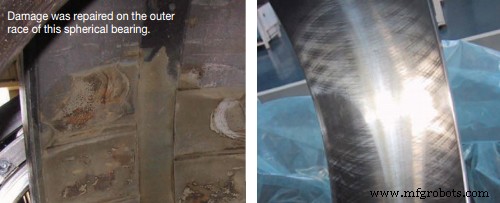
Damage encountered during repair ranges from visible corrosion and scuffs to subtle cracks or fractures that could lead to catastrophic failure if left unaddressed.
Common damage categories include:
- Chemical: Etching, stains, corrosion pitting, rust, or fretting corrosion.
- Heat: Discoloration or checks.
- Electrical: Burns, fluting, or pitting.
- Mechanical: Fatigue flaking, cracks, spalling, fractures, nicks, peeling, brinelling, scoring, abrasive wear, installation damage, misalignment, or lubrication failure.
Most damage types are repairable, except for extreme spalling, fractures, heavy etching, or torch‑heat damage. Contact a repair technician for a damage assessment and feasibility study.
Repair limitations
While repair can extend bearing life, there are practical limits. Bearings should not be remilled more than three times, as excessive material removal compromises design integrity.
Timken’s standards recommend a maximum stock removal of 0.025 in. per race and a roller size deviation of no more than 0.015 in. from OEM specifications.
Repairing is not a cure‑all; for instance, polishing cannot remove deep wear or indentations. Proper assessment and skilled workmanship are essential to avoid further damage.
Maximizing value
Use repair as a diagnostic tool to identify root causes of wear. Corrective actions—such as seal redesign or lubrication improvement—can reduce future damage and extend the bearing’s L10 life.
Timing is critical: removing a bearing too early wastes its full potential, while retaining it too long can push it beyond the point where repair remains economical. A balanced approach maximizes cost savings.
Inspection reports are invaluable. For example, black staining and rust typically point to water ingress, while abrasive wear indicates foreign material intrusion. Addressing the underlying seal or protection issue often resolves the problem.
Choosing bearing repair
When a bearing fails, the entire operation suffers—extra downtime, longer maintenance schedules, and delayed deliveries. Repair offers a fast, economical solution that extends the bearing’s life along its theoretical life line.
A robust repair program can deliver significant time and cost savings compared to discarding worn bearings and purchasing new ones.
Jay Alexander is general manager for Timken Industrial Bearing Services – North America. For more information, use the link below.
Equipment Maintenance and Repair
- Flange Bearings 101: What They Are, How They Differ, and How to Choose the Right One
- Ball Bearings: Evolution, Manufacturing, and Quality Assurance
- To Grease or Not to Grease: Best Practices for Electric Motor Bearing Lubrication
- Maximizing Bearing Longevity in Food Processing Operations
- How Food-Processing Plants Extend the Life of Disposable Worm Gearboxes with Advanced Lubricants
- The Three‑Barrier Solution: Enhancing Bearing Longevity in Harsh Environments
- Extend the Life of Automation Assets: Proven Strategies for Longevity and Performance
- Proven Strategies to Extend the Lifespan of Your Punch Tools
- Understanding Bearing Functionality and Innovation in Modern Machinery
- Maximize Your Robot’s Longevity with Expert Maintenance Practices