



Mastering Excavator Boom Configurations: Boost Efficiency and Versatility
I often hear excavators called the “Swiss Army knife” of the construction industry, and it’s true — they’re multi-tasking machines capable on practically any jobsite. A lot of people attribute their flexibility to a broad range of class sizes with multiple attachment options, but you may not realize that a big part of what makes excavators so versatile is the boom.
If you’re new to excavators, or if you use product brochures to spec machines, these boom tips may be beneficial the next time you’re in the market for a machine for a specific application.
-
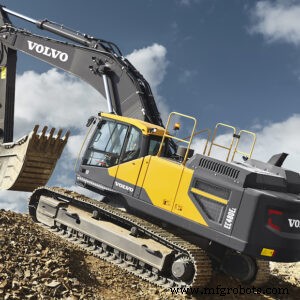
Mono Boom (Standard Boom): This is what we call the standard setup — it provides good reach and a decent bucket size range and is the most popular setup by far. Some customers use a mass excavation setup, which is a shorter boom and short stick. They go this route because they can put a bigger bucket on it. Using our 42-ton Volvo 380E excavator as an example, you have the choice of a 20′ 4″ (6.2 m) mass excavation boom with an 8′ 4″ stick, which allows you to put on that bigger bucket and move more material. Plus, it’s faster because you don’t have as far to swing. It’s one of the most productive setups, but you can be limited by reach.
-
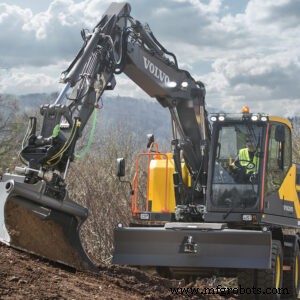
Two-Piece Boom: Two-piece booms are very versatile and can actually out-lift a mono boom up close to the machine. The mono boom, however, gives you more reach and out-lifts a two-piece boom at full extension. Two-piece booms allow you to change the bend of the boom to decrease its working height, which is ideal for digging under a bridge or in a building, for example. The price difference between a mono boom and two-piece boom isn’t very significant, which gives you options to get the configuration you need to best suit the work at hand.
-
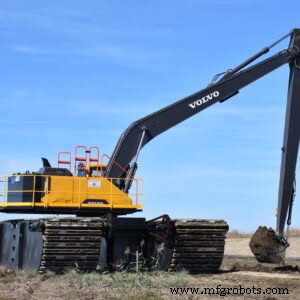
Long-Reach Boom: Long-reach booms are great for cleaning out ponds and canals — jobs where you’re digging out in water and need the extra reach. Boom length varies based on manufacturer and machine model. For example, the long-reach version of the Volvo EC380 excavator is 27′ 11″ (8.5 m) compared to the 21′ 2″ (6.45 m) standard boom and 16′ 5″ (5 m) arm that provide a max reach of 48′ 5″ (14.75 m).
- This brings up a good reminder on machine nomenclature. The “L” in EC380EL means it has a long undercarriage — the “LR” in our EC380ELR stands for long reach.
-
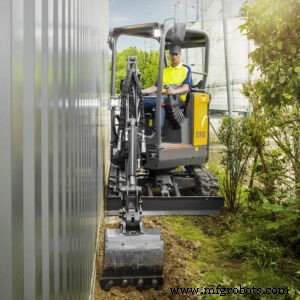
Two-Piece Offset Boom: The two-piece offset boom is another option on some excavator models. A two-piece offset boom knuckles off to the right or the left. If, for example, you’re working in a tight alley with limited swing, you can knuckle the boom over so that it digs in line with one of the tracks up next to a structure. Note on large machines it will decrease your lifting capacity because you have a knuckle and the cylinders out on the boom, so you’re increasing the weight that’s out in front of the machine. Two-piece offset booms are more expensive and can require additional maintenance. This boom configuration is popular in cities with extremely tight workspaces.
In general, a large percentage of customers go with a two-piece boom on wheeled excavators and a standard mono boom on crawler excavators.
A Note on Wheeled Excavators
Wheeled excavators are becoming more and more popular in the U.S. because contractors are learning that they dig just like a crawler excavator but are more versatile. Just pull the outriggers up and drive across the neighborhood or down the street. Or use them for lifters, barriers on the highway, etc., and you won’t tear up the ground. When you’re ready for a different job, just fold up the outriggers, drive to your next jobsite, and get to work again.
With outriggers, wheeled machines are just as stable as comparable crawlers — and in some instances, wheeled excavators actually have a wider footprint than a crawler and are more stable. In muddy or rough conditions, crawlers are better for the job — but if you’ve never considered a wheeled machine for your type of work, check them out.
A Unique Value, Only from Volvo
Where Volvo differentiates itself from our competitors is in our lifetime frame and structure warranty on all our excavator booms, arms and frames. We’re the only manufacturer that offers this guarantee. When you buy from Volvo, you don’t have to worry about breaking them — they’re guaranteed for life.
To see our full lineup of excavators and start comparing which machine and boom configuration is right for your job, visit the excavator section of our website.
By John Waldron
Industrial equipment
- Transformers with Multiple Windings: From Taps to Variacs – A Comprehensive Guide
- Mastering Pressure Measurements in Automotive Engineering
- Optimizing Excavator Design: A Proven Simulation Workflow
- Quick 45‑Minute Guide: Convert a High‑Reach Excavator to a Standard Boom for Versatile Operations
- 4 Proven Strategies to Boost Excavator Fuel Efficiency
- Digital Sensors in Industrial Machinery: Function, Types, and Best Practices
- A Comprehensive Guide to Daily Oil Rig Operations
- Primary Air Receivers: Their Role, Benefits, and Optimal Usage
- Maximize Efficiency: Expert Guide to Choosing the Right Excavator Attachments
- 6 Key Benefits of Bobcat Excavators That Deliver Superior Performance