



Advancing vs. Retarding Ignition Timing: Boosting Engine Performance Safely
A vehicle engine is a symphony of precision components—crankshaft, camshaft, pistons, connecting rods, and pulleys—moving in harmony to keep the machine running smoothly.
An internal combustion engine operates through four distinct piston strokes—intake, compression, power, and exhaust—each essential to efficient combustion.
Ignition timing governs when the spark plug fires during the compression stroke. Accurate timing is critical; a spark that is too early or too late can lead to damage over time.
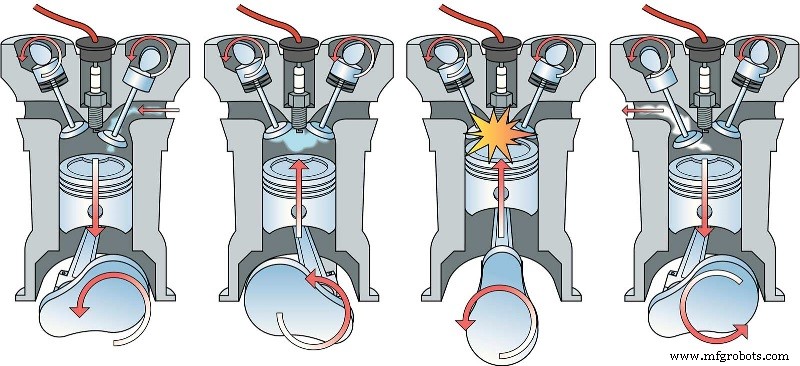
Key stages of a correctly timed combustion cycle:
- The spark plug fires during compression.
- The air/fuel mixture ignites.
- Expanding gases build pressure.
- Pressure peaks as the piston reaches top dead center (TDC).
- Peak pressure pushes the piston down, delivering power.
Following ignition, the exhaust stroke clears spent gases, preparing the engine for the next cycle. The precise timing of the spark is essential for maximizing performance.
Several factors influence ignition timing: spark plug condition, engine temperature, intake pressure, and any engine modifications. Adjusting timing must account for these variables to avoid adverse effects.
Ignition Timing: Advancing vs. Retarding
Ignition timing is expressed in degrees of crankshaft rotation before TDC (BTDC). Adjustments—advancing or retarding—alter when the spark occurs.
Advancing Timing
When the spark fires earlier in the compression stroke, the mixture has more time to ignite. This can increase horsepower by raising high‑end power, though it may reduce low‑end torque if pushed too far.
Retarding Timing
Delaying the spark reduces the risk of detonation—engine knocking that occurs when the mixture combusts prematurely. For turbocharged or supercharged engines operating at high pressures, retarding timing can improve efficiency by compensating for denser air/fuel mixtures.
How to Adjust Timing
Consult your vehicle’s owner’s manual for specific timing ranges. Modern engines rely on the ECU to advance or retard timing automatically based on sensor data. If your engine uses a distributor, manual adjustments are possible but require knowledge and proper tools.
Signs Your Ignition Timing Is Off
Incorrect timing can manifest in several ways. Monitor these symptoms to catch issues early:
- Engine knocking: A pinging sound caused by premature combustion.
- Reduced fuel economy: Mis-timed combustion forces the engine to burn more fuel to maintain power.
- Overheating: Premature ignition generates excess heat, stressing engine components.
- Low power: Excessive retarding can delay combustion, limiting engine output.
Addressing these signs promptly preserves engine health and performance.
Learn More About Ignition Timing at UTI
If you’re fascinated by automotive engineering, a career at Universal Technical Institute (UTI) can turn that interest into expertise. Our Automotive Technology program offers hands‑on training for diagnosing, maintaining, and repairing ignition systems, including advanced timing courses.
The Power & Performance II course builds on foundational knowledge to deepen understanding of timing and engine performance. Complete the program in under a year and enter the workforce ready to tackle real‑world challenges.17 Find out more about the program by requesting information here.
Industrial equipment
- IBM Breaks New Ground with 7 nm FinFET Technology Using EUV Lithography
- IIC and OpenFog Merge to Drive Edge Computing Innovation
- Secure Remote Access: Driving Innovation in Process Industries
- Celebrating 30 Years: MEP’s Impact on U.S. Manufacturing Excellence
- Optimize Maintenance: Usage‑Based Timing for Maximum Uptime
- CDI Systems: Reliable Spark for Small Engine Ignition Applications
- Drive Belt vs Timing Belt: Key Differences Explained
- How Electronic Ignition Systems Work: A Complete Guide
- How Magneto Ignition Systems Work: Key Principles & Applications
- Mastering Transistorized Ignition Systems: Design, Function, and Benefits