



How Car Air‑Conditioning Systems Operate: A Technical Guide
When asked how a car’s air‑conditioning system functions, many simply want it to work. If you’re curious about the science behind the cool, dry air you feel inside, this guide offers a clear, expert‑level overview of the system’s theory, components, and operation.
How Car AC Works
The heart of automotive air‑conditioning is the refrigerant cycle, which alternates a liquid refrigerant between low‑pressure gas and high‑pressure liquid states. This phase change absorbs heat and moisture from the cabin air, allowing the system to deliver cool, dry airflow.
Control of pressure and temperature drives the refrigerant’s state changes, enabling the cycle to run efficiently and reliably.
Refrigerants Used in Automotive AC
Early systems employed R‑12 (Freon), a non‑flammable chlorofluorocarbon that proved harmless to humans but destructive to the ozone layer. In the 1990s, manufacturers switched to R‑134a, a hydrofluorocarbon with no ozone‑depleting potential. The latest generation uses R‑1234yf, which emits far fewer greenhouse gases. While Europe mandates R‑1234yf, it is poised to become the U.S. standard soon.
Key Components of a Car AC System
Automotive air‑conditioning systems rely on several critical parts:
Compressor
- Serves as the system’s power unit, separating low‑pressure and high‑pressure sides.
- Draws in low‑pressure refrigerant gas and compresses it into a high‑temperature, high‑pressure gas.
- Mounted on the engine’s front and driven by the serpentine belt.
Condenser
- Cool the high‑pressure gas, converting it to a high‑pressure liquid.
- Functions like an engine radiator, using forced air from a fan or vehicle motion to dissipate heat.
- Located just behind the front grill.
Dryer (Receiver/Filter Drier)
- Removes moisture from the refrigerant using a desiccant, also providing filtration.
- Installed on the high‑pressure side between the condenser and the metering device.
Metering Device (Expansion Valve or Orifice Tube)
- Lowers refrigerant pressure, causing a rapid temperature drop.
- Releases a liquid refrigerant that remains under low pressure as it enters the evaporator.
- Placed on the high‑pressure side, between the dryer and the vehicle firewall.
Evaporator
- The refrigerant evaporates, absorbing heat and moisture from cabin air.
- Cabin air passes over the evaporator coils, emerging cool and dry.
- Only component inside the passenger compartment, positioned behind the dashboard.
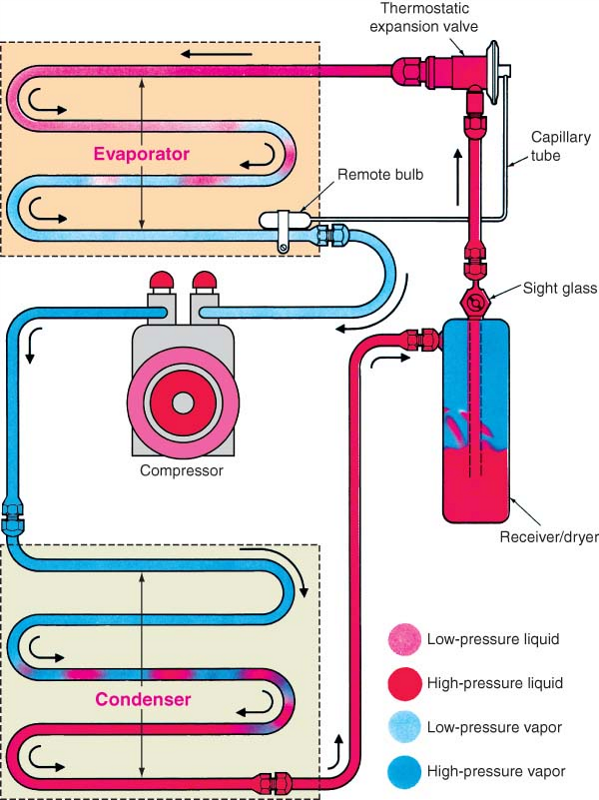
Refrigerant Flow Path
- Low‑temperature, low‑pressure refrigerant gas enters the compressor.
- Compressor outputs high‑temperature, high‑pressure gas.
- Gas cools in the condenser and condenses into a high‑pressure liquid.
- Dryer removes residual moisture from the liquid.
- Expansion valve reduces pressure, turning the liquid into a cold, low‑pressure gas.
- Gas evaporates in the evaporator, cooling cabin air.
AC System Diagram
The diagram below illustrates the main components and their connections:
Common AC System Failures
Because automotive AC operates under high pressure, the system must remain sealed. Leaks or contaminants can trigger failures that, if left unaddressed, may damage the compressor or render the system inoperable.
A simple recharge won’t fix a leak; you must locate the fault, replace the defective component, evacuate, and then recharge the system.
Key failure points include:
- Refrigerant leaks that reduce pressure and can overheat the compressor.
- Condenser blockage from road debris, which impedes airflow and reduces cooling efficiency.
- Dryer failure, allowing moisture to enter the system.
Implications for Your Career
Air conditioning has become a standard feature in every new U.S. vehicle. As a result, automotive AC technicians are in high demand to diagnose and repair issues such as warm air, unusual noises, and cabin water leaks.
Train to Become an Automotive Technician
At Universal Technical Institute (UTI), students gain hands‑on experience with every vehicle system, including air conditioning. In less than a year, you can acquire the skills to launch a career as an automotive technician. 1 To learn more, visit our program page and request information from an Admissions Representative today. 7
Industrial equipment
- How Car Suspension Systems Work—and Why They’re Critical for Safety
- Turbochargers Explained: How They Boost Engine Performance
- How Car Braking Systems Operate: Disc vs. Drum, Parts, Wear Signs, and Technician Careers
- How SCADA Systems Operate: Monitoring and Controlling Industrial Processes
- Boost Efficiency of Your Air Compressor Systems: Proven Tips & Strategies
- How Air Dryers Work: Keeping Compressed Air Clean & Efficient
- How Air-Over-Hydraulic Brakes Work: A Clear Guide
- Understanding Ventilation Systems: Keeping Your Indoor Air Fresh and Healthy
- Quick Guide: Repair Your Car AC in 5 Simple Steps
- How to Recharge Your Car's Air Conditioner: Step-by-Step Guide