



Optimizing Robotic Cells with Advanced Part‑Entry Accessories
In the first part of this series we highlighted how part‑entry accessories enhance automation profitability. Now we’ll explore three key solutions that excel when bulk feeding isn’t viable or when part geometry imposes no restrictions.
The Drawer System
Think of a kitchen drawer—only this version feeds parts into a robot. An operator opens the drawer, places the part, and closes it, handing the item to the robotic arm. The arm then picks, processes, and returns the part. Drawer systems accommodate any shape or size, making them ideal for offline production lines that require manual loading by one or more operators.
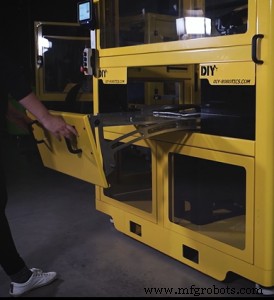
Choosing a drawer design depends on the robot’s motion profile. Multiple drawers can run in parallel, letting the robot work on one while another loads, thereby reducing downtime and boosting throughput.
Benefits
- Handles a wide range of products
- Customizable: single or double‑drawer options
- Operators can work on several drawers simultaneously
- Enables uninterrupted, continuous production
- Separates operator from the machine’s work zone
- Works with non‑symmetrical parts
Industries such as metal, plastic, automotive, electronics, and pharmaceuticals routinely use drawer feeders. Whether you need a single or double configuration, drawer systems deliver reliability and flexibility.
Equip your DIY robotics cell with the Lightbeam add‑on for a high‑performance drawer solution.
The Rotary Door
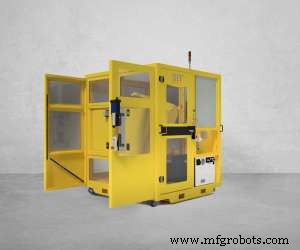
Rotary doors provide secure access for operators to add or remove parts without interrupting the robot’s cycle. They allow simultaneous work by the operator on one side and the robot on the other, speeding up part entry and enhancing safety.
Benefits
- Adaptable to varying part dimensions
- Supports concurrent operator and machine operation
- Cost‑effective and efficient
- Prioritizes operator safety
Rotary doors are common in automotive, metal, plastic, and many other sectors. They’re especially useful during maintenance and for providing secure operator access.
Choose the Orbit add‑on to integrate a rotary door into your DIY robotics cell.
The Conveyor
Conveyors—whether belt, roller, O‑ring, or air—transport parts from point A to B. Materials range from rubber and metal to plastic, and designs can be slotted or solid. Selecting the right conveyor type depends on the task: a cleat conveyor can drop finished parts into packaging, a rubber conveyor offers superior traction, a metal conveyor supports inclined layouts, and a slotted conveyor can separate parts.
Conveyors are prized for their versatility: they handle any shape, orientation, weight, or material, making them a staple across numerous industries.
Benefits
- High‑speed, continuous feeding
- Compatible with most robots and machines
- High accuracy and durable construction
- Low‑maintenance and user‑friendly
- Orientation‑independent feeding
- Cost‑effective material handling
Applications include marking, coding, packaging, material handling, robotics, assembly, and rubber processing. Small and medium enterprises can use conveyors to adapt quickly to changing production lines and gain a competitive edge over larger players.
Investing in part‑entry accessories not only improves labor efficiency but also increases throughput, yielding a faster return on investment.
Contact us to discover the best part‑entry accessory for your specific needs.
Related Posts
Industrial equipment
- Understanding Pressure Drop in Air Compressors: Prevention Tips for Reliable Operations
- Understanding Junction Boxes: Purpose, Design, and Safety
- Oxy‑Fuel Cutting: The Timeless, Cost‑Effective Metal Shaping Solution
- Rent vs. Buy: A Strategic Guide to Production Equipment Decisions
- Achieve Unmatched Precision with Star Swiss Lathes – Premium Canadian Aerospace Machines
- Why Oil‑Less Air Compressors Are Essential for Healthcare Facilities
- Are Ultra-Fast Laser Cutting Systems Worth the Investment?
- Quicklime Explained: Properties, Production, and Industrial Uses
- Avoiding Common Pitfalls When Re‑Sourcing Fabricated Metal Products
- Ribbon Blender vs Paddle Mixer: Choosing the Ideal Mixer for Dry Powder Blending