



CFM vs PSI: The Essential Guide for Industrial Buyers
Compressed‑air systems power everything from manufacturing lines and packaging facilities to automotive workshops, food processing plants, and automated production lines. Yet many buyers still confuse two vital compressor specs: CFM (Cubic Feet per Minute) and PSI (Pounds per Square Inch).
Misunderstanding these terms can lead to incorrect sizing, unstable tool performance, pressure drops, higher energy use, and unnecessary downtime.
In practice, the rule is simple:
- A high‑PSI compressor may still underperform if airflow is inadequate.
- A high‑CFM unit can fail if the application demands more pressure.
Before choosing any industrial air compressor, you must understand how CFM and PSI work together.
What Is CFM?
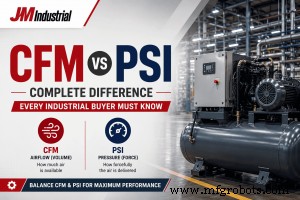
CFM measures the volume of air a compressor delivers each minute. In industrial settings, CFM determines how much compressed air is available to your equipment during operation.
Why CFM Is Often Overlooked
Airflow shortages are usually more disruptive than pressure shortfalls. For example, a packaging line may receive the required PSI, but if multiple pneumatic cylinders cycle simultaneously and demand exceeds the compressor’s CFM, operators may see:
- inconsistent actuator movement
- slower cycle times
- pressure fluctuations
- production interruptions
These symptoms point to a CFM issue, not a PSI problem.
What Is PSI?
PSI quantifies the pressure force of compressed air. While CFM tells you how much air you have, PSI tells you how forcefully that air is delivered to tools and equipment.
When PSI Matters
Many industrial systems require a minimum pressure to function correctly. If PSI is too low:
- Pneumatic tools lose torque.
- Valves fail to actuate.
- CNC systems become unstable.
- Automation equipment malfunctions.
Increasing PSI beyond what the equipment actually needs does not boost productivity. In many facilities, excessive PSI merely raises energy consumption and accelerates wear.
CFM vs PSI: The Practical Difference
Think of it this way:
- CFM = How much air you get.
- PSI = How forcefully that air is delivered.
Both are essential. An insufficient CFM can choke continuous operation even when pressure looks fine. Likewise, adequate airflow cannot make up for a lack of operating pressure.
Key Differences Between CFM and PSI
| Factor | CFM | PSI |
|---|---|---|
| Full Form | Cubic Feet per Minute | Pounds per Square Inch |
| Measures | Airflow volume | Air pressure |
| Main Purpose | Supply required air quantity | Provide operating force |
| Important For | Continuous airflow applications | Pressure‑dependent equipment |
| Commonly Used In | Packaging lines, conveying systems, automation | Pneumatic tools, CNC machines, fabrication |
| If Too Low | Pressure drops and slower operation | Equipment may not function properly |
| Energy Impact | Insufficient airflow increases compressor runtime | Excess PSI increases power consumption |
| Practical Meaning | How much air is delivered | How forcefully air is delivered |
Why Buyers Miscalculate Compressor Needs
Buyers often focus on PSI because it feels like the “power” figure, overlooking airflow demand. A common scenario: a compressor rated at 125 PSI but with insufficient CFM. At low demand the tools work, but when multiple systems run simultaneously:
- Pressure starts to drop.
- Recovery times lengthen.
- Compressor runs continuously.
- Energy usage spikes.
Although the pressure requirement is met, the airflow capacity is exceeded.
Which Is More Important: CFM or PSI?
It depends on your application. The goal is to balance both.
Applications Where CFM Is Critical
- Sandblasting
- Pneumatic conveying
- Packaging lines
- Automation systems
- Industrial painting
- Dust collection support
Applications Where PSI Is Crucial
- CNC machining
- Heavy pneumatic tools
- Injection molding
- High‑pressure cleaning
- Metal fabrication
The Real Goal: Balanced CFM and PSI
Effective systems deliver the required airflow at the correct operating pressure throughout peak production. Proper compressor sizing is key.
Compressor Sizing Example
Consider a facility with the following demand:
| Equipment | Air Demand (CFM) |
|---|---|
| Pneumatic Grinder | 15 |
| Packaging Line | 25 |
| Air Conveyor | 18 |
| Pneumatic Tools | 12 |
Total Airflow Demand = 15 + 25 + 18 + 12 = 70 CFM
Industrial systems typically reserve extra capacity for simultaneous use, leakage, future expansion, and peak loads. Adding a 25 % margin gives:
70 × 1.25 = 87.5 CFM ≈ 90 CFM
If the line requires 110 PSI, the compressor must reliably provide 90 CFM at 110 PSI. Many buyers verify PSI but ignore whether the compressor can deliver the needed airflow at that pressure.
Why Higher PSI Raises Operating Costs
Running a compressor above the actual requirement may seem like a performance boost, but it has the opposite effect:
- Increased energy consumption.
- Larger leakage losses.
- More aggressive cycling.
- Accelerated component wear.
Even a 2–3 PSI over‑pressure can significantly raise long‑term energy costs.
Signs of Incorrect CFM or PSI
Low CFM Indicators
- Pressure drops during peak production.
- Tools slow intermittently.
- Compressor runs continuously.
- Inconsistent automation cycles.
- Delayed actuator response.
Incorrect PSI Indicators
- Weak pneumatic tool performance.
- Unstable process equipment.
- Excessive air leakage.
- Overheating components.
- Higher maintenance frequency.
Often facilities attribute these problems to compressor failure when the real issue is improper sizing.
Why Tank Size Can Be Misleading
A larger tank does not automatically mean better performance. Tank size mainly affects storage, compressor cycling frequency, and temporary demand buffering. The real operational capability hinges on CFM delivery, PSI stability, and duty cycle performance. Buyers should prioritize airflow performance over tank size hype.
Industry Priorities for CFM vs PSI
| Industry/Application | Priority |
|---|---|
| Packaging Lines | Higher CFM |
| Pneumatic Conveying | Higher CFM |
| Sandblasting | Very High CFM |
| CNC Operations | Stable PSI |
| Automotive Tools | Balanced CFM & PSI |
| Automation Systems | Consistent Airflow |
| Fabrication Shops | Higher PSI |
Choosing the right compressor is more about matching operational demand than selecting the largest model.
Critical Factors to Evaluate
- Actual air consumption (real usage, not estimates).
- Simultaneous equipment operation.
- Future expansion plans.
- Air quality requirements (filtered, oil‑free, moisture control).
- Operating environment (ambient temperature, dust exposure, pipe length).
Common Mistake in Growing Facilities
Expansion without re‑evaluating compressed‑air demand can push airflow beyond original compressor capacity, leading to:
- Unstable pressure.
- Reduced efficiency.
- Increased downtime.
- Higher energy costs.
Replacing equipment is often unnecessary; the real solution is balancing airflow and pressure.
Practical Rule of Thumb
PSI ensures equipment can operate; CFM ensures it can operate efficiently over time.
Conclusion
Understanding CFM and PSI is vital for selecting industrial compressors. PSI guarantees operating pressure; CFM guarantees sustained production. The most effective systems are properly sized, not simply high‑pressure or high‑capacity units.
Frequently Asked Questions
What is more important: CFM or PSI?
Both matter. PSI ensures proper operating pressure; CFM ensures sufficient airflow during operation.
Can higher PSI compensate for low CFM?
No. Higher pressure cannot replace insufficient airflow.
Why do compressors lose pressure during production?
Airflow demand often exceeds the compressor’s CFM capacity during peak operation.
Does a larger tank improve airflow?
No. Tank size only stores compressed air temporarily; airflow capability still depends on the compressor’s performance.
Why do industrial systems require reserve CFM capacity?
Reserve capacity manages simultaneous tool usage, future expansion, leakage losses, and peak production demand.
Industrial equipment
- Top Specialty Screwdrivers Every Electrical Technician Needs
- Types of Sandblasting Media: Choosing the Right Material for Your Project
- Rexroth A8VO Hydraulic Pump: High-Pressure Performance for Industrial Applications
- Auger Drilling Explained: Techniques, Applications, and Benefits
- Mill Finish Explained: What It Means for Metal Surfaces
- 3 Critical Reasons to Schedule Regular Overhead Crane Inspections
- Understanding Ceramic Heating Elements: How They Work and Why They're Superior
- Top Trusted Sources for Industrial Design Inspiration
- FEMCO CNC Lathes Eliminate Workflow Bottlenecks
- Top 5 Benefits of Induction Welding: Energy Efficiency, Precision, and More