



Choosing the Optimal CFM Air Compressor for Industrial Operations
Compressed air is a cornerstone of modern industry, powering everything from pneumatic tools and automation systems to packaging and process equipment. When selecting a compressor, it’s not enough to look at pressure alone—airflow capacity, measured in CFM (Cubic Feet per Minute), is the decisive factor that keeps your equipment running smoothly.
A properly sized CFM system eliminates pressure fluctuations, improves energy efficiency, and guarantees consistent production. This guide walks you through evaluating, sizing, and selecting a compressor that matches real-world industrial airflow demands.
What Exactly Is CFM in an Air Compressor?
CFM represents the volume of air delivered each minute, determining how much work a system can handle. While pressure (PSI) defines the force, CFM dictates the actual amount of air available to tools and processes.
Manufacturer specifications often show ideal airflow, but operating conditions—pressure, temperature, and system resistance—can reduce the effective airflow at the point of use. Understanding usable airflow is therefore essential during compressor selection.
Insufficient airflow doesn’t break the system outright; it degrades performance. Tools slow, automation cycles become erratic, and pressure instability spreads throughout the system—making CFM the most critical parameter for any compressed‑air setup.
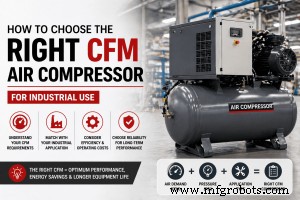
CFM vs PSI: How Airflow and Pressure Work Together
CFM and PSI serve distinct roles. PSI measures the force of the air, while CFM indicates how much air the system can supply.
Many operators mistakenly prioritize pressure, assuming higher PSI will cover for airflow deficits. In reality, a compressor rated for high PSI cannot sustain pressure if its CFM output is inadequate—especially when multiple tools run concurrently.
Below is a quick comparison:
| Parameter | CFM (Airflow) | PSI (Pressure) |
|---|---|---|
| Function | Supplies air volume | Provides force |
| System Impact | Controls performance stability | Controls output strength |
| If Insufficient | Pressure drops & tools slow | Tools lose required force |
| Selection Priority | Must be calculated accurately | Must match application requirements |
The takeaway is clear: size airflow first, then match pressure to your specific needs. A balanced system relies on both, but CFM dictates whether the compressor can sustain operation.
Understanding Industrial Air Demand
Air demand is dynamic, fluctuating throughout the production cycle. Knowing this behavior is vital before calculating required CFM.
- Base Load—continuous equipment such as automated machines, production lines, and process units that require a steady air supply.
- Intermittent Loads—pneumatic tools that run only when needed but collectively contribute significantly to total demand.
- Peak Demand—short bursts when multiple systems operate simultaneously or high‑consumption processes kick in. These spikes often determine if a compressor can maintain stable performance.
- Simultaneity Factor—most industrial setups do not run all equipment at once. Only a percentage of the connected load operates simultaneously, which must be factored into airflow calculations to avoid oversizing or undersizing.
Typical CFM Ranges by Application
Below is a practical reference for aligning your system requirements with compressor capacity:
| Application | Typical CFM Range |
|---|---|
| Pneumatic Tools | 5–20 per tool |
| CNC Machines | 20–100 |
| Packaging Systems | 50–200 |
| Sandblasting | 200–500+ |
| Process Plants | 500–2000+ |
| Heavy Industries | 2000+ |
CFM Classification: Low, Medium, and High Systems
Grouping CFM requirements simplifies decision‑making:
- Low‑CFM Systems—suitable for small workshops and maintenance environments with limited, intermittent demand.
- Medium‑CFM Systems—the most common in industrial settings, supporting manufacturing, packaging, and automation processes that require steady airflow.
- High‑CFM Systems—designed for large‑scale operations where multiple processes run concurrently under heavy load.
Air Compressor Size Guide Based on CFM
Choosing the right compressor size hinges on matching airflow capacity to your operational scale and demand patterns.
- Small Setups—lower airflow, suited for light‑duty operations.
- Medium‑Sized Industries—higher airflow, often using rotary screw compressors for continuous performance.
- Large Facilities—significantly higher airflow, potentially requiring multiple compressors or a centralized system.
- Very Large Plants—centrifugal compressors are ideal for handling extreme airflow demands efficiently over long periods.
Always consider current demand and future expansion to prevent performance limitations later.
Choosing the Right Compressor Type
Different compressor designs excel in specific operating conditions:
- Reciprocating Compressors—best for low‑demand, intermittent applications but not ideal for continuous industrial use.
- Rotary Screw Compressors—widely used in industry due to their ability to deliver continuous, efficient airflow, suitable for most medium to high CFM applications.
- Centrifugal Compressors—ideal for large‑scale operations requiring very high airflow, maintaining consistent, high‑volume performance in centralized setups.
How to Calculate Required CFM
Accurate CFM calculation goes beyond summing tool specifications. It requires a realistic view of system operation.
- Identify the airflow requirement of each piece of equipment.
- Determine how many units run simultaneously to estimate base demand.
- Add system losses—leaks, pressure drops, filter and dryer resistance.
- Include a safety margin for fluctuations and future expansion.
System Losses and Real Delivered CFM
Compressed air is inevitably lost before reaching the point of use—through leaks, pipe pressure drops, and resistance from filters or dryers. These losses can be 20–30% of the total output, making system efficiency as important as compressor selection.
Pipe Sizing and Airflow Efficiency
Undersized piping increases velocity and friction, causing pressure loss and reduced airflow. Proper pipe sizing ensures smooth distribution and stable system performance, especially in large installations where small inefficiencies magnify.
Energy Efficiency and CFM Optimization
Compressed‑air systems consume significant energy. Oversizing wastes power, while undersizing forces the compressor to run continuously under load, raising wear and operating costs. Optimizing airflow keeps the compressor within its efficient operating range, lowering energy use and improving longevity.
Role of Air Receiver Tanks
Air receiver tanks stabilize system performance by storing compressed air and buffering demand fluctuations. They reduce compressor cycling and maintain consistent pressure across the network.
Common Mistakes in CFM Selection
Typical pitfalls include:
- Choosing based solely on pressure.
- Ignoring system losses.
- Failing to account for simultaneous usage.
- Oversizing without proper analysis.
Final Selection Checklist
Before finalizing a compressor, evaluate:
- Actual airflow demand.
- Required pressure levels.
- System losses and future expansion needs.
- Compressor type and sizing.
Conclusion
Selecting the right CFM compressor is not about picking the largest or highest‑pressure machine; it’s about matching airflow capacity to real system demand. A properly sized compressor delivers stable performance, energy efficiency, and long‑term reliability.
By understanding the interplay between airflow, pressure, and system design, industrial operators can make informed decisions that support efficient, scalable operations.
Frequently Asked Questions
Is CFM or PSI more important?
Both matter, but CFM is typically the critical factor. CFM ensures enough air volume for continuous operation; PSI defines the force. Most performance issues stem from insufficient CFM rather than low PSI.
How much CFM do I need?
It depends on the equipment mix. Small setups may need 50–150 CFM; medium industries 150–500 CFM; large operations 500 CFM or more. Accurate calculations should factor simultaneous usage and system losses.
Can I raise PSI instead of CFM?
No. Higher PSI masks airflow shortages temporarily but offers no extra volume, leading to higher energy consumption without performance gains.
How to spot an undersized compressor?
Common signs: continuous operation, unstable pressure when multiple tools run, frequent pressure drops, and reduced tool efficiency.
Why does my system lose CFM even with a proper compressor?
System losses—air leaks, pipe pressure drops, filter/dryer resistance—can account for 20–30% of output, underscoring the need for efficient design.
Which compressor is best for continuous use?
Rotary screw compressors are the most reliable choice for continuous industrial applications, offering stable airflow, high efficiency, and longevity over extended hours.
Industrial equipment
- Understanding the Three Most Common Hose Clamp Types
- Encapsulated O‑Rings: Design, Materials, and Performance Benefits
- Discover Ingersoll’s 3‑Flute 90° Solid Carbide End Mills – Unmatched Performance for Aluminum Machining
- Elevate Efficiency: Conduct a Comprehensive System Audit Today
- Thread Rolling Explained: How It Works and Why It Matters
- Systematic Troubleshooting of Conveyor Brakes: A Proven Diagnostic Method
- Nitrogen’s Role in the U.S. Plastics Industry: Key Applications Explained
- 6 Key Insights About Laser Engraving Technology
- Doosan Lynx 220 Turning Centers: Speed, Power, and Precision
- Ensuring Peak Performance: Expert Guide to Compressor Motor Maintenance