



Trigon Snacks Boosts Safety with Bespoke Linear Metal Detector for Honey‑Roasted Nuts
Most snack producers opt for gravity metal detectors. Trigon Snacks, which uses 15 Fortress mini Vertex snack inspection systems with multi‑head weighers at its Aintree plant, follows the industry trend. However, for its new honey‑roasted nut line, the company chose a custom linear Stealth metal detector featuring an innovative retractable conveyor reject system.
Trigon Snacks processes 7,000 tons of nuts each year at its British Retail Consortium A‑grade, RSPO‑certified facility. It supplies a range of nuts and snacks to the licensed trade, retailers, and food‑service operators under its Big D and Bar Bite brands, as well as retailer own‑labels. For the honey‑roasted nuts, the company commissioned a highly sensitive horizontal metal‑detection system.
Retailer standard operating procedures required that the “naked nuts” be inspected for metal contaminants before being packaged for own‑label distribution. Trigon also demanded a supermarket‑spec detector that could tolerate fine oil and sugar residues.
Because of space constraints, the most practical choice was a compact, wide‑head Stealth detector designed to examine fried, dried, and seasoned nuts on a conveyor before they dropped into one‑ton sacks. This solution fit the mezzanine‑floor layout and the limited footprint.
Trigon’s lead engineer, Mark Grieve, notes that the plant processes 32 tons of honey‑roasted nuts each day. “The mezzanine location meant we needed a wide head that remained highly sensitive while fitting into a 40 cm‑wide conveyor belt,” he says.
Reject on a Roller
Integrating a custom convey‑and‑reject system was essential to maintain reliability and avoid false positives. The low profile of the nuts and the high inspection speed made a conventional kicker unsuitable. Likewise, a flap‑style reject could not be accommodated.
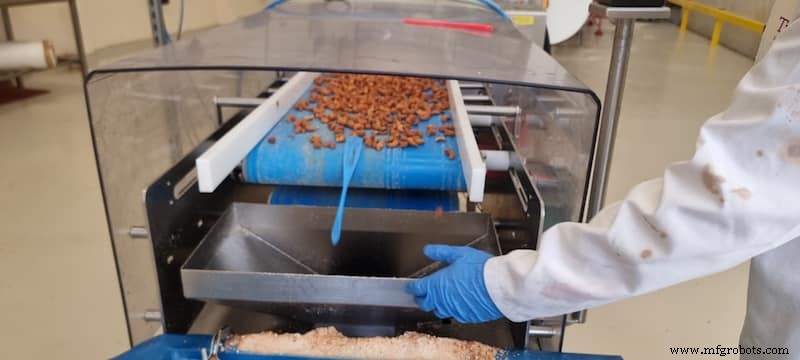
Fortress engineered a retractable band conveyor and reject mechanism that rolls the contaminated nuts into a dedicated bin beneath the belt. The detector calculates the travel time to the end of the band and commands the belt to retract, allowing the rejected nuts to be collected while the belt resumes inspection in seconds.
To date, Trigon reports zero false rejects on the honey‑roasted line, reinforcing its commitment to sustainability, ethics, and traceability. Although Mark was initially concerned about the compactness of the system, he now confirms it is reliable and user‑friendly.
Hourly manual tests are the only source of daily waste, which the lead engineer estimates at less than 0.05 % of total production – well below the industry average, where some lines experience double‑digit rates.
Fortress Sales Manager Jaison Anand highlights the detector’s performance: it can detect ferrous and non‑ferrous particles as small as 1.0 mm and stainless steel as small as 1.5 mm. The sensitivity stems from the optimized aperture dimensions.
“Aperture size is critical for optimal operation. By aligning the aperture with the product size, we achieve the best performance,” Jaison explains. “That’s why we installed a wide, low‑profile detector head on Trigon’s honey‑nut line.”
Trigon Snacks, which celebrated its 50th anniversary last year, has been a long‑time partner of Fortress Technology. The company was one of the first UK snack customers for Fortress’s food‑safety specialists.
Managing Director Phil Brown, who was a sales manager at the time, recalls how Trigon helped shape the mini Vertex metal detector that is now standard among snack manufacturers worldwide. “I demonstrated a standard gravity detector, but they required something far more compact with an ultra‑slim case that could fit between the volumetric filler and bagging machine. We built a bespoke solution and, as expected, they adopted it!”
After several decades, 15 of these Vertex conveyor detectors remain fully compliant with HACCP regulations, continuously detecting the smallest metal particles and safeguarding Trigon’s own‑label and retailer brands.
Industrial equipment
- Avoiding Common Pitfalls When Re‑Sourcing Fabricated Metal Products
- Build a Sensitive Arduino Metal Detector with Ferrous/Nonferrous Discrimination
- Build a Sensitive Metal Detector with Arduino Nano – DIY Guide
- Metal Detector Circuits Explained: A Professional Guide
- 5 Essential Questions to Ask Your Metal Supplier for Quality and Value
- Key Criteria for Selecting a Trusted Metal Supplier
- Metal Cladding Explained: Benefits, Types, and Design Tips
- Understanding Metal Processing: Turning Scrap into New Products
- Understanding Envelope Detectors: Converting High-Frequency Signals into Accurate Envelopes
- Understanding Pot Metal: Composition, Uses, and Quality Concerns