



Streamlining Pharmaceutical Fluid Control System Delivery with a Specialist Project Partner
In pharmaceutical manufacturing, designing and installing hygienic fluid control systems is essential for optimal process performance. Coordinating separate procurement, delivery, and commissioning suppliers often leads to complex project management challenges. A specialist partner—such as Bürkert Fluid Control Systems—provides a unified approach that resolves inefficiencies and delivers expert support across mechanical, electrical, and automation domains.
Damien Moran, Bürkert’s Field Segment Manager for the hygienic & pharmaceutical sector, explains how this integrated project management model delivers tangible benefits.
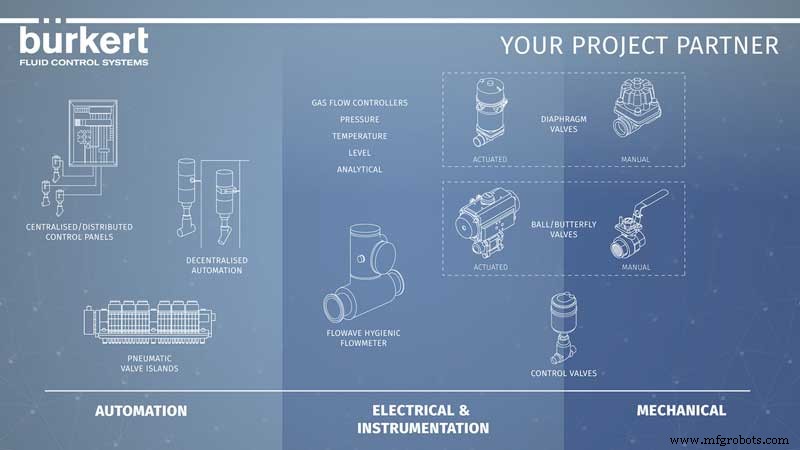
A typical pharmaceutical manufacturing project is managed by an engineering design consultant who must specify, procure, commission, and support a wide range of automation, valve, and instrumentation packages. These encompass automation (control panels, pneumatic valve islands), electrical and instrumentation (flow meters, sensors, electro‑pneumatic valves), and mechanical components (hand‑operated valves). The end‑user may request components from an approved supplier list, while the system integrator might suggest preferred brands. Ultimately, the design consultant is responsible for selecting fluid control components that integrate seamlessly, ensuring process optimisation, streamlined commissioning, and reliable field operation.
Managing fieldbus communications, certification approvals, and the integration of diverse brands can consume significant resources. Selecting multiple brands may be driven by cost or component preference, but it increases coordination demands. An alternative is to collaborate with a valve and instrumentation partner that guarantees effective integration across all areas. Such a partner can also provide end‑to‑end project management and ongoing field support.
Fluidic Design Expertise
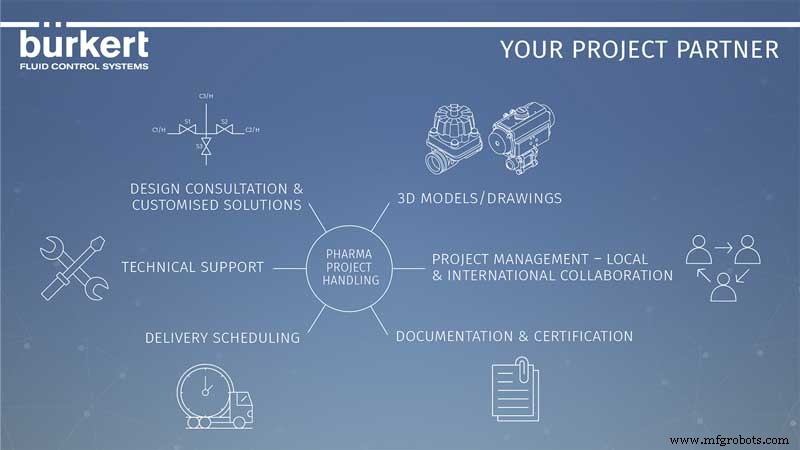
Design consultation is often the most valuable stage of a project, offering the chance to validate and optimise the system layout with specialist input. Bürkert’s approach includes custom solutions such as combining individual valves into a single, multi‑port block valve to reduce footprint, maintenance, and cost. By minimising dead‑volume areas with a manipulated drainable design, system performance is further enhanced. In automation, we advise on centralised versus decentralised control concepts, integration of digital communication protocols, and the flow of diagnostics and information.
A critical step in the design phase is integrating valve and instrumentation models into the Piping & Instrumentation Diagram (P&ID) to create a comprehensive 3‑D plant model. This requires 3‑D CAD STEP files of all components, which our partner makes available for free download from our website or directly upon request. Additionally, a virtual fluidic simulator demonstrates a proof‑of‑concept, enabling design queries to be resolved early and ensuring a smoother, more efficient rollout.
Global Expertise & Collaboration
Implementing the design demands meticulous project management grounded in technical competence and a commitment to ongoing support. Bürkert’s model pairs a local account manager with a dedicated pharmaceutical sector specialist, all linked to a central Hygienic Competence team that coordinates global expertise. Many projects involve international stakeholders—such as a UK design consultant working with OEMs and contractors worldwide—so our international network of pharmaceutical project managers facilitates seamless communication and execution across borders.
Ensuring that all required documentation—certificates, approvals, and compliance records—is in place is vital in the pharmaceutical sector. A project partner with deep knowledge of product‑specific requirements can advise on the necessary approvals and confirm that they are met, reducing risk and accelerating deployment.
Commissioning Support and Beyond
During installation, physical space is often at a premium. Staggered delivery of components that aligns with the project timeline is essential. A single project partner can manage this process efficiently, coordinating palletisation, storage designations, and customised tagging, labelling, and packaging to simplify installation in tight spaces.
While the engineering consultant typically relies on an installer, technical support for electrical or automated aspects—such as valve island or control valve commissioning—may also be required. Providing this support, along with a comprehensive handover to the end‑user and ongoing field assistance, delivers tangible value and peace of mind.
To optimise the design and implementation of hygienic pharmaceutical fluid control systems, a holistic project management approach is paramount. Treating each component as a commodity can lead to inefficiencies, especially in systems with significant electrical and automation complexity. Delivering seamless integration of mechanical, electrical, and automation packages is essential, and partnering with a pharmaceutical‑specialised project team guarantees a more efficient delivery process and an optimised outcome for the end‑user.
Kirsty Anderson
Bürkert Fluid Control Systems :
Tel: +44 (0)1285 648761 Fax: +44 (0)1285 648721
Web: www.burkert.co.uk
Email: [email protected]
Industrial equipment
- RTI’s Services Delivery Partner Program: Empowering Growth Through Strategic Partnerships
- How 3D Printing Revolutionizes Hydraulic Component Design and Performance
- Getting Started with FPGA Development: Building a 4‑Bit Adder on Xilinx Artix‑7
- Integrating USB Power Delivery into Your Design – A Practical Guide
- Master Front-End Engineering Design: A Step-by-Step Guide to Project Planning
- How Technology Drives Efficiency in Last-Mile Delivery
- Star CNC SW-20 Swiss-Type Lathe: Accelerate Production with Efficient, User-Friendly Programming
- Laser Cutting: Boosting Design Precision, Speed, and Cost-Efficiency
- Optimizing High‑Speed PCB Design for Embedded Systems
- Choosing the Most Efficient Pump Design for Water Treatment