



Integrating USB Power Delivery into Your Design – A Practical Guide
In this video, we’ll cover some of the aspects of USB Power Delivery, or USB PD, which greatly expands on the simple 5 V supply built into regular USB.
USB Power Delivery (USB PD) extends the basic 5 V USB supply to support up to 100 W. By allowing devices to negotiate voltage and current, USB PD enables flexible, high‑power connections. To illustrate this capability, we’ll examine a set of ROHM Semiconductor components designed for rapid integration.
Using an AC‑to‑DC Converter and Mini Consumer Boards to Add USB Power to a Design
ROHM’s AC‑to‑DC converters serve as power providers. The 45 W module is compact, while the 100 W version includes larger inductors and capacitors to accommodate higher current.
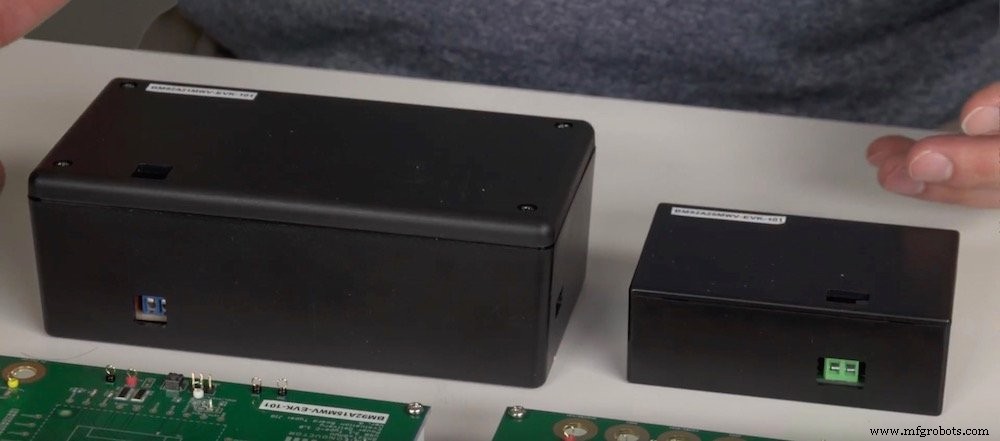
ACDC converter
The mini‑consumer board houses a USB PD controller that requests a predefined voltage and current from a connected provider. Its compact, space‑optimized layout is ready for direct integration, eliminating the need for custom development.
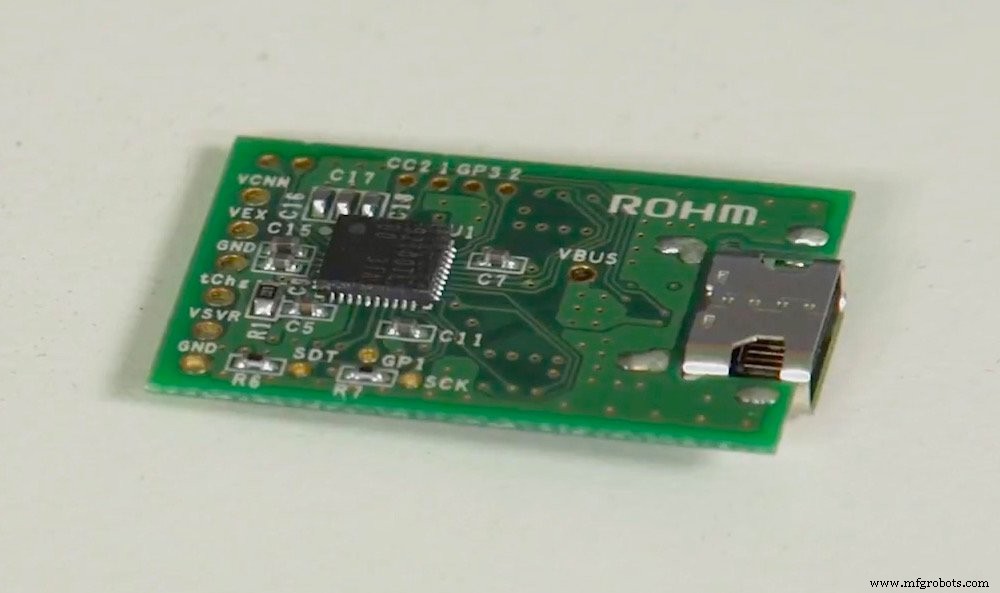
Mini consumer board
For designers needing deeper insight or custom power profiles, the evaluation kits expose all controller pins, facilitating prototyping with embedded processors or tailored power specifications.
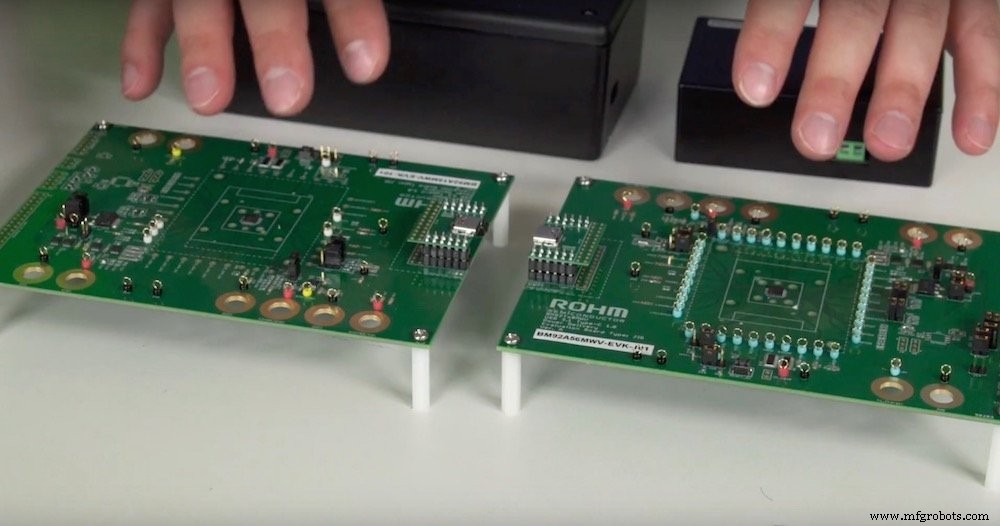
Eval kits
The demo unit bundles a 100 W AC‑to‑DC converter with four mini‑consumer boards, showcasing how multiple devices can share a single high‑power supply.
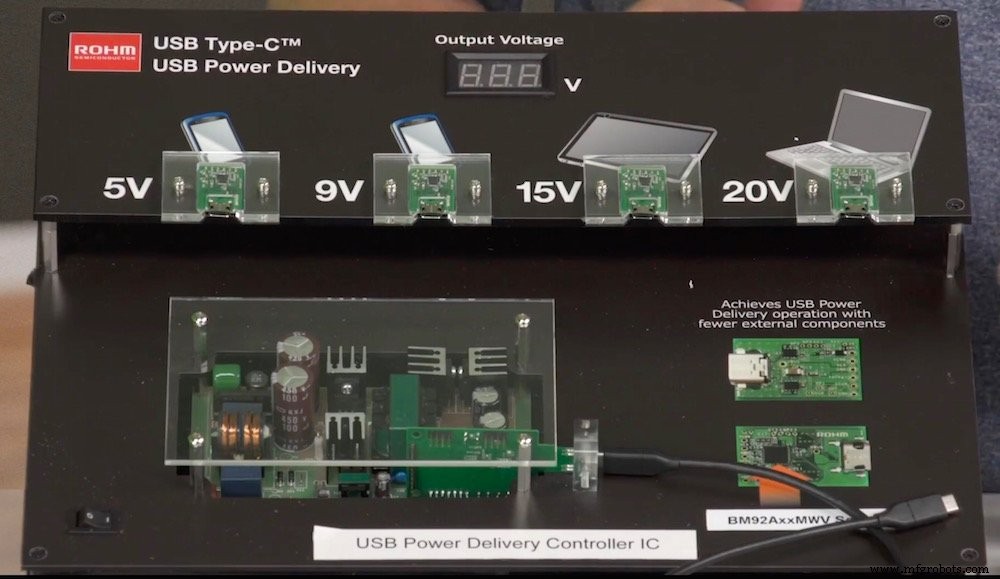
Demo unit with four mini consumer boards
Each supply includes a provider‑side controller, while every consumer board contains a corresponding consumer‑side controller. When a USB C connector is inserted, the two controllers exchange negotiation data over the CC1 or CC2 line—determined by cable orientation—requesting the desired voltage and current.
If your application requires a 20 V input, simply place the 20 V consumer board into your layout and obtain up to 5 A at 20 V. For a 5 V supply, use the 5 V controller version. At 9 V, the same board delivers the required output, demonstrating the versatility of USB PD across voltage levels.
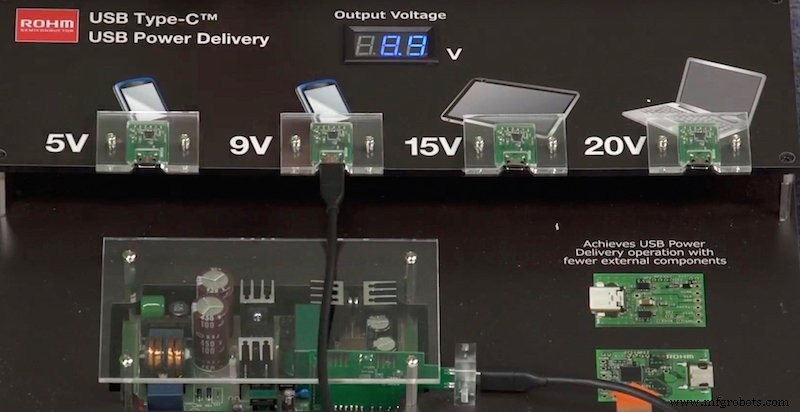
USB PD and USB Type‑C deliver superior power and charging capabilities compared to legacy USB. ROHM’s adapters and mini‑consumer boards simplify rapid deployment, and their underlying controllers are fully configurable for bespoke solutions.
Industry Articles are a form of content that allows industry partners to share useful news, messages, and technology with All About Circuits readers in a way editorial content is not well suited to. All Industry Articles are subject to strict editorial guidelines with the intention of offering readers useful news, technical expertise, or stories. The viewpoints and opinions expressed in Industry Articles are those of the partner and not necessarily those of All About Circuits or its writers.
Industrial equipment
- Consumer Product Design: A Practical Guide for Success
- Design for Manufacturability: A Practical Guide for Engineers and Designers
- Ensuring Electrical Safety: Grounding, Polarized Plugs, GFCIs, and AFCIs
- USB‑C: The Unified Power Connector That Cuts E‑Waste and Simplifies Life
- Essential Guide to Choosing the Right DC Power Connector
- Compact, High‑Efficiency USB Charging for Vehicles: One‑Chip, Multi‑Port Solution
- Simplify USB‑PD 1‑4S Charging with ROHM BD99954 Buck/Boost IC
- Preventing Wet Stacking in Light Towers: A Practical Guide
- Step-by-Step Guide to Charging Capacitors Safely and Efficiently
- Choosing the Right Kubota Track Loader: A Professional Guide