



Compact, High‑Efficiency USB Charging for Vehicles: One‑Chip, Multi‑Port Solution
This article presents a single‑chip design that delivers clean 5V to multiple USB ports in a vehicle, while minimizing space, heat, and EMI.
Modern cars feature USB outlets in the head unit, glove box, armrests, and rear seats (see Figure 1). These ports typically connect to the vehicle’s head unit via long captive cables, which can cause Ohmic voltage drop, generate EMI, and overheat the head‑unit charger.
Existing automotive USB solutions often rely on multi‑chip packages, non‑synchronous regulators, or bulky external components. Such designs consume valuable PCB area, dissipate excess heat, and lack spread‑spectrum EMI suppression—making them unsuitable for the growing number of ports in contemporary vehicles.
Ideal One‑Chip Solution
The MAX20037/MAX20038 family integrates a 3.5 A automotive‑grade synchronous buck converter, a USB host‑charger emulator, and robust USB protection switches—all in a 5 mm × 5 mm, 28‑pin TQFN package. Key features include:
- High Efficiency – Synchronous rectification yields peak efficiencies >90% (see Figure 3).
- Low Noise & EMI – Fixed 2.2 MHz PWM with optional spread‑spectrum modulation keeps emissions below regulatory limits.
- Automatic Cable Compensation – A load‑current sense amplifier and configurable feedback adjust VSENSP to cancel voltage drop across captive cables. Adjustments can be made via I²C or external resistors.
- Broad Load Support – Handles USB‑compliant devices (max 30 mA during enumeration, 100 mA/150 mA after enumeration) and non‑compliant loads.
- ESD Protection – MAX20037 offers up to 6 V data‑switch protection with external ESD array; MAX20038 protects up to 18 V internally.
Illustrative Schematic
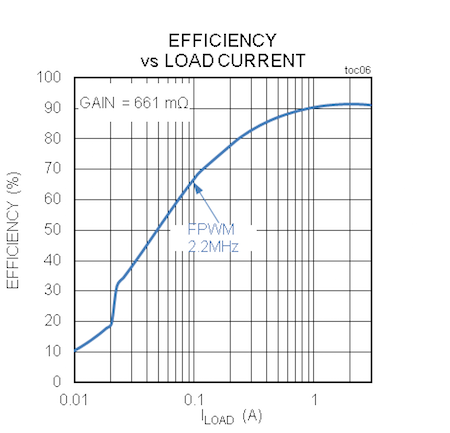
Figure 2. Car USB 5V adapter schematic
Data lines (HVD‑, HVD+, D‑, D+) handle the USB host‑client handshake before power delivery. The integrated sensing amplifier monitors load current, ensuring a stable 5 V output regardless of cable resistance.
Space & Thermal Advantages
Operating at 2.2 MHz reduces output ripple and allows for smaller external inductor and filter components. The 28‑pin TQFN package occupies less than 25 mm² of board area, freeing valuable space for additional features.
Performance Highlights
Figure 3. MAX20037/MAX20038 efficiency versus load
Typical curves show >90% efficiency across the 3.5 A output range, dramatically reducing heat in the head‑unit and improving system reliability.
Conclusion
By consolidating all necessary functions into a single, high‑current, synchronous‑rectifier IC, the MAX20037/MAX20038 solution addresses the key challenges of adding numerous USB ports to a vehicle: it slashes PCB real estate, eliminates excessive heat, mitigates EMI, and automatically compensates for captive cable losses.
Learn More
Explore the MAX20037/MAX20038 Automotive High‑Current Step‑Down Converters with USB Protection/Host Charger Adapter Emulation for next‑generation in‑vehicle USB infrastructure.
Industry Articles are a form of content that allows industry partners to share useful news, messages, and technology with All About Circuits readers in a way editorial content is not well suited to. All Industry Articles are subject to strict editorial guidelines with the intention of offering readers useful news, technical expertise, or stories. The viewpoints and opinions expressed in Industry Articles are those of the partner and not necessarily those of All About Circuits or its writers.
Industrial equipment
- Build a Wireless IR‑Sensor‑Driven Robotic Vehicle
- Expert Design Strategies to Safeguard High‑Speed USB, HDMI, DisplayPort, and eSATA Interfaces
- Simplify USB‑PD 1‑4S Charging with ROHM BD99954 Buck/Boost IC
- Integrating USB Power Delivery into Your Design – A Practical Guide
- Markforged 3D Printing: The Secret Weapon Behind BattleBots Team Valkyrie
- SIMULIA: Advanced Tire Engineering & Design Solutions
- Master CNC Part Design: Expert Tips & Techniques
- MS52 CNC Bar/Chucker: Open‑Front Design for High‑Volume Production
- Master Lattice Design with nTopology: Advanced Additive Manufacturing Solutions
- How Industrial Robotics Drive Efficiency and Profitability