



How Embedded Systems Drive Modern Vehicle Innovation
Embedded systems have become the backbone of today’s automotive landscape, propelling vehicles from simple mechanical machines to sophisticated, connected ecosystems. They underpin critical functions such as safety, performance, and infotainment, enabling cars to be safer, more efficient, and increasingly autonomous.
Embedded Systems: The Modern Car’s Core
Since the first application by Volkswagen in 1968, embedded electronics have steadily advanced the automotive industry. Today, a typical passenger vehicle houses between 25 and 35 microcontrollers, while premium models can contain 60 to 70. These control units manage everything from engine management to advanced driver‑assist systems, improving fuel economy, emissions, and overall vehicle reliability.
For a deeper dive into the variety of microcontrollers used in modern cars, Different types of microcontrollers used in automobiles.
Key Embedded System Applications in Vehicles
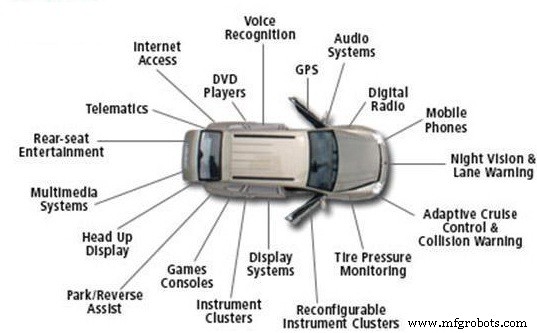
- Airbags
- Anti‑Lock Braking System (ABS)
- Black Box (Event Data Recorder)
- Adaptive Cruise Control (ACC)
- Drive‑Through Wire (electronic control of mechanical components)
- Satellite Radio
- Telematics
- Emission Control
- Traction Control
- Automatic Parking
- In‑Vehicle Entertainment
- Night Vision
- Heads‑Up Display
- Backup Collision Sensors
- Navigational Systems
- Tire Pressure Monitoring
- Climate Control
Below are brief overviews of some of the most impactful systems.
Anti‑Lock Braking System (ABS)
ABS prevents wheel lock‑up during hard braking, maintaining steering control on slippery surfaces. Sensors monitor wheel speed; the ECU modulates brake pressure via valves and pumps, ensuring optimal traction.
Navigation Systems
Modern GPS‑based navigation integrates satellite signals, map databases, and real‑time sensors to provide turn‑by‑turn guidance, traffic updates, and route optimization. Key components include a GPS receiver, navigation computer, and user interface.
Adaptive Cruise Control (ACC)
ACC uses radar or lidar to detect vehicles ahead, automatically adjusting speed to maintain a safe following distance. This technology is foundational for higher‑level autonomous driving and reduces driver fatigue on long journeys.
Airbag Control System
Upon collision detection, the airbag system rapidly inflates a cushion in less than 0.1 seconds, cushioning occupants and mitigating injury. This process relies on precise electronic triggers and high‑speed actuators.
Automatic Parking System
Equipped with front and rear sensors, this system identifies parking spots and maneuvers the vehicle into position—whether parallel, perpendicular, or angled—by calculating distance and steering inputs autonomously.
Main Suppliers of Automotive Electronics
Several leading semiconductor and embedded‑system vendors supply critical components for vehicle electronics:
- Atmel – Offers 8051 and ARM‑based microcontrollers for safety and security applications.
- Texas Instruments – Provides DSPs and automotive control chips optimized for high‑performance processing.
- Xilinx – Supplies FPGAs and CPLDs for navigation, adaptive controls, and custom logic.
- Other notable suppliers include Silicon (Si) providers, NEC, Analog Devices, NXP, and Renesas.
Embedded systems have revolutionized every phase of vehicle design and production, delivering safer, greener, and smarter cars. Understanding these technologies is essential for anyone involved in automotive engineering or purchasing a modern vehicle. If you have questions or would like personalized guidance, feel free to comment below.
Embedded
- How Cloud Computing Strengthens Military and Defense Operations
- Debugging in Embedded Systems: Types, Techniques, and Tools for Reliable Software
- Embedded Systems: Definition, Architecture, and Real‑World Applications
- IC Technology & Microcontrollers: The Cornerstone of Modern Embedded Systems
- Networks in Embedded Systems: Types, Roles, and Why They Matter
- Ensuring Reliable Timing in Safety‑Critical Multicore Embedded Systems
- Embedded Linux Device Drivers: Roles, Runtime Insights, and Development Guidance
- TRS‑STAR EPS‑KBLHE: Rugged, Fan‑less Embedded PCs for Silent Industrial Automation
- Embedded Systems & System Integration: Modern Architecture & Connectivity
- Python’s Growing Role in Embedded Systems: Why It Matters