



Satellite Navigation & Software‑Defined Radio: Enhancing GNSS Performance
Global Navigation Satellite Systems (GNSS) use orbiting satellites to provide precise positioning for devices on Earth. Receivers apply multilateration algorithms, interpreting timing and orbital data to deduce their location. Though originally a defense technology, GNSS now powers a wide spectrum of consumer, commercial, and industrial solutions.
The most prominent GNSS is the United States‑owned Global Positioning System (GPS), which has transformed everything from smartphone navigation to aviation, construction surveying, and logistics. Its strategic and economic value has prompted other nations and alliances to launch complementary constellations, including Galileo (EU), GLONASS (Russia), and BeiDou (China).
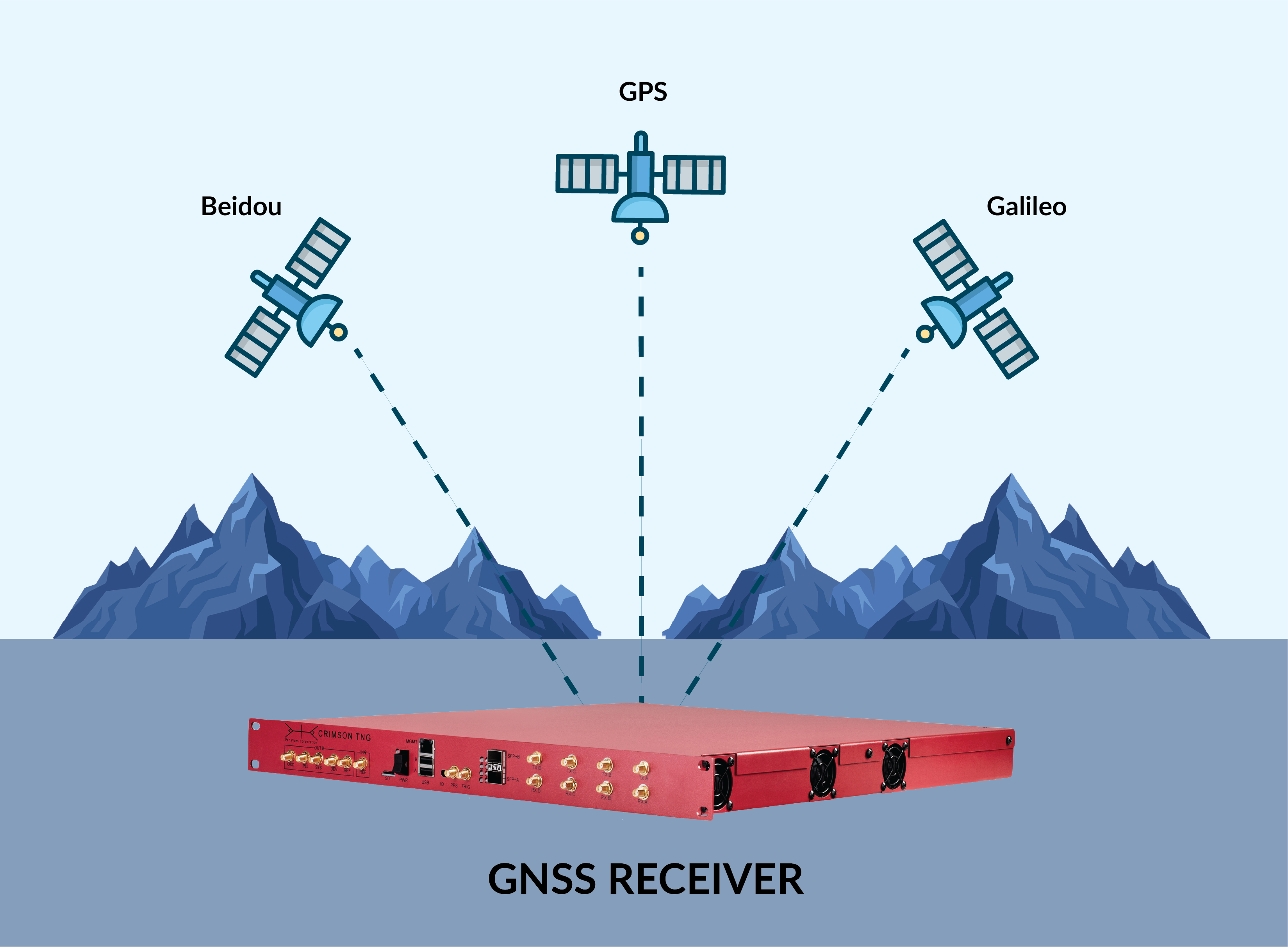
Performance evaluation of GNSS receivers hinges on spatial accuracy, sensitivity, and integrity. Satellites orbit at ~20,000 km and transmit 20–240 W, yielding a surface signal strength of about –130 dBm—roughly 0.05 % of a typical cell‑phone signal. Receivers must detect these faint signals, demodulate the encoded data, and reject out‑of‑band interference.
Balancing high sensitivity with robust filtering is critical. Sensitivity determines the weakest signal a receiver can reliably decode, while filtering protects against unwanted emissions and enhances desired signals. The decoded data then drives the application’s navigation logic.
Traditionally, these functions are implemented in dedicated application‑specific integrated circuits (ICs). While ubiquitous—found in automotive navigation, smartphones, and fleet‑tracking devices—such ICs are rigid, tied to a single constellation or frequency band (e.g., GPS L1). Upgrading them for newer frequencies or additional constellations incurs significant cost and downtime.
Multi‑GNSS solutions, leveraging multiple constellations and frequencies, offer tangible benefits: improved continuity, faster time‑to‑first‑fix, and enhanced performance in challenging environments like polar or mountainous terrain where line‑of‑sight to satellites is limited.
Integrity remains a core concern. Natural interference, atmospheric disturbances, and artificial radio jamming can degrade or spoof GNSS signals. In contested scenarios—where bands may be jammed or falsified—receivers must discern legitimate signals from spurious or malicious emissions. Traditional hardware‑centric receivers lack the agility to adapt quickly to such threats, often requiring costly redesigns.
Software‑Defined Radios (SDRs) address these limitations by relocating key functions from hardware to software. An SDR’s flexible front end allows dynamic tuning across multiple frequencies and constellations, often simultaneously. Many SDRs include on‑board digital signal processing (DSP) units that provide advanced digital filtering and adaptive algorithms.
By combining wideband reception with programmable DSP, SDR‑based GNSS receivers can:
- Operate across all major constellations (GPS, Galileo, GLONASS, BeiDou) without hardware changes.
- Rapidly deploy new signal processing techniques via firmware updates.
- Detect and mitigate jamming or spoofing through real‑time signal analysis.
- Offer superior time‑to‑fix and positional accuracy in dense urban canyons and high‑latitude regions.
These capabilities translate into cost savings, future‑proofing, and enhanced resilience for mission‑critical applications—ranging from autonomous vehicles to military operations. For any new GNSS deployment, integrating an SDR platform is a forward‑looking strategy that unlocks a broader spectrum of possibilities.
Embedded
- 16 Key Advantages of Asset Management and Tracking Software
- Avular Unveils Modular Hardware and Software Platform at CES 2022
- Pixus Technologies: Cutting‑Edge Ruggedized Software‑Defined Radios for Mission‑Critical Environments
- Intel Launches Loihi 2: Next‑Gen Neuromorphic Chip with Advanced Programmability and 3D Scaling
- Accurate Flight Tracking on a Budget: Raspberry Pi Zero Wireless, SDR, and FlightAware
- Build a Compact FM Radio with Arduino Nano and RDA8057M
- Maximize Efficiency: Inventory Management Software Features & Benefits
- Optimized 3D Design Software for CNC Tube Bending & Cutting
- GE Leads Innovation in Industrial Robot Automation Software
- Revolutionizing Robotics: New Hardware and Software Breakthroughs