



Xilinx Unveils Versal HBM Series, Driving Next‑Generation Network Bandwidth and Security
Xilinx has reinforced its position in high‑performance networking and data‑center workloads by introducing the Versal HBM series—an extension of its Versal adaptive compute acceleration platform (ACAP) that integrates high‑bandwidth memory (HBM2e) directly into the silicon.
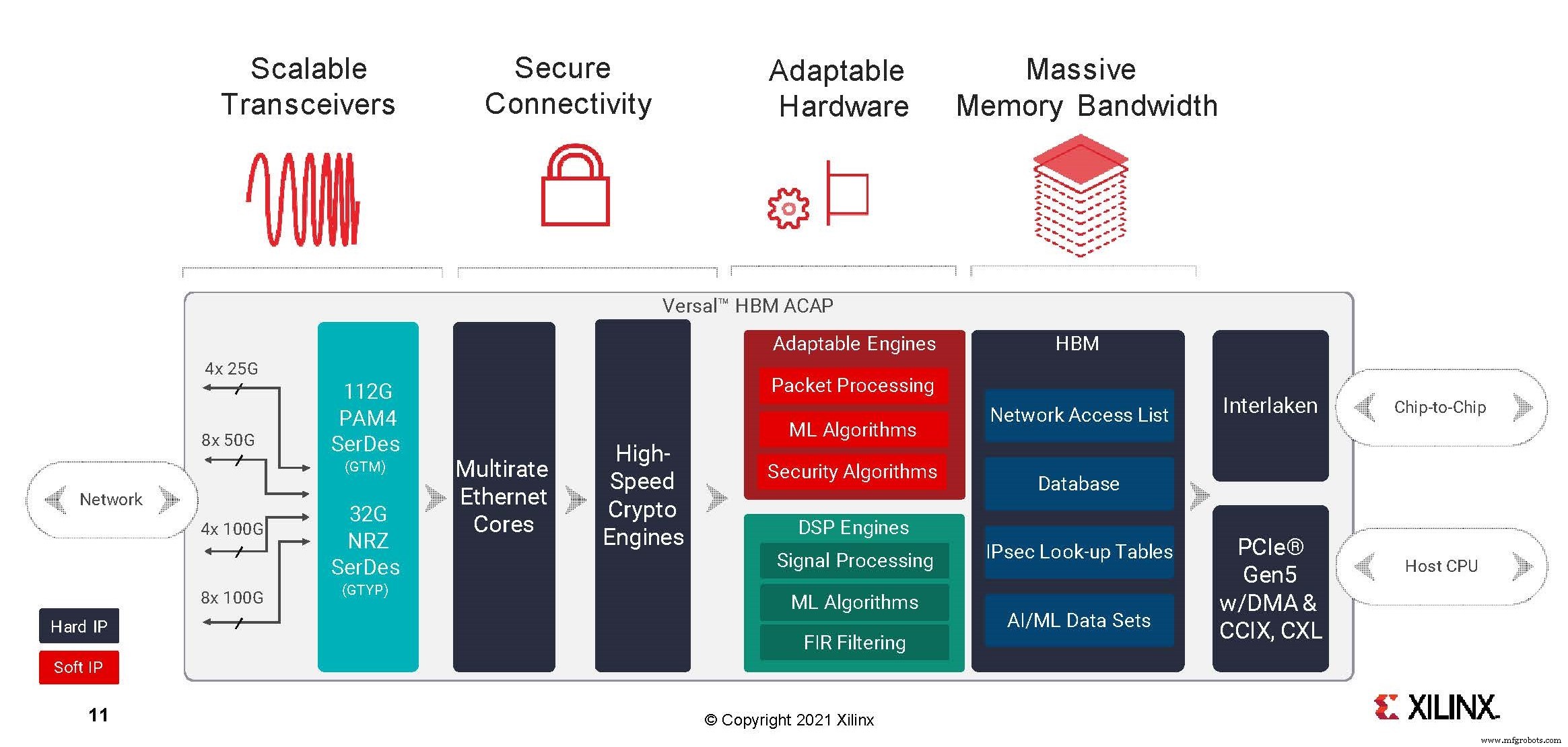
Leveraging TSMC’s Co‑WoS 3D‑stacking technology, the new line delivers 820 GB/s of sustained throughput and 32 GB of on‑chip capacity. That represents eight times the memory bandwidth of a comparable DDR5‑based design while cutting power consumption by 63 %—a comparison drawn from a typical four‑chip DDR5‑6400 configuration.
“The convergence of bandwidth, performance, and security is critical,” says Mike Thompson, Xilinx’s senior product line manager for Versal FPGAs. “Versal HBM expands capacity across these three layers, enabling us to keep pace with the exploding volume of network traffic and the growing demand for secure, high‑throughput processing.”
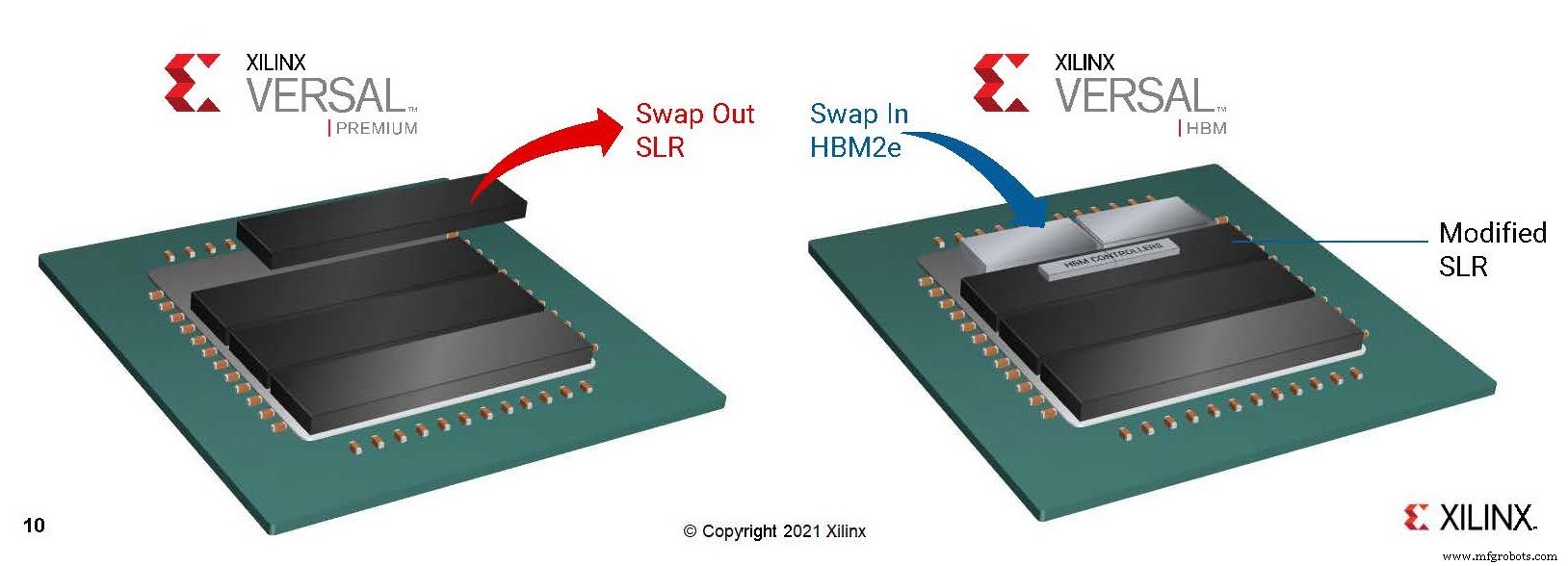
The architecture replaces a single super‑logic region (SLR) in the base Versal Premium device with an HBM2e stack and adds a dedicated HBM controller in another SLR. This modular swap yields an equivalent of 14 Virtex‑E UltraScale+ FPGAs while eliminating 32 DDR5 chips, dramatically reducing board real‑estate and power draw.

Versal HBM also incorporates a hardened IP core suite that supports 5.6 Tb/s of serial bandwidth via 112 Gb/s PAM4 transceivers, 2.4 Tb/s of scalable Ethernet, 1.2 Tb/s of line‑rate encryption, 600 Gb/s of Interlaken, and 1.5 Tb/s of PCIe Gen5 with built‑in DMA. The platform natively supports CCIX and CXL, providing an out‑of‑box, multi‑terabit networking stack for a wide array of protocols and optical standards.
As a truly adaptive compute platform, Versal HBM can reconfigure its logic in milliseconds, allowing designers to deploy AI inference, DSP, and scalar workloads on the fly. This agility eliminates the need for hardware redesigns and accelerates time‑to‑market for evolving algorithms and emerging protocols.
The result is a powerful accelerator that excels in big‑data scenarios—fraud detection, recommendation engines, database acceleration, financial modeling, and deep‑learning inference for natural language processing. By delivering orders‑of‑magnitude performance gains over modern server‑class CPUs and supporting datasets four times larger, customers can reduce server counts and cut total cost of ownership.
In networking, a single Versal HBM ACAP can replace multiple NPUs and DDR modules required for an 800 G next‑generation firewall. The device handles packet processing, security functions, and AI‑based anomaly detection at a fraction of the power and form factor, yielding substantial CapEx and OpEx savings for cloud and network operators.
Versal HBM is accessible to hardware, software, and data‑science developers. Vivado Design Suite, Vitis Unified Software Platform, and Vitis AI provide a cohesive development environment that spans RTL, C/C++, and domain‑specific frameworks.
Production‑ready 7 nm Versal devices form the foundation. Developers can prototype on Versal Premium boards and migrate to Versal HBM once it becomes available. Sampling begins in early 2022, with full documentation and early‑access tools slated for release in late 2021.
Embedded
- Understanding Q Factor and Bandwidth in Resonant Circuits: Theory, Calculations, and Practical Design
- Firmware Security: Safeguarding Against Memory Corruption & Injection Attacks
- Bluetooth Mesh Security & Privacy: Building a Trusted IoT Network
- Optimizing Performance and Security in IoT Wearables: The Role of Advanced NOR Flash
- Armv9: Elevating Security and AI Performance
- Xilinx Unveils Kria SOMs to Accelerate Edge AI and Embedded Vision
- Xilinx & Motovis Launch Integrated Forward‑Camera Solution for Automotive Perception
- Maxim Integrated Showcases Advanced Wearable Health, IoT, and Security Solutions at Embedded World
- Swissbit Showcases Cutting‑Edge Hardware Security for IoT Devices at it‑sa
- Processors Power the Seamless Integration of IoT and AI