



Wireless Power: From Smartphones to EVs – The Road Ahead
Today’s world is increasingly powered by wireless interfaces— from earbuds and induction hobs to the burgeoning field of electric‑vehicle charging. The question remains: can we eventually power a car without a cable, or deliver grid electricity to remote sites without pylons and trenches?
Wireless power delivery falls into two broad categories. The first relies on tight coupling between a transmitter and a receiver, creating an electric or magnetic field that shuttles energy directly across a short gap. Many household appliances— induction hobs, toothbrushes, and most phone chargers—use this principle to induce a current in a nearby receiver coil.
The second category, radiative coupling, directs a beam of energy—often high‑frequency radio waves—toward a receiver that is tuned to harvest as much of that power as possible.

Alignment between the sender and the receiver is crucial for efficient energy transfer. (Image: Molex Ventures)
Efficiency and transmission range are the key metrics for both approaches. Tight coupling demands precise alignment; for instance, a pan on an induction hob stops heating immediately when it strays from the center of the magnetic ring. Smartphones use embedded magnets to keep the phone perfectly centered on a charging pad, a small but essential engineering effort that dramatically improves charging times.
On a larger scale, wireless charging for electric vehicles faces similar alignment challenges. A recent Molex survey found that 36 % of automotive executives expect wireless charging to become a standard feature by 2030. While cell‑phone chargers typically operate at tens of watts, EVs require 50 kW to 250 kW to make long‑range travel competitive with combustion engines. Even a few percent of misalignment can translate into hundreds of watts of wasted heat at the interface.
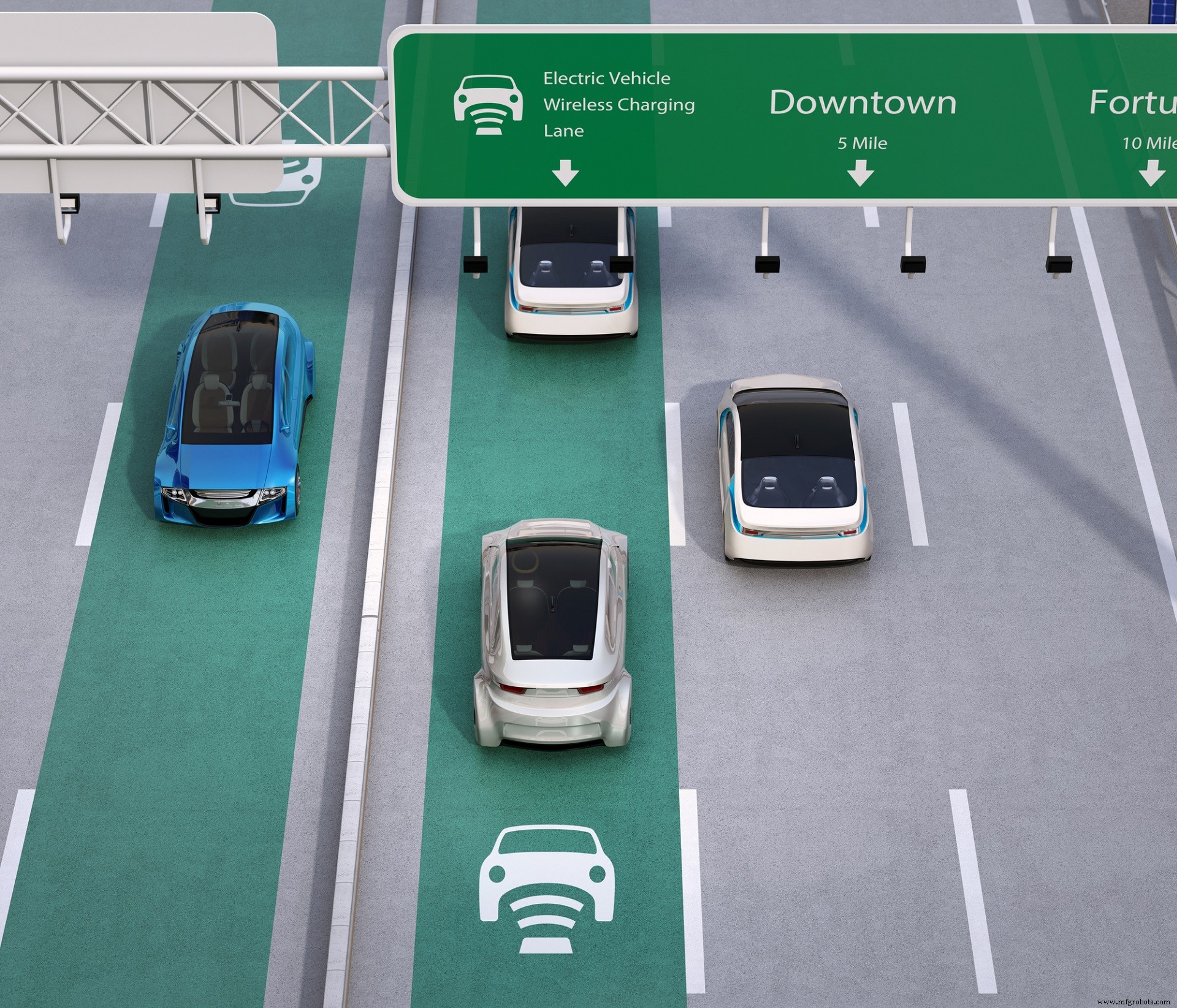
A concept for electric‑vehicle wireless charging lanes? (Image: Molex Ventures)
SAE International’s J2954_202010 standard tackles many of these issues by defining interoperability, electromagnetic compatibility, EMF limits, performance, safety, and testing for stationary EV charging. The specification currently covers above‑ground pads and does not yet address flush‑mounted installations, but it establishes a framework for future dynamic charging scenarios.
The standard also outlines an alignment protocol that helps drivers line up their vehicles with charging pads—and sets the stage for autonomous alignment in the future. Nevertheless, the technology will require robust engineering and disciplined user habits to match the convenience of plugging a car into a traditional charging station.
Wireless charging inside a vehicle illustrates the current limitations: a phone must be placed in a specific spot to achieve optimal coil alignment. Even the most advanced consumer chargers are still effectively tethered to a fixed location.
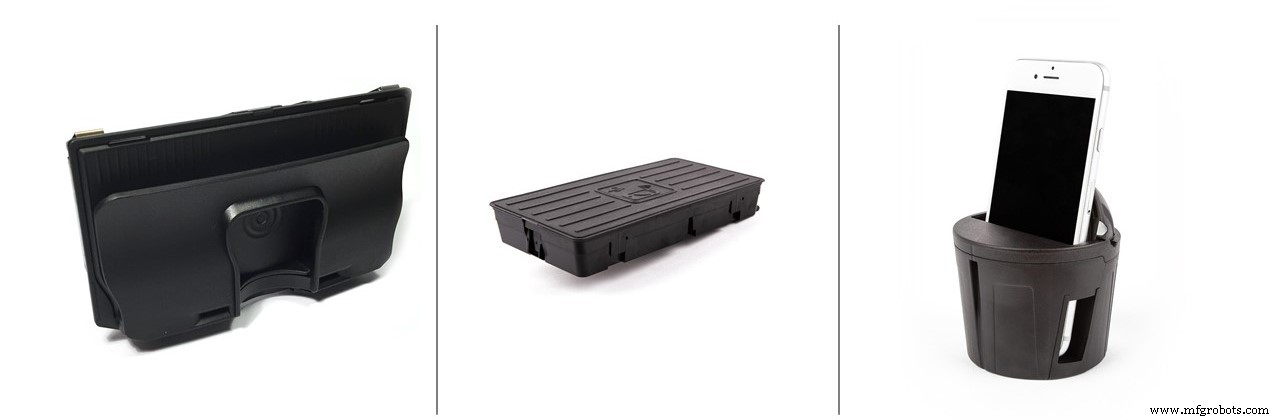
Various forms of charging pads: rack, pad, and cupholder (Image: Molex Ventures)
Modern smartphones use powerful magnets to simplify alignment, but the experience remains constrained to a defined point. A more fluid user experience would allow devices to charge anywhere within a certain volume, without precise coupling. Ossia, a Molex Ventures‑funded startup, is pursuing precisely that vision by leveraging MIMO‑style antenna arrays to beam power even when the receiver is not in direct line of sight.
Ossia’s system emits a regular signal from its antenna to synchronize with nearby devices. Each receiver broadcasts a beacon that reports its presence and power requirement. The transmitter measures the phase of each beacon and uses that information to steer a coherent energy beam toward the device. With multiple antennas, the transmitter can resolve phase differences at each element, enabling highly accurate beamforming that can even reflect off walls to reach the receiver.

A device enabled with the Ossia Cota power receiver sends a beacon to locate the transmitter, which then delivers power via the same path. (Image: Molex Ventures)
The transmitter can support multiple devices simultaneously. Each receiver sends a power‑request beacon, and the transmitter allocates power pulses proportionally to those requests, ensuring efficient distribution within the volume.
By delivering power through a beam rather than a rigid coil, this approach redefines what we consider “wireless charging.” Ceiling‑mounted smoke alarms could run indefinitely, and robot vacuums could operate without docking. The paradigm shift moves from charging to power delivery, unlocking new possibilities for ubiquitous, untethered energy.
Just as smartphones liberated us from wired landlines, a truly volumetric wireless power system could transform everyday habits. The key to realizing this vision lies in advances in alignment sensors, thermal management, and high‑efficiency beamforming—fields where expertise and focused research can accelerate progress toward an increasingly connected, untethered world.
>> This article was originally published on our sister site, EE Times Europe.
 Lily Yeung is director of corporate development at Molex, LLC and vice president of Molex Ventures, LLC, a subsidiary of Molex. Blending expertise in finance, research and analysis, and emerging technologies, Lily now serves on the frontline, fostering innovation at Molex and within the electronics industry. She is responsible for promoting the entrepreneurial ecosystem by working directly with forward‑thinking startups, incubators, angel groups, venture capital firms and corporate venture capital groups. By making strategic equity investments in promising early‑stage companies, Molex Ventures nurtures startups with the greatest potential to make a positive impact on industries and society.
Related Contents:
- Untangling in‑vehicle wireless power design challenges
- Understanding wireless charging basics
- Untangling wireless charging
- Drones keep moving on wireless charging solutions
- 10 key trends in wireless technology
- Emerging solutions enhance electric‑vehicle power management
For more Embedded, subscribe to Embedded’s weekly email newsletter.
Embedded
- 5 Key Wireless Standards Powering IoT Connectivity
- The IoT’s Full Potential May Be Delayed by Security and Interoperability Challenges
- STWLC68: Low‑BOM, High‑Efficiency Wireless Charging for 5G Devices
- Wireless Charging Breaks Flight Time Limits for Drone Fleets
- How Maintenance KPIs Drive Asset Reliability and Business Value
- Sustainability: The Next Priority for Wireless Technology
- RF Wireless Power Drives Universal Sensor Network Adoption
- Wireless Power Transfer: Fundamentals and Benefits
- Maximize Plasma Cutting Efficiency with True‑Hole Technology
- The Future of Autonomous Vehicles: Technology, Challenges, and Innovations