



Enhancing Appliance Safety with IEC 60730 Class B Standards
This article explains how the IEC 60730 Class B standard ensures functional safety for household appliances, covering both mechanical and electrical design, and highlights controllers that help manufacturers meet these requirements.
Modern appliances streamline everyday tasks, allowing users to perform chores with ease and confidence. When they operate correctly, they add value; when they fail, they can pose significant risks—including fire hazards that endanger lives and property.
The International Electrotechnical Commission (IEC) introduced the IEC 60730 Class B standard to embed safety into the very fabric of appliance design. Underwriters Laboratories (UL) has also endorsed the standard, reinforcing its credibility and ensuring that ranges, cooktops, washers, dryers, dishwashers, refrigerators, and freezers meet rigorous safety criteria.
Preventing Serious Appliance Problems
According to the National Fire Prevention Association (NFPA), ranges and cooktops accounted for 62% of all reported home cooking fires, with unattended cooking identified as the leading cause of such incidents. NFPA data also show that these appliances were responsible for 46% of cooking‑equipment‑related deaths between 2013 and 2017.
The U.S. Fire Administration (USFA) confirms that cooking remains the top cause of residential fires, as illustrated in Figure 1.
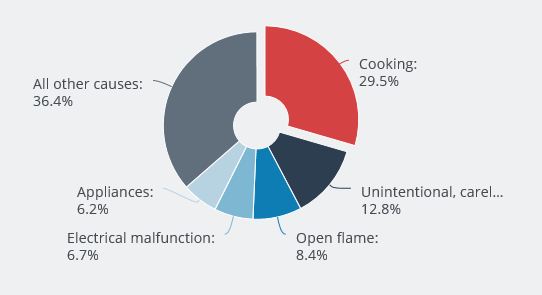
Figure 1. Cooking was the main cause of residential building fires resulting in injuries in the U.S. in 2018. Source: U.S. Fire Administration.
Despite technological advances across many sectors, reported home cooking fires have risen steadily since the National Fire Incident Reporting System (NFIRS) was launched in 1999. This trend underscores the urgent need for manufacturers to prioritize safety features in ranges and cooktops.
Safety Regulations for Functional Safety in Appliances
IEC 60730‑1, released in 1986 and updated through April 2020, applies to automatic electrical controls used in household and similar equipment. UL’s approval further validates the standard’s authority.
Functional safety acknowledges that failures are inevitable; the goal is to ensure that a fault leads to a fail‑safe outcome. IEC/UL 60730 defines three safety classes: Class A (non‑critical), Class C (preventing special hazards), and Class B—encompassing major appliances such as cookers, washers, dryers, dishwashers, refrigerators, and freezers. Class B governs software and control functions that prevent hazards when faults occur, covering thermal cut‑offs, automatic door locks, and self‑cleaning mode controls. Certification is now mandatory for self‑cleaning ovens in the U.S. and Europe, as well as for laundry equipment with auto‑locking mechanisms.
Existing Appliance Approach to Safety
Traditional solutions rely on a microcontroller (MCU) that interfaces with buttons, sliders, and wheels—whether mechanical or capacitive—and runs a safety library to monitor button health. Modern appliances use capacitive touchscreens combined with a separate MCU dedicated to safety functions.
Critical user‑interface buttons—such as the self‑cleaning trigger on high‑temperature ovens—must meet stringent requirements. A two‑touch activation and single‑touch deactivation ensure users confirm intent before the oven reaches 900°F (500°C), mitigating fire risk. The safety library guarantees that the stop button remains responsive in all conditions.
A New Approach to Appliance Safety
Advancements in touchscreen technology now allow manufacturers to satisfy Class B requirements directly through the display interface. The ATMXT336UD‑MAUHA1 maXTouch controller family incorporates safety‑related features that eliminate the need for a separate physical button. Users can trigger the shutdown function with a soft tap anywhere on the touchscreen, reducing cost, clutter, and design complexity while improving usability.
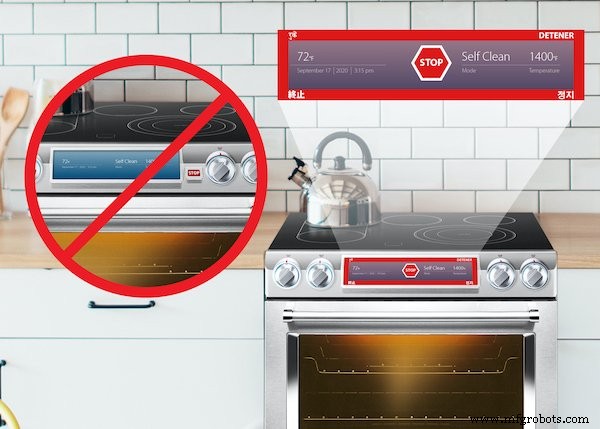
Figure 2. By putting the emergency stop function on the touchscreen, the appliance manufacturer can allow the user to select the language they are most comfortable with for the stop function.
The Class B touchscreen can detect and act on faults autonomously. For example, if a heavy pot breaks the thin indium tin oxide (ITO) touch sensor, the controller’s real‑time diagnostics identify the failure and automatically shut down the burners—without human intervention—thereby preventing potential fires.
The controller monitors the sensor’s integrity in the background, pushing alerts to the host CPU via a dedicated interrupt line or I²C message. This proactive approach contrasts with legacy systems that required the host to poll the touchscreen for status.
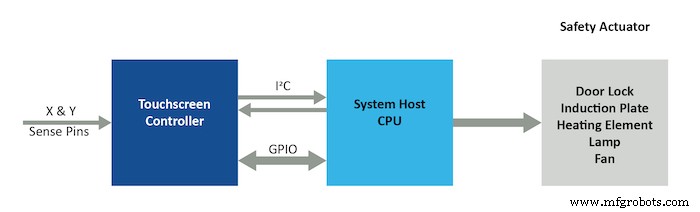
Figure 3. In a typical appliance application, the Class B touchscreen controller easily interfaces to a host CPU.
Class B certification mandates rigorous functional‑safety tests, including memory integrity checks. The controller runs a background “walking 1s” test that sequentially verifies each bit of its limited RAM, as illustrated in Figure 4.
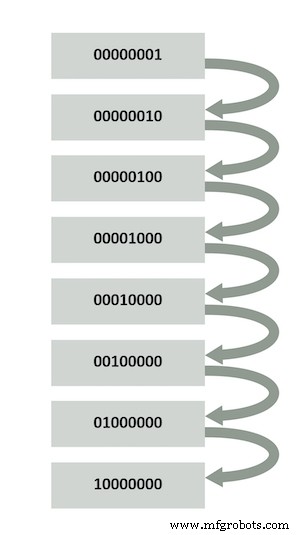
Figure 4. A walking 1s test for an 8‑bit memory sequentially verifies each bit.
The testing process shuffles application code to free memory regions for examination, ensuring that all RAM, flash, CPU registers, and internal clocks operate correctly—all while the controller continues to report touch events at >60 Hz.
Communication reliability is enhanced through an upgraded I²C bus that employs sequence numbers and a cyclic redundancy check (CRC). In an electrically noisy appliance environment, these mechanisms guarantee that coordinate data is not corrupted and that the host can detect missed packets. If connectivity permits, the host can alert the user’s mobile device or smartwatch when a fault occurs, even if the user is away.
Periodic self‑diagnostics produce a configurable heartbeat signal via a general‑purpose I/O pin, allowing the host to monitor the touchscreen’s health continuously. By integrating these safety functions directly into the controller, manufacturers reduce the burden of additional host‑side software, simplifying the overall qualification process.
Laundry Room Safety
NFPA reports that U.S. fire departments respond to an average of 15,970 home structure fires involving clothes dryers or washing machines each year. Safety‑oriented design can markedly reduce these incidents.
Front‑loading washers use high‑speed motors and feature door‑locking mechanisms that prevent accidental opening during operation. With Class B touchscreen control, the lock can be managed without a separate button or microcontroller, streamlining the design and enhancing reliability. An optional manual unlock override remains safe‑compliant, enabling users to add or remove items during a cycle.
Meeting Class B certification for laundry appliances not only satisfies regional regulations but also enables manufacturers to market a globally compliant product line, eliminating the need for region‑specific variations.
Towards Safer Appliances
Developed over several man‑years with continuous supplier feedback, the Class B touchscreen controller offers high‑end appliances a competitive advantage while remaining affordable for entry‑level models. Once manufacturers master this capability and achieve certification, they can extend the approach to any appliance—ovens, ranges, washers, dryers, dishwashers, refrigerators, microwave‑convection combos, and even range fume hoods—catering to safety‑conscious consumers worldwide.
Industry Articles are a form of content that allows industry partners to share useful news, messages, and technology with All About Circuits readers in a way editorial content is not well suited to. All Industry Articles are subject to strict editorial guidelines with the intention of offering readers useful news, technical expertise, or stories. The viewpoints and opinions expressed in Industry Articles are those of the partner and not necessarily those of All About Circuits or its writers.
Embedded
- Revolutionizing Haptic Feedback: The Advantages of Piezoelectric Transducers
- Mastering IEC Power Standards for Smart Home Appliance Design
- Enhance Workplace Safety & Reduce Downtime with Predictive Maintenance – Senseye
- Boost Manufacturing Efficiency: Validate Job Standards in Real Time with MachineMetrics
- Transform Assembly Lines with Vision-Enabled Robotics
- Elevate Manufacturing Efficiency with Motoman Robots
- Revolutionizing Appliance Manufacturing: Robots Drive Speed, Quality, and Market Edge
- Enhance Precision & Safety with KUKA’s Advanced Arc Welding Robots
- Elevating Safety Standards with Brazonics' Advanced Brazing Solutions in Hampton, NH
- Swanton Welding Boosts Safety Standards with Lancaster Safety Partnership