



Scaling LoRaWAN Networks: Insights and Symphony Link Innovations
In their recent study, Martin Bor and Utz Roedig from Lancaster University critically examine the scalability limits of LoRaWAN™ networks. Their conclusion is stark: “current LoRaWAN installations do not scale.” The authors estimate that a single gateway can comfortably support only about 120 nodes transmitting 20 bytes every 16.7 minutes—an upper bound that many IoT applications will find restrictive.
Symphony Link™—the proprietary LoRa protocol from Link Labs—addresses these bottlenecks with a suite of dynamic, coordinated mechanisms that significantly improve throughput and reliability, especially in single‑gateway deployments.
Five Root Causes of LoRaWAN’s Scalability Constraints
- All gateways and nodes share the same frequency channels for every transmission.
- Long airtime—up to 2 seconds—reduces channel availability.
- Uplink traffic follows a pure‑Aloha pattern, leading to frequent collisions.
- Gateway downlinks (ACKs, commands) occupy the channel, unbeknownst to nodes that wish to transmit.
- SX1301‑based gateways possess only eight receiver chains, limiting concurrent traffic.
Because the LoRa Alliance prioritizes backward compatibility, it is challenging to retrofit these limitations with new organizing features without breaking legacy nodes.
How Symphony Link Enhances Scalability
- Frequency Block Hopping
- Dynamic Transmit Power & Spreading Factor Selection
- Synchronous Uplink Slotting
- Variable Uplink/Downlink Time Boundary
- Compressed Acknowledgements
- Quality of Service Prioritisation
- Listen‑Before‑Talk Channel Clearance
Frequency Block Hopping
Each node links to a single gateway for the duration of a frame. The gateway advertises the uplink frequencies available for that frame, enabling nodes to pseudo‑randomly distribute traffic across the entire ISM band. This approach mitigates inter‑gateway collisions and, when interference is detected, the gateway simply excludes the affected band.
With block hopping, Symphony Link becomes fully FHSS‑compliant (Part 15), allowing transmit powers up to 1 W if required. In contrast, US LoRaWAN certification mandates a lower “Hybrid” mode, since standard LoRaWAN hops over only eight fixed channels.
Dynamic Transmit Power & Spreading Factor Selection
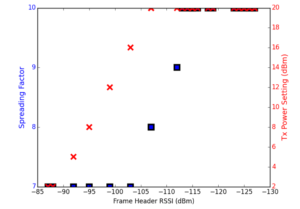
To exploit orthogonal spreading factors (SFs) effectively, a node should use the SF that delivers the shortest airtime while maintaining link quality. Because LoRa’s dynamic range is only 20 dB, nodes close to the gateway must reduce transmit power to avoid overpowering weaker signals.
Symphony Link nodes sample the gateway’s frame header every two seconds, estimate the reverse link budget, and adjust power and SF accordingly. A configurable link penalty further protects against fast fading, ensuring a stable signal‑to‑noise ratio.
Synchronous Uplink Slotting
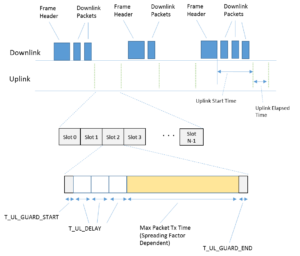
Pure‑Aloha networks cap efficiency at roughly 16 %. Introducing time slots doubles that figure. Symphony Link’s gateway frame header defines slot timing per SF, and nodes randomly select a slot, dramatically reducing collision probability.
Variable Uplink/Downlink Time Boundary
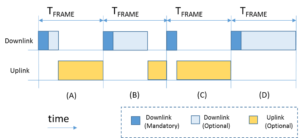
In LoRaWAN, a gateway’s downlink is invisible to nodes, effectively taking the channel offline. Symphony Link introduces a dynamic boundary that signals to nodes when the gateway is available for uplink, eliminating silent periods without the need for a multi‑gateway network server.
Compressed Acknowledgements
ACKs consume precious airtime, as every acknowledgement momentarily locks the gateway. Symphony Link aggregates all ACKs into a single, compressed packet that all nodes in the previous frame receive, freeing the channel for additional uplinks.
Quality of Service
QoS prioritises critical traffic (e.g., alarms) over less urgent data. In congested networks, this ensures that essential messages still reach the gateway on time.
Listen‑Before‑Talk
Prior to transmission, a node verifies channel silence. If another node occupies the same slot, it instantly hops to a new channel, maintaining network integrity.
Internet of Things Technology
- RTI Announces OMG Adoption of the OPC UA/DDS Gateway Standard
- Efficient IIoT Sensor‑to‑Cloud Gateways with RTI Connext DDS Routing Service
- Bosch IoT Gateway Software 9.0 Now Available: OSGi R6, Advanced Device APIs, New Protocols
- What Is LoRaWAN? A Technical Deep Dive
- LoRaWAN Use Cases, Limitations, and How Symphony Link Enhances Industrial IoT
- When to Use the LoRaWAN Specification: A Practical Guide for MNO and Private Network Deployments
- Build or Buy Your IoT Gateway? Expert Analysis of Cost, Time, and Complexity
- Fully‑Managed IoT Gateway Accelerates Development and Deployment
- STMicroelectronics Launches $99 LoRa Development Kits for Rapid IoT Deployment
- Enhancing 3D Scanning Accuracy for Automotive Quality Control