



RTI Announces OMG Adoption of the OPC UA/DDS Gateway Standard

Integrating diverse connectivity solutions and standards remains a top hurdle for system designers and integrators building complex Industrial IoT ecosystems.
RTI has been driving the Industrial IoT revolution by creating standardized connectivity gateways that enable DDS systems to seamlessly interoperate with other core frameworks. This year we introduced a standard OPC UA/DDS Gateway—a bridge between two of the industry’s most prominent communication protocols—and we are pleased to announce its recent adoption by the Object Management Group (OMG).
OPC UA/DDS Gateway Specification
In a joint initiative between the OMG and the OPC Foundation, the collaboration on DDS and OPC UA connectivity standards was announced last year. Following this, the OMG issued an RFP for a standard OPC UA/DDS Gateway to enable transparent interoperability between DDS and OPC UA applications. RTI responded with a comprehensive 140‑page proposal, incorporating feedback from DDS and OPC UA users and vendors, which received approval at the March OMG Technical Meeting. This article offers a concise overview of the specification and showcases the prototypes we built to validate it.
Specification Overview
The OPC UA/DDS Gateway specification aims to enable DDS and OPC UA applications to interoperate seamlessly using each framework’s native mechanisms. It addresses two core challenges:
- Building an OPC UA to DDS Bridge that lets DDS applications operate within an OPC UA Server’s AddressSpace using DDS publish‑subscribe and RPC capabilities.
- Building a DDS to OPC UA Bridge that lets OPC UA Client applications act as first‑class citizens in the DDS Global Data Space via standard OPC UA services.
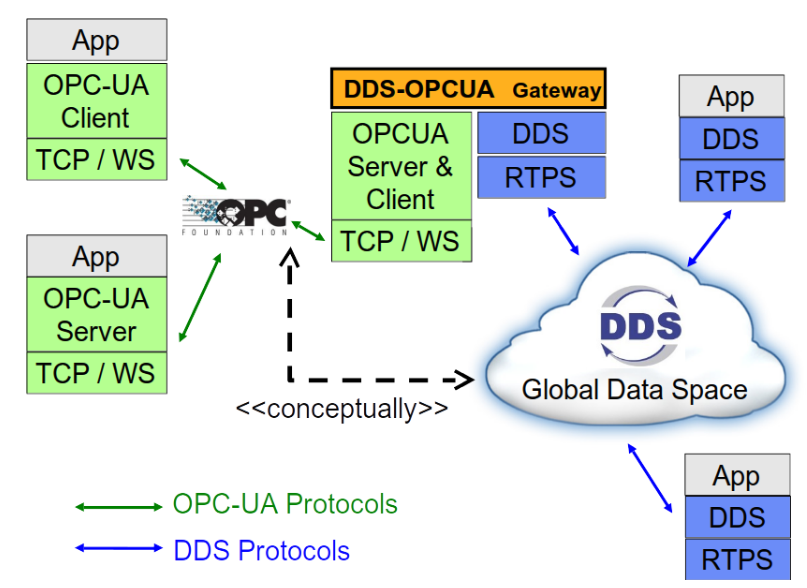
Figure 1: OPC UA/DDS Gateway Concept
OPC UA to DDS Bridge
The OPC UA to DDS Bridge allows DDS applications to read, write, and subscribe to data within an OPC UA Server’s AddressSpace. This functionality is critical for integrating OPC UA‑enabled devices into systems that require DDS’s scalability and QoS features. Figure 2 illustrates a typical deployment where DDS applications subscribe via the DDS‑RTPS wire protocol to information from OPC UA Servers using the OPC UA Binary Protocol.
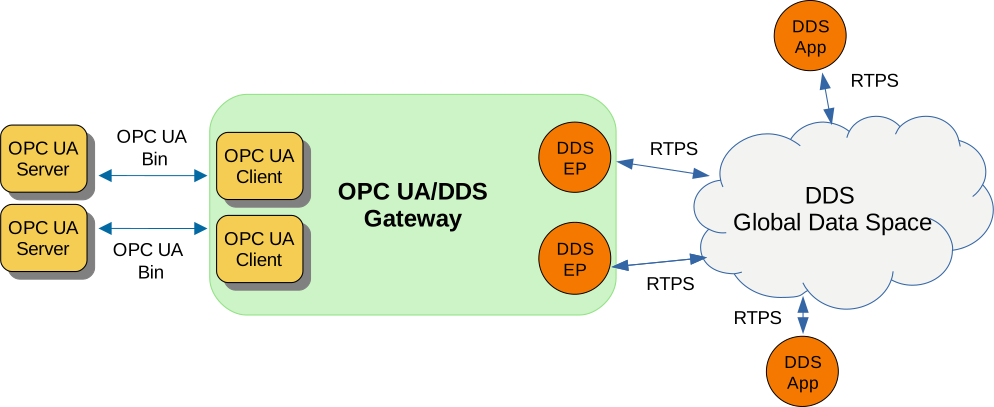
Figure 2: OPC UA to DDS Bridge
The bridge’s operation is straightforward: on the OPC UA side it creates a client that connects to a server and performs standard OPC UA services such as Read, Write, and subscription management. On the DDS side it instantiates a set of DataReaders and DataWriters to interact with DDS topics.
The specification splits the data exposed to DDS into two categories:
- Service Set Mappings – DDS services that emulate most OPC UA services using the OMG RPC over DDS specification, enabling DDS requesters to invoke operations like Read, Write, and Browse.
- Subscription Model Mapping – a simplified mapping of the OPC UA Server that lets integrators combine multiple MonitoredItems into DDS topics, offering a powerful modeling approach for DDS consumers.
To simplify configuration, we defined an XML schema. Below is a concise example of an OPC UA/DDS Gateway configuration file for an OPC UA to DDS Bridge.
<dds>
  <types>
    <struct>...</struct>
  </types>
  <ddsopcua_gateway name="MyGateway">
    <opcua_connection>...</opcua_connection>
    <domain_participant>...</domain_participant>
    <opcua_to_dds_bridge>
      <service_set>...</service_set>
      <subscription>
        <opcua_input>...</opcua_input>
        <dds_output>...</dds_output>
        <dds_output>...</dds_output>
        <dds_output>...</dds_output>
        <mapping>...</mapping>
      </subscription>
    </opcua_to_dds_bridge>
  </ddsopcua_gateway>
</dds>
Listing 1: OPC UA/DDS Gateway Configuration Example (OPC UA to DDS Bridge)
The configuration file is structured as follows:
- It defines DDS data types that describe the topics created by the mappings.
- It declares a gateway instance that instantiates an OPC UA to DDS Bridge, including an OPC UA client connection and a DDS DomainParticipant.
- It configures the service sets exposed to DDS applications, such as the Attribute Service Set for one‑shot reads or writes.
- It specifies OPC UA inputs (subscriptions to MonitoredItems) and DDS outputs (topic publications), with mapping assignments that link inputs to output fields.
DDS to OPC UA Bridge
The DDS to OPC UA Bridge enables OPC UA Client applications to participate fully in the DDS Global Data Space. This functionality allows existing OPC UA clients and tools to browse DDS topics, instances, and data types across multiple DDS domains, and to create tailored subscriptions. Figure 3 demonstrates a deployment where OPC UA Clients use the Binary Protocol to access information provided by DDS applications via the native DDS‑RTPS protocol.
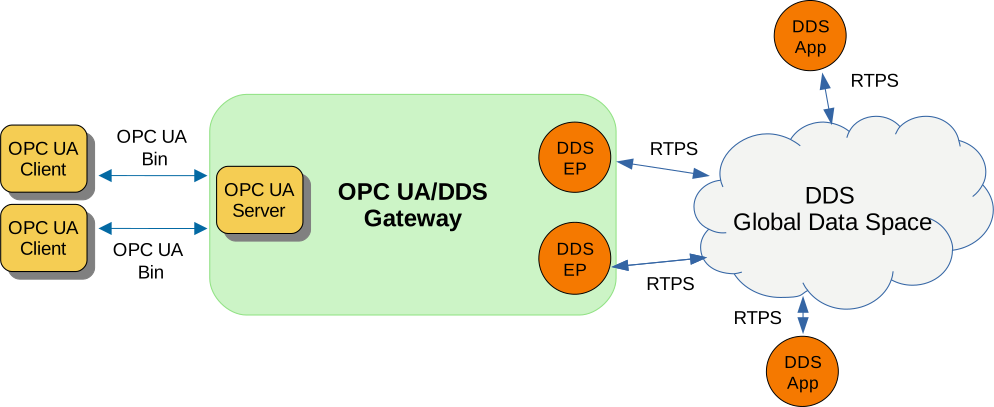
Figure 3: DDS to OPC UA Bridge
In essence, the DDS to OPC UA Bridge models the DDS Global Data Space within an OPC UA Server’s address space. It defines Objects and Variable Nodes for DDS domains, topics, instances, and data types, and exposes them via standard OPC UA services. An XML configuration schema allows integrators to choose which parts of the DDS space are represented in the OPC UA address space.
<dds>
  <types>
    <struct>...</struct>
  </types>
  <ddsopcua_gateway name="MyOtherGateway">
    <opcua_server>...</opcua_server>
    <domain_participant>...</domain_participant>
    <domain_participant>...</domain_participant>
    <dds_to_opcua_bridge>
      <domain>
        <topic_group>...</topic_group>
        <topic>...</topic>
      </domain>
      <domain>
        <topic_group>...</topic_group>
      </domain>
    </dds_to_opcua_bridge>
  </ddsopcua_gateway>
</dds>
Listing 2: OPC UA/DDS Gateway Configuration Example (DDS to OPC UA Bridge)
The configuration file is organized as follows:
- It defines the DDS data types instantiated by the gateway.
- It declares a gateway instance that instantiates a DDS to OPC UA Bridge, including an OPC UA Server and multiple DDS DomainParticipants.
- It selects DDS domains to be represented in the OPC UA address space.
- It specifies DDS topics—either explicitly or via Topic Groups that use regular expressions on topic name, type, etc.
Prototypes and Demos
To validate the specification and gather community feedback, we developed a series of prototypes and demos presented at major events. Last year, we showcased our first prototype at Embedded World and Hannover Messe, built on RTI Routing Service, a leading platform for bridging connectivity technologies. This prototype focused on mapping the OPC UA subscription model to DDS and on providing configuration mechanisms to simplify integration.
This year, we will demonstrate the reverse side of the gateway at Hannover Messe, featuring a lightweight prototype that exposes the DDS Global Data Space through an embedded OPC UA Server. Attendees can observe how a generic OPC UA client can subscribe to DDS data using native OPC UA services.
If you plan to attend Hannover Messe, visit us at the IIC pavilion (Hall 8 #C24) for a live demo. If you can’t make it, we’ll publish more details soon—stay tuned!
OPC UA/DDS Gateway as a Core Connectivity Gateway
The OPC UA/DDS Gateway is a pivotal component of the Industrial IoT revolution. The Industrial Internet Consortium’s Industrial Internet Connectivity Framework (IICF) identifies core connectivity standards—DDS, OPC UA, HTTP/Web Services, and oneM2M—to streamline integration across functional domains. The IICF’s assessment template evaluates solutions on business, usage, functionality, and implementation criteria. Core connectivity gateways, as defined by the IICF, preserve data syntax to ensure transparent interoperability across domains.
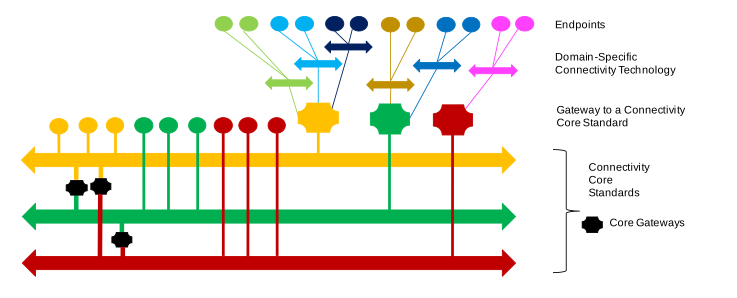
Figure 4: A standard connectivity gateway allows interoperability across domains.
RTI is deeply committed to developing standard connectivity gateways. In RTI Connext DDS 5.3.0, we released the first General Access Release of RTI Web Integration Service—a standard connectivity gateway that brings web browsers into the DDS Global Data Space via the OMG Web‑Enabled DDS specification.
We believe that interoperability is the
Internet of Things Technology
- DDS Foundation Unveiled: Strengthening DDS Standard and Community for the Industrial IoT
- RTI Perftest 2.4 Released: Enhanced Performance Testing for Connext DDS
- Clearing the Confusion: Navigating Standards in the Industrial IoT Revolution
- OPC UA & DDS Forge Unified Partnership with IIC and Industrie 4.0
- Architecting Connectivity in the Industrial Internet of Things
- Revolutionizing Industrial IoT Connectivity: DDS Architecture That Cuts Costs & Boosts Reliability
- Web‑Enabled DDS: Bridging IoT, Cloud, and Real‑Time Connectivity
- Why No Universal IoT Security Standard? Understanding the Complex Landscape
- Is a New IoT Standard Needed? OneM2M's Perspective on Interoperability
- Standard Procedure for Comprehensive Work Equipment Inspection