



IPv6 Explained: Why It Matters for the Future of the Internet
Every device that connects to a network—your laptop, phone, or IoT sensor—has a unique network identifier. Back in the 1980s, that identifier was an Internet Protocol (IP) address, the cornerstone of data routing in the TCP/IP suite.
IP version 4, or IPv4, was introduced in 1981. With 32 bits, it offers about 4.3 billion distinct addresses. By 2015, that pool was exhausted; the global population had exceeded 7 billion and more than 2 billion people were online.
To extend the lifespan of IPv4, Network Address Translation (NAT) became widespread. Home routers typically use private addresses like 192.168.x.x, translating them to a single public IPv4 address. While NAT conserves address space, it introduces complexity and can hinder peer‑to‑peer communications.
In response, the Internet Engineering Task Force (IETF) developed IPv6—the next generation of IP. The first IPv6 address was deployed in 2008, and adoption has grown steadily since.
What Is IPv4?
IPv4 addresses are 32‑bit values expressed in dot‑decimal notation, such as 192.0.2.1. Each of the four octets ranges from 0 to 255, and together they encode 2^32 unique combinations—roughly 4.3 billion.
What Is IPv6?
IPv6 expands the address space to 128 bits, written in eight groups of four hexadecimal digits, e.g.:
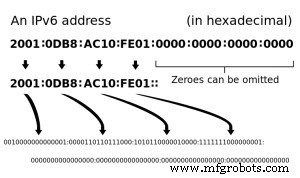
This structure yields 2^128 possible addresses—about 340 trillion, trillion, trillion—effectively eliminating scarcity for the foreseeable future.
An IPv6 address comprises three logical parts:
- Network prefix (48 bits) – allows administrators to change prefixes without reconfiguring devices.
- Subnet ID (16 bits) – distinguishes subnets within a network.
- Interface ID (64 bits) – uniquely identifies the device.
Address notation can be shortened: leading zeros in a group are omitted, and contiguous groups of zeros can be collapsed into a double colon (::). For example, 2001:0DB8:AC10:FE01:0000:0000:0000:0000 becomes 2001:DB8:AC10:FE01::.
Key Advantages of IPv6
- Automatic address configuration – devices can generate globally routable addresses from their MAC addresses, eliminating the need for NAT and DHCP.
- Simplified routing – the hierarchical prefix structure reduces routing table size.
- Enhanced security – mandatory support for IPsec and better support for multicast.
Preparing for the Transition
IPv6 adoption is progressing, but IPv4 will remain in use for decades. Organizations should dual‑stack their networks—supporting both IPv4 and IPv6—so they can smoothly transition without disrupting services.
Internet of Things Technology
- Why IPv6 Is Essential—and Why Your Network Still Isn’t Using It
- AWS SysOps Administrator Certification: Exam Details, Cost, Prerequisites and Career Benefits
- Network Analysis Explained: Advanced Techniques for Complex Electrical Circuits
- Expert Overview of M2M Network Architectures for IoT
- Smart Buildings Unveiled: Essential Insights for Modern Architecture
- Understanding Low‑Power Wireless Sensor Networks: Driving Efficient IoT Solutions
- How Intelligent Networks Drive Business Efficiency and Growth
- Discover Your Network Security Key: Easy Steps to Find and Protect Your Wi‑Fi
- Metal Fabrication 101: A Clear Guide for Beginners
- Understanding Cloud Networking: Key Concepts & Benefits